Search


引用資料與參考文獻 (8)
Invitrogen™
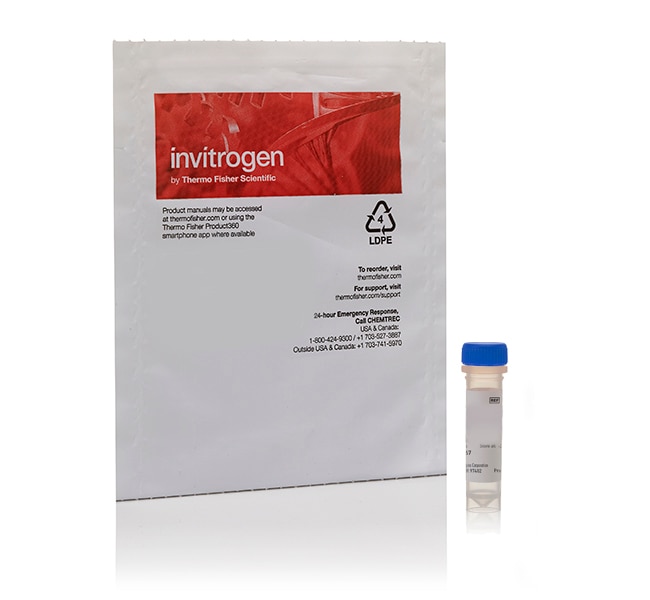
ChromaTide™ Texas Red™-12-dUTP
Molecular Probes™ ChromaTide™ dye labeled dUTP, OBEA-dCTP, and UTP nucleotides can be used to synthesize labeled DNA probes without the深入閱讀
| 產品號碼 | Quantity |
|---|---|
| C7631 | 25 μL |
產品號碼 C7631
價格 (TWD)
22,400.00
Online offer
Ends: 31-Dec-2026
28,000.00您節省 5,600.00 (20%)
Each
Quantity:
25 μL
價格 (TWD)
22,400.00
Online offer
Ends: 31-Dec-2026
28,000.00您節省 5,600.00 (20%)
Each
Molecular Probes™ ChromaTide™ dye labeled dUTP, OBEA-dCTP, and UTP nucleotides can be used to synthesize labeled DNA probes without the need for hazardous and expensive radioisotope-labeled nucleotides. These nucleotides can be incorporated using standard molecular biology techniques; labeled probes can then be used in in situ hybridization, microarray, or blotting protocols. ChromaTide™ dye labeled nucleotides are available in different fluorescent colors to facilitate multicolor analysis.
ChromaTide™ Labeled Nucleotides Specifications:
• Ex/Em of dye: Texas Red™-12-dUTP (595/615 nm)
• Length of alkynylamino linker: 12 atoms
Methods for Incorporating ChromaTide™ Nucleotides Into Probes
• Nick translation
• Random primer labeling
• End-labeling with terminal deoxynucleotidyl transferase
• Reverse transcription
• PCR amplification
See Methods for Enzymatic Incorporation of ChromaTide™ dUTPs for specific guidelines for each of these methods.
Alexa Fluor™ and BODIPY™ Fluorescent Dyes Make Excellent Probes
Probes made with labeled nucleotides can be used for multicolor techniques such as in situ hybridization and hybridization to arrays. Our proprietary BODIPY™ and Alexa Fluor™ dye conjugates are exceptionally bright, photostable, and essentially pH insensitive. The narrow emission profile of the BODIPY™ dyes helps ensure minimal spectral overlap. The Alexa Fluor™ dyes are highly water soluble, as are DNA probes made from them, making them the labels of choice for fluorescence in situ hybridization.
Long Linkers Improve Performance
The ChromaTide™ dUTP and UTP nucleotides are modified at the C-5 position of uridine via a unique alkynylamino linker, which provides a spacer between the nucleotide and the dye to reduce interactions between them. The number in the product name, e.g., the “12” in fluorescein-12-dUTP, indicates the net length of the spacer, in atoms. These spacers result in brighter conjugates and increased hapten accessibility for secondary detection reagents.
For complete listing of our ChromaTide™ Reagents: Molecular Probes ChromaTide™ and aha labeled nucleotides—Table 8.5.
For additional information on these labeling reagents, read Labeling Oligonucleotides and Nucleic Acids—Section 8.2 in the Molecular Probes™ Handbook.
For Research Use Only. Not intended for human or animal therapeutic or diagnostic use.
ChromaTide™ Labeled Nucleotides Specifications:
• Ex/Em of dye: Texas Red™-12-dUTP (595/615 nm)
• Length of alkynylamino linker: 12 atoms
Methods for Incorporating ChromaTide™ Nucleotides Into Probes
• Nick translation
• Random primer labeling
• End-labeling with terminal deoxynucleotidyl transferase
• Reverse transcription
• PCR amplification
See Methods for Enzymatic Incorporation of ChromaTide™ dUTPs for specific guidelines for each of these methods.
Alexa Fluor™ and BODIPY™ Fluorescent Dyes Make Excellent Probes
Probes made with labeled nucleotides can be used for multicolor techniques such as in situ hybridization and hybridization to arrays. Our proprietary BODIPY™ and Alexa Fluor™ dye conjugates are exceptionally bright, photostable, and essentially pH insensitive. The narrow emission profile of the BODIPY™ dyes helps ensure minimal spectral overlap. The Alexa Fluor™ dyes are highly water soluble, as are DNA probes made from them, making them the labels of choice for fluorescence in situ hybridization.
Long Linkers Improve Performance
The ChromaTide™ dUTP and UTP nucleotides are modified at the C-5 position of uridine via a unique alkynylamino linker, which provides a spacer between the nucleotide and the dye to reduce interactions between them. The number in the product name, e.g., the “12” in fluorescein-12-dUTP, indicates the net length of the spacer, in atoms. These spacers result in brighter conjugates and increased hapten accessibility for secondary detection reagents.
For complete listing of our ChromaTide™ Reagents: Molecular Probes ChromaTide™ and aha labeled nucleotides—Table 8.5.
For additional information on these labeling reagents, read Labeling Oligonucleotides and Nucleic Acids—Section 8.2 in the Molecular Probes™ Handbook.
For Research Use Only. Not intended for human or animal therapeutic or diagnostic use.
For Research Use Only. Not for use in diagnostic procedures.
規格
Labeling MethodDirect Labeling
Label or DyeTexas Red™
Quantity25 μL
Shipping ConditionWet Ice
Concentration1 mM
Product LineChromaTide, Texas Red
Unit SizeEach
內容物與存放
Store in freezer (-5 to -30°C) and protect from light.
常見問答集 (常見問題)
I'm getting high background after labeling with ChromaTide nucleotides. What do you recommend I do?
The nucleic acid probe is not fluorescent after labeling with ChromaTide nucleotides. What do you recommend I try?
Can ChromaTide nucleotides be used for labeling nucleic acids in live cells?
How do I determine the incorporation efficiency of the ChromaTide Labeling Nucleotides after enzymatic incorporation?
What is the average dye to base incorporation rate when enzymatically incorporating ChromaTide nucleotides?
引用資料與參考文獻 (8)
引用資料與參考文獻
Abstract
Condensation of plasmid DNA with polylysine improves liposome-mediated gene transfer into established and primary muscle cells.
Journal:Gene Ther
PubMed ID:9156800
'Cationic liposomes provide a means to introduce genes into cells both ex vivo and in vivo. In the past few years their use has been described in several tissues, e.g. lungs, liver, endothelium, brain. In this study we evaluated a commercially available poly-cationic liposome formulation in delivering a reporter gene
Inheritance of a pre-inactivated paternal X chromosome in early mouse embryos.
Journal:Nature
PubMed ID:14661031
'In mammals, dosage compensation ensures equal X-chromosome expression between males (XY) and females (XX) by transcriptionally silencing one X chromosome in XX embryos. In the prevailing view, the XX zygote inherits two active X chromosomes, one each from the mother and father, and X inactivation does not occur until after
Substantial background reduction in ligase-based apoptosis detection using newly designed hairpin oligonucleotide probes.
Journal:Biotechniques
PubMed ID:10631490
DNA methylation promotes Aurora-B-driven phosphorylation of histone H3 in chromosomal subdomains.
Journal:J Cell Sci
PubMed ID:17164288
Confinement of enzymatic reactions to nuclear and chromosomal subdomains regulates functional organization of the nucleus. Aurora-B kinase regulates cell-cycle-dependent phosphorylation of chromosomal substrates through sequential localization to a series of sites on chromosomes and the mitotic spindle. In G2 nuclei, Aurora-B recruitment to heterochromatin restricts histone H3S10 phosphorylation to a
Spectral karyotyping combined with locus-specific FISH simultaneously defines genes and chromosomes involved in chromosomal translocations.
Journal:Genes Chromosomes Cancer
PubMed ID:10719373
Genes that play roles in malignant transformation have often been found proximate to cancer-associated chromosomal breakpoints. Identifying genes that flank chromosomal reconfigurations is thus essential for cancer cytogenetics. To simplify and expedite this identification, we have developed a novel approach, based on simultaneous spectral karyotyping and fluorescence in situ hybridization