Search
 項目搜尋
項目搜尋 結構搜尋
結構搜尋
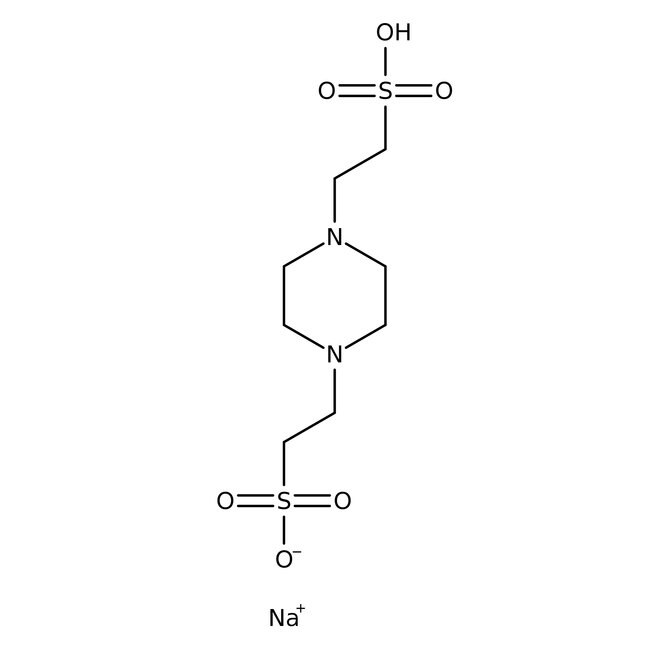

Thermo Scientific Chemicals
PIPES, 1.0M buffer soln., pH 7.0
CAS: 5625-37-6 | C8H18N2O6S2 | 302.36 g/mol
Have Questions?
變更視圖


規格
CAS5625-37-6
ChEBICHEBI:44933
Chemical Name or MaterialPIPES buffer soln.
ColorColorless
IUPAC Name2-[4-(2-sulfoethyl)piperazin-1-yl]ethanesulfonic acid
檢視更多
PIPES (Piperazine-N,N?-bis(2-ethanesulfonic acid), is frequently used as a buffering agent in biochemistry. PIPES has pKa near the physiological pH which makes it useful in cell culture work. PIPES has been documented minimizing lipid loss when buffering glutaraldehyde histology in plant and animal tissues and has a negligible capacity to bind divalent ions. Fixation of fungal zoospores for fluorescence microscopy and electron microscopy was optimal with a combination of glutaraldehyde and formaldehyde in PIPES buffer is done.
This Thermo Scientific Chemicals brand product was originally part of the Alfa Aesar product portfolio. Some documentation and label information may refer to the legacy brand. The original Alfa Aesar product / item code or SKU reference has not changed as a part of the brand transition to Thermo Scientific Chemicals.
Applications
PIPES (Piperazine-N,N′-bis(2-ethanesulfonic acid), is frequently used as a buffering agent in biochemistry. PIPES has pKa near the physiological pH which makes it useful in cell culture work. PIPES has been documented minimizing lipid loss when buffering glutaraldehyde histology in plant and animal tissues and has a negligible capacity to bind divalent ions. Fixation of fungal zoospores for fluorescence microscopy and electron microscopy was optimal with a combination of glutaraldehyde and formaldehyde in PIPES buffer is done.
Solubility
Soluble in 1M NaOH (0.5 M at 20°C), water (∼1 g/L at 100°C), and 0.5 N NaOH (0.1 M).
Notes
Store in cool place. Keep container tightly closed in a dry and well-ventilated place. Keep away from strong oxidizing agents.
PIPES (Piperazine-N,N′-bis(2-ethanesulfonic acid), is frequently used as a buffering agent in biochemistry. PIPES has pKa near the physiological pH which makes it useful in cell culture work. PIPES has been documented minimizing lipid loss when buffering glutaraldehyde histology in plant and animal tissues and has a negligible capacity to bind divalent ions. Fixation of fungal zoospores for fluorescence microscopy and electron microscopy was optimal with a combination of glutaraldehyde and formaldehyde in PIPES buffer is done.
Solubility
Soluble in 1M NaOH (0.5 M at 20°C), water (∼1 g/L at 100°C), and 0.5 N NaOH (0.1 M).
Notes
Store in cool place. Keep container tightly closed in a dry and well-ventilated place. Keep away from strong oxidizing agents.
RUO – Research Use Only
General References:
- MJ Alowitz.; MM Scherer. Kinetics of nitrate, nitrite, and Cr (VI) reduction by iron metal. Environmental Science & Technology.2002, 36, (3), 299-306.
- JB Olmsted, GG Borisy. Ionic and nucleotide requirements for microtubule polymerization in vitro. Biochemistry. 1975, 14, (13), 2996-3005.