Search
 項目搜尋
項目搜尋 結構搜尋
結構搜尋
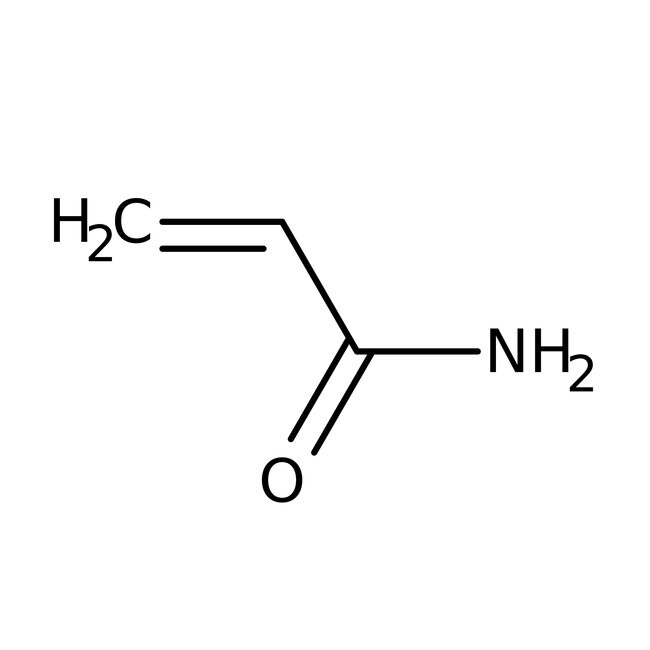


Thermo Scientific Chemicals
Acrylamide (40%) Solutions
CAS: 79-06-1 | C3H5NO | 71.08 g/mol
Have Questions?
變更視圖


化學識別
CAS79-06-1
IUPAC Nameprop-2-enamide
Molecular FormulaC3H5NO
InChI KeyHRPVXLWXLXDGHG-UHFFFAOYSA-N
SMILESNC(=O)C=C
檢視更多
規格 規格表
規格表
規格表FormLiquid
ConcentrationBisacrylamide: none
ConcentrationAcrylamide: 40%
CommentSuitable for electrophoresis
Acrylamide is a commonly used matrix for electrophoretic separation of nucleic acids and proteins. Acrylamide is used as a chemical intermediate in production of polyacrylamides, for use in protein electrophoresis (PAGE), synthesis of dyes and copolymers for contact lenses.
This Thermo Scientific Chemicals brand product was originally part of the Alfa Aesar product portfolio. Some documentation and label information may refer to the legacy brand. The original Alfa Aesar product / item code or SKU reference has not changed as a part of the brand transition to Thermo Scientific Chemicals.
Applications
Acrylamide is a commonly used matrix for electrophoretic separation of nucleic acids and proteins. Acrylamide is used as a chemical intermediate in production of polyacrylamides, for use in protein electrophoresis (PAGE), synthesis of dyes and copolymers for contact lenses.
Solubility
It is soluble in water.
Notes
Store in cool place. Keep container tightly closed in a dry and well-ventilated place. Light sensitive. Keep away from Acids, Oxidizing agents, Iron and iron salts., Copper, Brass, Free radical initiators.
Acrylamide is a commonly used matrix for electrophoretic separation of nucleic acids and proteins. Acrylamide is used as a chemical intermediate in production of polyacrylamides, for use in protein electrophoresis (PAGE), synthesis of dyes and copolymers for contact lenses.
Solubility
It is soluble in water.
Notes
Store in cool place. Keep container tightly closed in a dry and well-ventilated place. Light sensitive. Keep away from Acids, Oxidizing agents, Iron and iron salts., Copper, Brass, Free radical initiators.
RUO – Research Use Only
General References:
- Molloy, M.P., et al. Extraction of membrane proteins by differential solubilization for separation using two-dimensional gel electrophoresis. Electrophoresis. 1998, 19, (5), 837-44.
- Rabilloud, T. Two-dimensional gel electrophoresis in proteomics: old, old fashioned, but it still climbs up the mountains. Proteomics. 2002, 2, (1), 3-10.