Search
 項目搜尋
項目搜尋 結構搜尋
結構搜尋


Thermo Scientific Chemicals
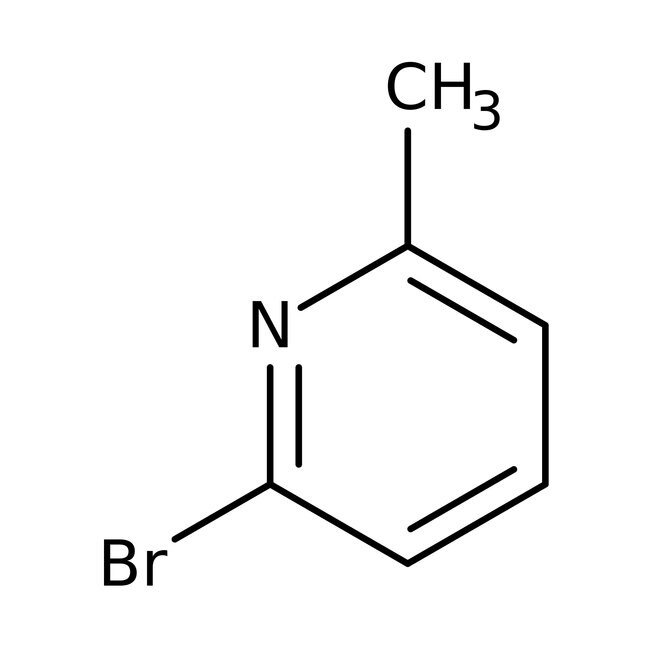
2-Bromo-6-methylpyridine, 98%
CAS: 5315-25-3 | C6H6BrN | 172.03 g/mol
Have Questions?
變更視圖


化學識別
CAS5315-25-3
IUPAC Name2-bromo-6-methylpyridine
Molecular FormulaC6H6BrN
InChI KeySOHDPICLICFSOP-UHFFFAOYSA-N
SMILESCC1=CC=CC(Br)=N1
檢視更多
規格 規格表
規格表
規格表Identification (FTIR)Conforms
Refractive Index1.5605-1.5655 @ 20?C
Appearance (Color)Clear colorless to yellow
FormLiquid
Assay (GC)≥97.5%
6-Bromo-2-picoline is a halogenated pyridine derivative used is a building block in the preparation of nitrogen containing heterocyclic compounds. It may used in following synthesis 6,6?-dimethyl-2,2?-bipyridine, 6-methyl-2-pyridyl-2-pyridylmethanone, 2-methyl-6-(trimethylsilyl)-pyridine and N,N’-bis-(6-methylpyrid-2-yl)-(1R,2R)-1,2- diaminocyclohexane (cydiampy).
This Thermo Scientific Chemicals brand product was originally part of the Alfa Aesar product portfolio. Some documentation and label information may refer to the legacy brand. The original Alfa Aesar product / item code or SKU reference has not changed as a part of the brand transition to Thermo Scientific Chemicals.
Applications
6-Bromo-2-picoline is a halogenated pyridine derivative used is a building block in the preparation of nitrogen containing heterocyclic compounds. It may used in following synthesis 6,6′-dimethyl-2,2′-bipyridine, 6-methyl-2-pyridyl-2-pyridylmethanone, 2-methyl-6-(trimethylsilyl)-pyridine and N,N’-bis-(6-methylpyrid-2-yl)-(1R,2R)-1,2- diaminocyclohexane (cydiampy).
Solubility
Soluble in chloroform, ethyl aceate. Not miscible or difficult to mix with water.
Notes
Store in cool, dry place in tightly closed container. With adequate ventilation. Store away from oxidizing agent.
6-Bromo-2-picoline is a halogenated pyridine derivative used is a building block in the preparation of nitrogen containing heterocyclic compounds. It may used in following synthesis 6,6′-dimethyl-2,2′-bipyridine, 6-methyl-2-pyridyl-2-pyridylmethanone, 2-methyl-6-(trimethylsilyl)-pyridine and N,N’-bis-(6-methylpyrid-2-yl)-(1R,2R)-1,2- diaminocyclohexane (cydiampy).
Solubility
Soluble in chloroform, ethyl aceate. Not miscible or difficult to mix with water.
Notes
Store in cool, dry place in tightly closed container. With adequate ventilation. Store away from oxidizing agent.
RUO – Research Use Only
General References:
- Rajalakshmanan E and Alexander V. Synthesis of Dimethylbipyridines by the Reductive Coupling of 2-Halomethylpyridines with Nickel Catalyst. Synth. Commun. 2005,35(6), 891-895.
- Abarca B, et al. 3-(2-Pyridyl)-[1,2,3] triazolo [1,5-a] pyridines. An experimental and theoretical (DFT) study of the ring-chain isomerization. Org. Biomol. Chem. 2005,3(21), 3905-3910.