Search


引用資料與參考文獻 (31)
Invitrogen™
Premo Autophagy Assays with Sensor LC3B, p62, or Tandem Sensor RFP-GFP-LC3B
Detect cell autophagy with our Tandem Autophagy Assay Kits, which offer chimeric sensors containing fluorescent proteins GFP and RFP.
| 產品號碼 | Color | Label or Dye |
|---|---|---|
| P36239 | Red-Orange, Green | RFP-GFP-LC3B |
產品號碼 P36239
價格 (TWD)
31,290.00
Online offer
Ends: 31-Dec-2026
44,700.00您節省 13,410.00 (30%)
Each
Color:
Red-Orange, Green
Label or Dye:
RFP-GFP-LC3B
價格 (TWD)
31,290.00
Online offer
Ends: 31-Dec-2026
44,700.00您節省 13,410.00 (30%)
Each
Easily monitor various stages of cellular autophagy with our Premo Autophagy Tandem assay and sensor, which are based on the RFP-GFP-LC3B tandem sensor. Premo Autophagy assay kits offer the selectivity of Premo Autophagy sensors, which are based on chimeras of autophagy-associated proteins LC3B or p62, and green (GFP) and/or red fluorescent protein (RFP), with the transduction efficiency of BacMam technology. Transduction or even co-transduction can be performed in a wide variety of cells, including neurons and neural stem cells (NSCs) using a simple protocol that involves adding the BacMam 2.0 chimeric reagent to cells, incubating overnight, and then visualizing transduction using standard GFP (green fluorescent protein) and RFP (red fluorescent protein) settings.
Premo Autophagy sensors take advantage of autophagy-associated proteins LC3B or p62, along with GFP or RFP, to detect either the induction or inhibition of autophagy in cells. The Premo Autophagy sensors are transduced using BacMam (insect Baculovirus with a Mammalian promoter) technology, enabling unambiguous visualization of the chimeric proteins in autophagosomes. BacMam reagents are non-replicating in mammalian cells and therefore non BSL-2. They are also non-cytotoxic and ready-to-use. Unlike typical expression vectors, BacMam reagents enable titratable and reproducible expression, and offer high co-transduction efficiency; therefore, multiple BacMam reagents can be readily used on the same cells. Recent improvements made to the BacMam system enable efficient transduction in a wider variety of cells, including neurons and neural stem cells (NSCs) with an easy, one-step protocol. To visualize autophagy, simply add the BacMam Autophagy Sensor to cells and incubate overnight for protein expression, then detect signal using standard GFP and RFP fluorescence settings on your instrument.
The LC3B protein plays a critical role in autophagy. Normally, this protein resides in the cytosol, but following cleavage and lipidation with phosphatidylethanolamine, LC3B associates with the phagophore. This localization can be used as a general marker for autophagic membranes. The p62 protein, also known as sequestosome (SQSTM1), is an ubitiquitin-binding protein that functions as a receptor for cargos destined to be degraded by the cellular autophagic machinery. When autophagy is induced, the p62 protein localizes to the autophagosomes and is subsequently degraded. Conversely, with the inhibition of autophagy, the p62 protein accumulates in the autophagosome. Thus, the subcellular localization of a p62-fluorescent protein chimera serves as a useful marker for the induction and inhibition of autophagy.
Additionally, by combining the acid-sensitive GFP (i.e., Emerald GFP) with an acid-insensitive RFP (i.e., TagRFP) in the tandem sensor RFP-GFP-LC3B, the change from an autophagosome (neutral pH) to the autolysosome (with an acidic pH) can be visualized by imaging the specific loss of the GFP fluorescence upon acidification of the autophagosome following lysosomal fusion. Upon induction of autophagy, the Premo Tandem Autophagy Sensor labels the punctate autophagosomes; these structures are positive for both GFP and RFP. Once the lysosome has fused, the pH drops, which quenches the GFP, making autolysosomes appear red. Additionally, combining the Premo Autophagy Tandem Sensor with the far-red emitting LysoTracker Deep Red (available separately) allows for a three-color analysis of autophagosomal/autolysomal/lysosomal dynamics.
The Premo Autophagy Tandem assay kit includes chloroquine diphosphate, which is used as a negative control to inhibit autophagy.
Advantages of using Premo Autophagy Tandem assay:
- Multiplex inspired — combining the Premo Autophagy Tandem Sensor with the far-red emitting LysoTracker Deep Red allows for a three-color analysis of complete autophagic pathway dynamics
- Highly efficient delivery system — >90% transduction of a wide range of mammalian cell lines, including primary cells, stem cells, and neurons
- Fast and convenient — simply add the Premo Autophagy reagent to your cells, incubate overnight, and image—or store frozen, assay-ready cells for later use
- Robust — Premo Autophagy reagents are non-replicating in mammalian cells, lack observable cytopathic effect, and are suitable for biosafety level (BSL) 1 protocols
For Research Use Only. Not for use in diagnostic procedures.
規格
ColorRed-Orange, Green
Compatible CellsMammalian Cells
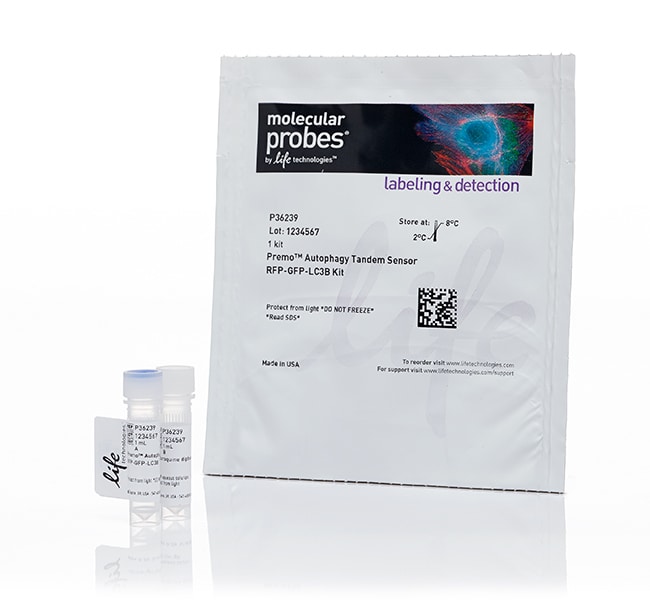
DescriptionPremo Autophagy Tandem Sensor RFP-GFP-LC3B Kit
Excitation/EmissionTagRFP: 555/584
EmGFP: 488/509
EmGFP: 488/509
For Use With (Equipment)Fluorescence Microscope
Label TypeOther Label(s) or Dye(s)
Label or DyeRFP-GFP-LC3B
Product LinePremo
Product TypeAutophagy Sensor
Quantity1 kit
Shipping ConditionWet Ice
Detection MethodFluorescence
FormatTube
Unit SizeEach
內容物與存放
Autophagy Sensor RFP-GFP-LC3B, and chloroquine diphosphate. Store at 2°C to 6°C, protected from light. Do Not Freeze.
常見問答集 (常見問題)
How can I increase the transduction efficiency with the BacMam 2.0 reagents such as the the CellLight and Premo products?
Can I use the Premo Autophagy Sensor products to study autophagy in cells in combination with a lentivirus transfection?
引用資料與參考文獻 (31)
引用資料與參考文獻
Abstract
Pressure Overload-Induced Cardiac Dysfunction in Aged Male Adiponectin Knockout Mice Is Associated With Autophagy Deficiency.
Journal:
PubMed ID:25961840
'Heart failure is a leading cause of death, especially in the elderly or obese and diabetic populations. Various remodeling events have been characterized, which collectively contribute to the progression of heart failure. Of particular interest, autophagy has recently emerged as an important determinant of cardiac remodeling and function. Here, we
The pro-apoptotic role of autophagy in breast cancer.
Journal:
PubMed ID:24945999
'Autophagy is a catabolic process that has a vital role in cancer progression and treatment. Current chemotherapeutic agents, which target autophagy, result in growth inhibition in many cancer types. In this study, we examined the role of autophagy in breast cancer (BCa) patients as well as BCa cell lines. Tissue
Spatial coupling of mTOR and autophagy augments secretory phenotypes.
Journal:Science
PubMed ID:21512002
'Protein synthesis and autophagic degradation are regulated in an opposite manner by mammalian target of rapamycin (mTOR), whereas under certain conditions it would be beneficial if they occurred in unison to handle rapid protein turnover. We observed a distinct cellular compartment at the trans side of the Golgi apparatus, the
Trehalose intake induces chaperone molecules along with autophagy in a mouse model of Lewy body disease.
Journal:
PubMed ID:26299928
The accumulation of mis-folded and/or abnormally modified proteins is a major characteristic of many neurodegenerative diseases. In Lewy body disease (LBD), which includes Parkinson's disease and dementia with Lewy bodies, insoluble a-synuclein is widely deposited in the presynaptic terminals as well as in the neuronal cytoplasm in distinct brain regions.
Airway Exposure to E-Cigarette Vapors Impairs Autophagy and Induces Aggresome Formation.
Journal:
PubMed ID:26377848
Electronic cigarettes (e-cigarettes) are proposed to be a safer alternative to tobacco cigarettes. Hence, we evaluated if e-cigarette vapors (eCV) impair cellular proteostasis similar to cigarette smoke exposure. First, we evaluated the impact of eCV exposure (2.5 or 7.5?mg) on Beas2b cells that showed significant increase in accumulation of total