Search

Invitrogen™
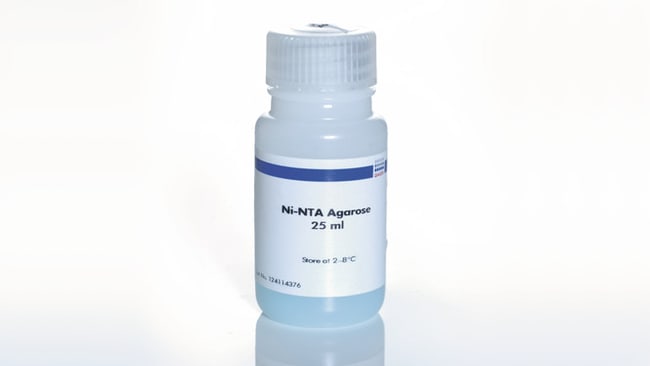
Ni-NTA Agarose
Ni-NTA Agarose is a nickel-charged affinity resin that can be used to purify recombinant proteins containing a polyhistidine (6xHis) sequence.深入閱讀
Have Questions?
變更視圖

| 產品號碼 | Quantity |
|---|---|
| R90115 | 25 mL |
| R90101 | 10 mL |
| R90110 | 100 mL |
產品號碼 R90115
價格 (TWD)
14,070.00
線上優惠
Ends: 30-Sep-2026
20,100.00您節省 6,030.00 (30%)
Each
Quantity:
25 mL
價格 (TWD)
14,070.00
線上優惠
Ends: 30-Sep-2026
20,100.00您節省 6,030.00 (30%)
Each
Ni-NTA Agarose is a nickel-charged affinity resin that can be used to purify recombinant proteins containing a polyhistidine (6xHis) sequence. Proteins bound to the resin may be eluted with either low pH buffer or by competition with imidazole or histidine. One-step purification can be performed under both native and denaturing conditions. Ni-NTA uses the chelating ligand nitrilotriacetic acid (NTA) coupled to a cross-linked 6% agarose resin that is suitable for use in batch and gravity flow applications.
For Research Use Only. Not for use in diagnostic procedures.
規格
Quantity25 mL
Stationary PhaseNi-NTA
Column TypeAffinity Column
FormSuspension
TypeAgarose
Unit SizeEach
內容物與存放
The Ni-NTA resin is pre-charged and able to bind up to 50 mg of recombinant protein per 1 ml of resin. It is provided as a 50% slurry in 30% ethanol. The resin will appear blue in color when charged with Ni2+ . Store at +4°C. Ni-NTA resin is guaranteed stable for 6 months when properly stored.