Search


引用資料與參考文獻 (24)
Invitrogen™
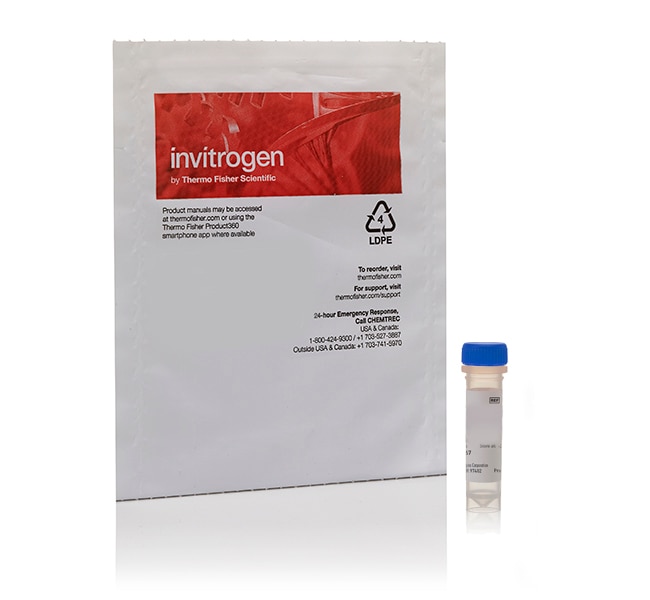
Streptavidin, Alexa Fluor™ 568 conjugate
Alexa Fluor™ 568 streptavidin comprises a biotin-binding protein (streptavidin) covalently attached to a fluorescent label (Alexa Fluor™ dye). Streptavidin has深入閱讀
| 產品號碼 | Quantity |
|---|---|
| S11226 | 1 mg |
產品號碼 S11226
價格 (TWD)
***
Quantity:
1 mg
價格 (TWD)
***
Alexa Fluor™ 568 streptavidin comprises a biotin-binding protein (streptavidin) covalently attached to a fluorescent label (Alexa Fluor™ dye). Streptavidin has a very high binding affinity for biotin, and a conjugate of streptavidin is commonly used together with a conjugate of biotin for specific detection of a variety of proteins, protein motifs, nucleic acids, and other molecules (for example, a biotinylated primary antibody bound to a protein target can be detected with a fluorescently labeled streptavidin). Strategies similar to this are used in many detection protocols including western blots, flow cytometry, imaging and microscopy, and microplate assays. Alexa Fluor™ dye streptavidin conjugates are supplied as 1 mg lyophilized product or in 0.5 mL volumes of a 2 mg/mL solution.
Important Features of Alexa Fluor™ 568 Streptavidin Conjugates:
• Alexa Fluor™ 568 streptavidin conjugate has Ex/Em maxima of ∼ (578/603)
• Bright, photostable fluorescence
• High solubility in aqueous solutions
• Available in multiple colors
• Ideal for western blots, flow cytometry, imaging and microscopy, microplate assays and more
Properties of Alexa Fluor™ Dyes
Alexa Fluor™ dyes are organic fluorescent dyes developed for better performance in imaging and other labeling protocols and exhibit improved photostability and brightness and improved solubility in aqueous solutions. Available in a broad range of colors, these dyes are a good choice for most imaging applications.
Blocking Endogenous Biotin
Naturally occurring biotins can interfere with biotin-streptavidin detection schemes. For experiments involving fixed and permeabilized cells, try our Endogenous Biotin-Blocking Kit to minimize this interference.
For Research Use Only. Not intended for any animal or human therapeutic or diagnostic use.
Related Links:
Learn more about Avidin-Biotin Detection
Learn more about Alexa Fluor™ Dyes
Find out about other Labeled Streptavidin Conjugates
Read Avidin and Streptavidin Conjugates-Section 7.6 in the Molecular Probes Handbook
Important Features of Alexa Fluor™ 568 Streptavidin Conjugates:
• Alexa Fluor™ 568 streptavidin conjugate has Ex/Em maxima of ∼ (578/603)
• Bright, photostable fluorescence
• High solubility in aqueous solutions
• Available in multiple colors
• Ideal for western blots, flow cytometry, imaging and microscopy, microplate assays and more
Properties of Alexa Fluor™ Dyes
Alexa Fluor™ dyes are organic fluorescent dyes developed for better performance in imaging and other labeling protocols and exhibit improved photostability and brightness and improved solubility in aqueous solutions. Available in a broad range of colors, these dyes are a good choice for most imaging applications.
Blocking Endogenous Biotin
Naturally occurring biotins can interfere with biotin-streptavidin detection schemes. For experiments involving fixed and permeabilized cells, try our Endogenous Biotin-Blocking Kit to minimize this interference.
For Research Use Only. Not intended for any animal or human therapeutic or diagnostic use.
Related Links:
Learn more about Avidin-Biotin Detection
Learn more about Alexa Fluor™ Dyes
Find out about other Labeled Streptavidin Conjugates
Read Avidin and Streptavidin Conjugates-Section 7.6 in the Molecular Probes Handbook
For Research Use Only. Not for use in diagnostic procedures.
規格
Label or DyeAlexa Fluor Dyes
Product TypeStreptavidin Conjugate (fluorescent)
Quantity1 mg
Shipping ConditionRoom Temperature
ConjugateAlexa Fluor 568
FormSolid
Product LineAlexa Fluor
Unit SizeEach
內容物與存放
Store in freezer (-5 to -30°C) and protect from light.
常見問答集 (常見問題)
How many binding sites does the streptavidin within the Streptavidin, Alexa Fluor 568 conjugate (Cat. No S11226) have and what is its molecular weight?
I am planning to use a fluorescent streptavidin labeled conjugate. What are the storage conditions and shelf life for the lyophilized powder and reconstituted solution?
I am planning to use a fluorescent streptavidin labeled conjugate. How should I prepare the working solution of the conjugate?
引用資料與參考文獻 (24)
引用資料與參考文獻
Abstract
Regulatory T cell development in the absence of functional Foxp3.
Journal:Nat Immunol
PubMed ID:17273171
'Although the development of regulatory T cells (T(reg) cells) in the thymus is defined by expression of the lineage marker Foxp3, the precise function of Foxp3 in T(reg) cell lineage commitment is unknown. Here we examined T(reg) cell development and function in mice with a Foxp3 allele that directs expression
Targeting quantum dots to surface proteins in living cells with biotin ligase.
Journal:Proc Natl Acad Sci U S A
PubMed ID:15897449
'Escherichia coli biotin ligase site-specifically biotinylates a lysine side chain within a 15-amino acid acceptor peptide (AP) sequence. We show that mammalian cell surface proteins tagged with AP can be biotinylated by biotin ligase added to the medium, while endogenous proteins remain unmodified. The biotin group then serves as a
Receptor (CD155)-dependent endocytosis of poliovirus and retrograde axonal transport of the endosome.
Journal:J Virol
PubMed ID:15194795
'Poliovirus (PV), when injected intramuscularly into the calf, is incorporated into the sciatic nerve and causes an initial paralysis of the inoculated limb in transgenic mice carrying the human PV receptor (hPVR/CD155) gene. Here, we demonstrated by using an immunoelectron microscope that PV particles exist on vesicle structures in nerve
Signal propagation in Drosophila central neurons.
Journal:J Neurosci
PubMed ID:19439602
'Drosophila is an important model organism for investigating neural development, neural morphology, neurophysiology, and neural correlates of behaviors. However, almost nothing is known about how electrical signals propagate in Drosophila neurons. Here, we address these issues in antennal lobe projection neurons, one of the most well studied classes of Drosophila
Surface expression and endocytosis of the human cytomegalovirus-encoded chemokine receptor US28 is regulated by agonist-independent phosphorylation.
Journal:J Biol Chem
PubMed ID:12244063
'Human cytomegalovirus encodes the G protein-coupled chemokine receptor homologue US28 that binds several CC chemokines and sequesters extracellular chemokines from the environment of infected cells. Mechanistically, it has been shown that US28 undergoes rapid constitutive receptor endocytosis and recycling. Monoclonal antibodies were raised that allowed the characterization of a ligand-independent