Search


引用資料與參考文獻 (3)
Invitrogen™
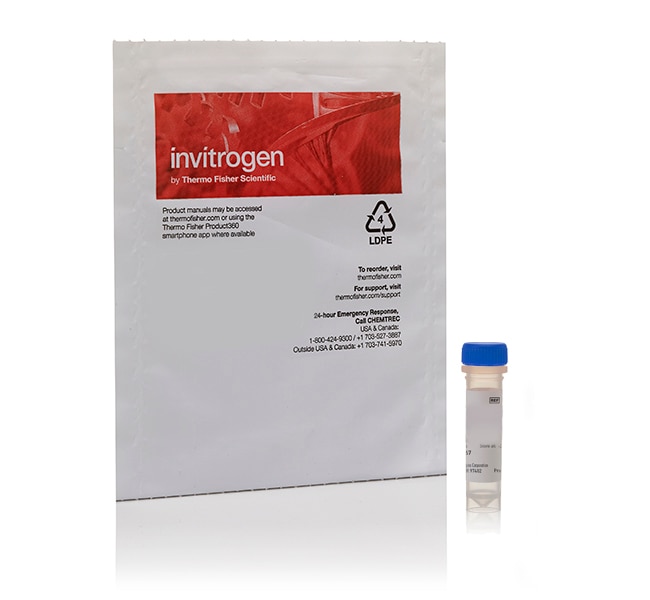
SYTO™ 85 Orange Fluorescent Nucleic Acid Stain - 5 mM Solution in DMSO
For use with fluorescence microscopy and flow cytometry
| 產品號碼 | Quantity |
|---|---|
| S11366 | 250 μL |
產品號碼 S11366
價格 (TWD)
12,376.00
Online offer
Ends: 30-Sep-2026
15,700.00您節省 3,324.00 (21%)
Each
Quantity:
250 μL
價格 (TWD)
12,376.00
Online offer
Ends: 30-Sep-2026
15,700.00您節省 3,324.00 (21%)
Each
The cell-permeant SYTO 85 orange fluorescent nucleic acid stain exhibits bright, orange fluorescence upon binding to nucleic acids. Because the staining pattern of the SYTO dyes in live cells may vary between cell types, we offer the SYTO Orange Fluorescent Nucleic Acid Stain Sampler Kit (Cat. No. S-11360) to enable researchers to find the most appropriate orange-fluorescent SYTO stain for their system.
Any physiological buffer between pH 7.0–8.0, including PBS, can be used to dilute the SYTO dyes for the staining solution.
For Research Use Only. Not for use in diagnostic procedures.
規格
ColorOrange
DescriptionSYTO™ 85 Orange Fluorescent Nucleic Acid Stain - 5 mM Solution in DMSO
Detection MethodFluorescence
Dye TypeCell-Permeant
Emission583 nm
Excitation Wavelength Range567 nm
For Use With (Equipment)Fluorescence Microscope
Product LineSYTO
Quantity250 μL
Shipping ConditionRoom Temperature
Volume (Metric)250 μL
Label TypeFluorescent Dye
Product TypeNucleic Acid Stain
Sub Cellular LocalizationNucleic Acids
Unit SizeEach
內容物與存放
Store in freezer at -5°C to -30°C and protect from light.
常見問答集 (常見問題)
How do SYTO dyes bind to DNA?
引用資料與參考文獻 (3)
引用資料與參考文獻
Abstract
Revealing the sequence of interactions of PuroA peptide with Candida albicans cells by live-cell imaging.
Journal:Sci Rep
PubMed ID:28252014
Rapid and robust detection methods for poison and microbial contamination.
Journal:J Agric Food Chem
PubMed ID:22630610
CORRELATED EVOLUTION OF GENOME SIZE AND CELL VOLUME IN DIATOMS (BACILLARIOPHYCEAE)(1).
Journal:J Phycol
PubMed ID:27041049