Search
Additional Information:
{{banner.description}}

FIGURE: 1 / 6
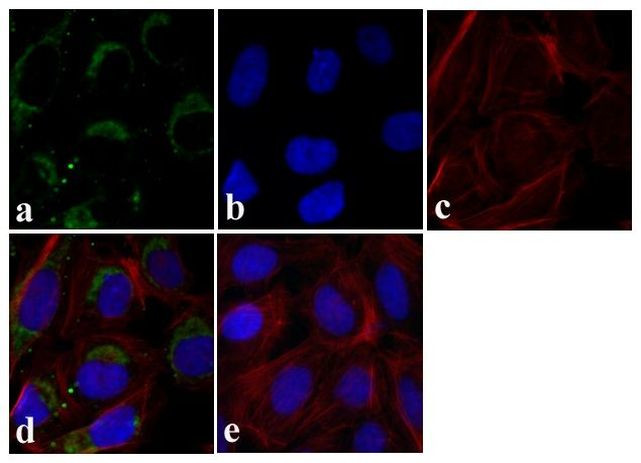
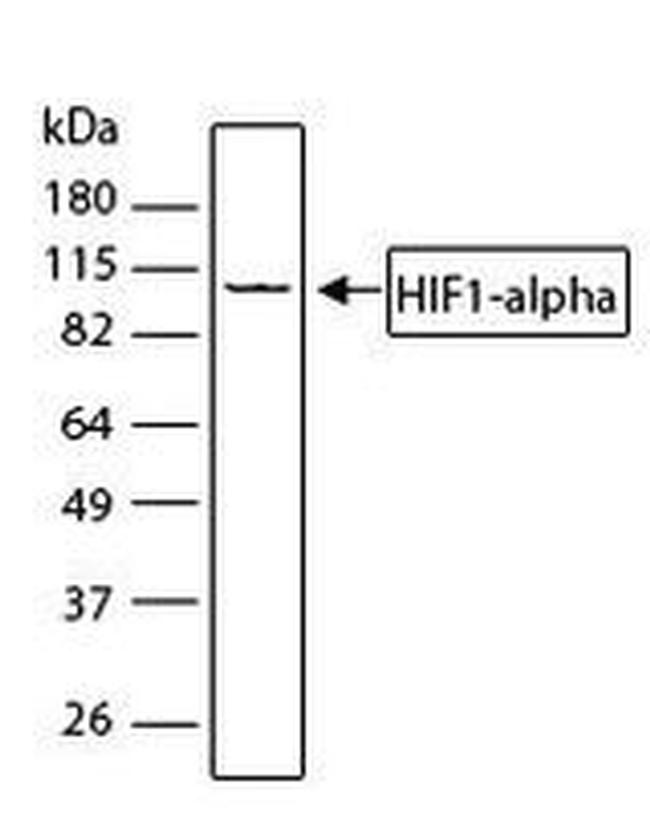
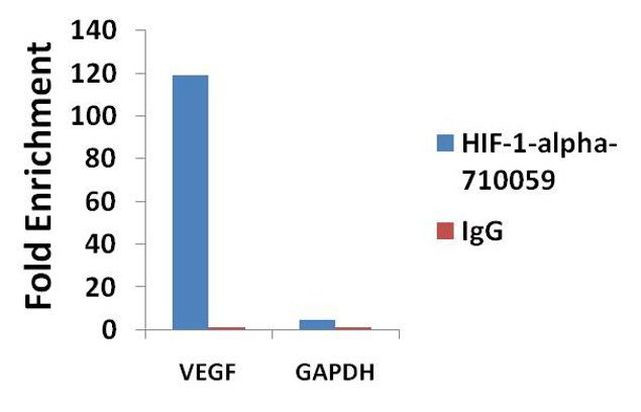
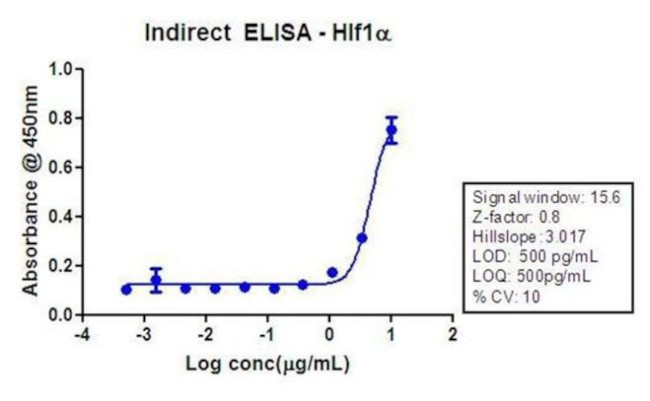
HIF1A Antibody (710059) in ICC/IF
Immunofluorescent analysis of HIF1-alpha was done on 70% confluent log phase U-2 OS cells. The cells were fixed with 4% paraformaldehyde for 15 minutes, and blocked with 5% BSA for 1 hour at room temperature. The cells were labeled with HIF1-alpha Recombinant Rabbit Superclonal™ Antibody (Product # 710059) at 1 µg/mL in 1% BSA and incubated for 3 hours at room temperature and then labeled with Alexa Fluor 488 Goat anti-Rabbit IgG Secondary Antibody (Product # A-11008) at a dilution of 1:400 for 30 minutes at room temperature (Panel a: gree... View More




Product Details
710059
Applications
Tested Dilution
Publications
Product Specifications
Species Reactivity
Human
Host/Isotype
Rabbit
/ IgG
Expression System
Expi293
Class
Recombinant Superclonal
Type
Antibody
Clone
16HCLC
Immunogen
proprietary
Conjugate
Form
Liquid
Concentration
0.5 mg/mL
Amount
100 µg
Purification
Protein A
Storage buffer
PBS
Contains
0.09% sodium azide
Storage conditions
Store at 4°C short term. For long term storage, store at -20°C, avoiding freeze/thaw cycles.
Shipping conditions
Wet ice
RRID
Product Specific Information
This antibody is predicted to react with mouse based on sequence homology.
Recombinant rabbit Superclonal™ antibodies are unique offerings from Thermo Fisher Scientific. They are comprised of a selection of multiple different recombinant monoclonal antibodies, providing the best of both worlds - the sensitivity of polyclonal antibodies with the specificity of monoclonal antibodies - all delivered with the consistency only found in a recombinant antibody. While functionally the same as a polyclonal antibody - recognizing multiple epitope sites on the target and producing higher detection sensitivity for low abundance targets - a recombinant rabbit Superclonal™ antibody has a known mixture of light and heavy chains. The exact population can be produced in every lot, circumventing the biological variability typically associated with polyclonal antibody production. Note: Formerly called “Recombinant polyclonal antibody”, this product is now rebranded as “Recombinant Superclonal™ antibody”. The physical product and the performance remain unchanged.
Target Information
HIF1-alpha (HIF1A) is a subunit of HIF1, which is a transcription factor found in mammalian cells cultured under reduced oxygen tension. HIF-1 is a heterodimer consisting of an alpha and beta subunit, both belonging to the basic-helix-loop-helix Per-aryl hydrocarbon receptor nuclear translocator-Sim (PAS) family of transcription factors. HIF1 functions as a transcriptional regulator of the adaptive response to hypoxia. Under hypoxic conditions, HIF-1 activates the transcription of over 40 genes, including erythropoietin, glucose transporters, glycolytic enzymes, vascular endothelial growth factor, HILPDA, and other genes whose protein products increase oxygen delivery or facilitate metabolic adaptation to hypoxia. HIF1-alpha regulates hypoxia-mediated apoptosis, cell proliferation and tumor angiogenesis. Hypoxia which induces p53 protein accumulation, directly interacts with HIF1-alpha and reduces hypoxia-induced expression of HIF1-alpha by promoting MDM2-mediated ubiquitination and proteasomal degradation under hypoxic conditions. Recent studies suggest that induction of NOX4 by HIF1-alpha contributes to maintain ROS levels after hypoxia and hypoxia-induced proliferation. In humans, it is located on the q arm of chromosome 14. The C-terminal of HIF1A binds to p300. p300/CBP-HIF complexes participate in the induction of hypoxia-responsive genes, including VEGF. Hypoxia contributes significantly to the pathophysiology of major categories of human disease, including myocardial and cerebral ischemia, cancer, pulmonary hypertension, congenital heart disease and chronic obstructive pulmonary disease.
For Research Use Only. Not for use in diagnostic procedures. Not for resale without express authorization.
References (0)
Have you cited this product in a publication?
Let us know so we can reference it here.
Bioinformatics
Protein Aliases: ARNT interacting protein; ARNT-interacting protein; ARNT2; Basic-helix-loop-helix-PAS protein MOP1; bHLHe78; Class E basic helix-loop-helix protein 78; hif 1; hif 1a; HIF-1-alpha; HIF-1alpha 786; hypoxia inducible factor 1 alpha subunit; hypoxia inducible factor 1, alpha subunit (basic helix-loop-helix transcription factor); Hypoxia-inducible factor 1-alpha; hypoxia-inducible factor1alpha; Member of PAS protein 1; member of PAS superfamily 1; PAS domain-containing protein 8; transcription factor; transcription factor; hypoxia-inducible factor 1a; unnamed protein product
Gene Aliases: BHLHE78; HIF-1-alpha; HIF-1A; HIF-1alpha; HIF1; HIF1-ALPHA; HIF1A; MOP1; PASD8
UniProt ID: (Human) Q16665
Entrez Gene ID: (Human) 3091
RNA polymerase II regulatory region sequence-specific DNA binding
RNA polymerase II core promoter proximal region sequence-specific DNA binding
RNA polymerase II transcription factor activity, sequence-specific DNA binding
core promoter proximal region sequence-specific DNA binding
bacterial-type RNA polymerase transcriptional activator activity, sequence-specific DNA binding
bacterial-type RNA polymerase transcriptional repressor activity, sequence-specific DNA binding
transcription corepressor binding
transcription coactivator binding
transcriptional activator activity, RNA polymerase II transcription regulatory region sequence-specific binding
p53 binding
DNA binding
transcription factor activity, sequence-specific DNA binding
protein binding
ligand-dependent nuclear receptor binding
enzyme binding
protein kinase binding
protein domain specific binding
ubiquitin protein ligase binding
histone deacetylase binding
sequence-specific DNA binding
protein heterodimerization activity
protein dimerization activity
Hsp90 protein binding
RNA polymerase II sequence-specific DNA binding transcription factor binding
E-box binding
transcription regulator activator activity
response to reactive oxygen species
angiogenesis
blood vessel development
response to hypoxia
cellular glucose homeostasis
neural crest cell migration
epithelial to mesenchymal transition
embryonic placenta development
B-1 B cell homeostasis
positive regulation of endothelial cell proliferation
vasculature development
heart looping
positive regulation of neuroblast proliferation
chondrocyte differentiation
glandular epithelial cell differentiation
glandular epithelial cell maturation
connective tissue replacement involved in inflammatory response wound healing
outflow tract morphogenesis
cardiac ventricle morphogenesis
lactate metabolic process
regulation of glycolytic process
regulation of transcription, DNA-templated
regulation of transcription from RNA polymerase II promoter
cellular iron ion homeostasis
apoptotic process
signal transduction
neuroblast proliferation
lactation
visual learning
response to iron ion
regulation of gene expression
vascular endothelial growth factor production
positive regulation of vascular endothelial growth factor production
positive regulation of gene expression
negative regulation of gene expression
positive regulation of epithelial cell migration
response to muscle activity
positive regulation of macroautophagy
axonal transport of mitochondrion
neural fold elevation formation
cerebral cortex development
cell differentiation
negative regulation of ossification
bone mineralization
negative regulation of bone mineralization
positive regulation of vascular endothelial growth factor receptor signaling pathway
TOR signaling
negative regulation of TOR signaling
oxygen homeostasis
positive regulation of chemokine production
regulation of transforming growth factor beta2 production
collagen metabolic process
cellular response to oxidative stress
embryonic hemopoiesis
insulin secretion involved in cellular response to glucose stimulus
positive regulation of insulin secretion involved in cellular response to glucose stimulus
regulation of cell proliferation
hemoglobin biosynthetic process
glucose homeostasis
negative regulation of apoptotic process
negative regulation of neuron apoptotic process
positive regulation of blood vessel endothelial cell migration
positive regulation of erythrocyte differentiation
positive regulation of angiogenesis
positive regulation of glycolytic process
positive regulation of transcription, DNA-templated
negative regulation of growth
positive regulation of transcription from RNA polymerase II promoter
muscle cell cellular homeostasis
positive regulation of hormone biosynthetic process
blood vessel morphogenesis
digestive tract morphogenesis
camera-type eye morphogenesis
cartilage development
neuron apoptotic process
elastin metabolic process
intestinal epithelial cell maturation
epithelial cell differentiation involved in mammary gland alveolus development
iris morphogenesis
retina vasculature development in camera-type eye
positive regulation of chemokine-mediated signaling pathway
regulation of thymocyte apoptotic process
negative regulation of thymocyte apoptotic process
cellular response to interleukin-1
cellular response to hypoxia
dopaminergic neuron differentiation
mesenchymal cell apoptotic process
hypoxia-inducible factor-1alpha signaling pathway
cellular response to virus
positive regulation of cytokine production involved in inflammatory response
negative regulation of pri-miRNA transcription from RNA polymerase II promoter
positive regulation of pri-miRNA transcription from RNA polymerase II promoter
negative regulation of oxidative stress-induced neuron intrinsic apoptotic signaling pathway
positive regulation of nitric oxide metabolic process
regulation of protein neddylation
negative regulation of mesenchymal cell apoptotic process
Disclaimer

Clicking the images or links will redirect you to a website hosted by BenchSci that provides third-party scientific content. Neither the content nor the BenchSci technology and processes for selection have been evaluated by us; we are providing them as-is and without warranty of any kind, including for use or application of the Thermo Fisher Scientific products presented.

Performance Guarantee
If an Invitrogen™ antibody doesn't perform as described on our website or datasheet,we'll replace the product at no cost to you, or provide you with a credit for a future purchase.*
Learn more
We're here to help
Get expert recommendations for common problems or connect directly with an on staff expert for technical assistance related to applications, equipment and general product use.
Contact tech support