Search
Additional Information:
{{banner.description}}

FIGURE: 1 / 9
c-Jun Antibody (711202) in ICC/IF
Immunofluorescence analysis was performed on fixed and permeabilized PC-3 cells for detection of endogenous c-jun using Anti-c-jun Recombinant Rabbit Superclonal™ Antibody (Product # 711202, 2 µg/mL) and labeled with Goat anti-Rabbit IgG (Heavy Chain) Superclonal™ Secondary Antibody, Alexa Fluor® 488 conjugate (Product # A27034, 1:2000). Panel a) shows representative cells that were stained for detection and localization of c-jun protein (green), Panel b) is stained for nuclei (blue) using SlowFade® Gold Antifade Mountant with DAPI (Produc... View More







Product Details
711202
Applications
Tested Dilution
Publications
Product Specifications
Species Reactivity
Human,
Mouse
Published species
Human,
Mouse
Host/Isotype
Rabbit
/ IgG
Expression System
Expi293
Class
Recombinant Superclonal
Type
Antibody
Clone
2HCLC
Immunogen
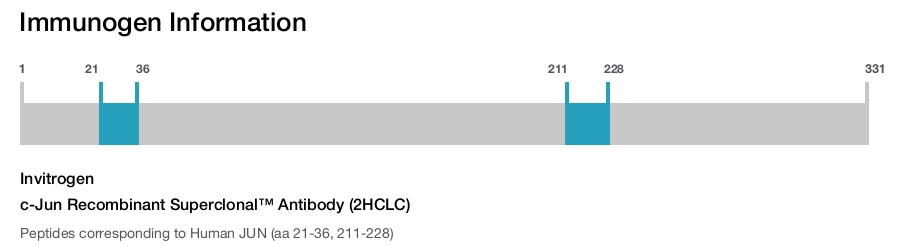
Peptides corresponding to Human JUN (aa 21-36, 211-228)
Conjugate
Unconjugated
Unconjugated
Unconjugated
Form
Liquid
Concentration
0.5 mg/mL
Amount
100 µg
Purification
Protein A
Storage buffer
PBS, pH 7.2
Contains
0.09% sodium azide
Storage conditions
Store at 4°C short term. For long term storage, store at -20°C, avoiding freeze/thaw cycles.
Shipping conditions
Wet ice
RRID
Product Specific Information
This antibody is predicted to react with Monkey, Bovine, Pig and Mouse.
Recombinant rabbit Superclonal™ antibodies are unique offerings from Thermo Fisher Scientific. They are comprised of a selection of multiple different recombinant monoclonal antibodies, providing the best of both worlds - the sensitivity of polyclonal antibodies with the specificity of monoclonal antibodies - all delivered with the consistency only found in a recombinant antibody. While functionally the same as a polyclonal antibody - recognizing multiple epitope sites on the target and producing higher detection sensitivity for low abundance targets - a recombinant rabbit Superclonal™ antibody has a known mixture of light and heavy chains. The exact population can be produced in every lot, circumventing the biological variability typically associated with polyclonal antibody production. Note: Formerly called “Recombinant polyclonal antibody”, this product is now rebranded as “Recombinant Superclonal™ antibody”. The physical product and the performance remain unchanged.
Target Information
c-Jun is a transcription factor that recognizes and binds to the enhancer heptamer motif 5'-TGA[CG]TCA-3'. It promotes activity of NR5A1 when phosphorylated by HIPK3 leading to increased steroidogenic gene expression upon cAMP signaling pathway stimulation. Involved in activated KRAS-mediated transcriptional activation of USP28 in colorectal cancer (CRC) cells.
For Research Use Only. Not for use in diagnostic procedures. Not for resale without express authorization.
Bioinformatics
Protein Aliases: Activator protein 1; AH119; AP1; cjun; enhancer-binding protein AP1; immediate early; JUN; Jun A; Jun activation domain binding protein; Jun oncogene; JUND; p39; Proto-oncogene c-Jun; proto-oncogene cJun; transcription factor AP-1; Transcription factor AP-1 subunit Jun; Transcription factor Jun; V-jun avian sarcoma virus 17 oncogene homolog; v-jun sarcoma virus 17 oncogene homolog
Gene Aliases: AP-1; AP1; c-Jun; cJUN; JUN; Junc; p39
UniProt ID: (Human) P05412, (Mouse) P05627
Entrez Gene ID: (Human) 3725, (Mouse) 16476
transcription regulatory region sequence-specific DNA binding
RNA polymerase II core promoter proximal region sequence-specific DNA binding
RNA polymerase II transcription factor activity, sequence-specific DNA binding
transcriptional repressor activity, RNA polymerase II transcription regulatory region sequence-specific binding
transcriptional activator activity, RNA polymerase II transcription regulatory region sequence-specific binding
DNA binding
chromatin binding
double-stranded DNA binding
transcription factor activity, sequence-specific DNA binding
RNA binding
GTPase activator activity
protein binding
enzyme binding
ubiquitin protein ligase binding
cAMP response element binding
identical protein binding
ubiquitin-like protein ligase binding
RNA polymerase II sequence-specific DNA binding transcription factor binding
R-SMAD binding
general transcription initiation factor binding
sequence-specific double-stranded DNA binding
RNA polymerase II distal enhancer sequence-specific DNA binding
transcriptional activator activity, RNA polymerase II core promoter proximal region sequence-specific binding
RNA polymerase II activating transcription factor binding
transcription factor activity, RNA polymerase II distal enhancer sequence-specific binding
transcription coactivator activity
transcription factor binding
protein homodimerization activity
sequence-specific DNA binding
transcription regulatory region DNA binding
poly(A) RNA binding
protein heterodimerization activity
HMG box domain binding
basic leucine zipper transcription factor
negative regulation of transcription from RNA polymerase II promoter
angiogenesis
microglial cell activation
liver development
positive regulation of endothelial cell proliferation
outflow tract morphogenesis
regulation of transcription, DNA-templated
regulation of transcription from RNA polymerase II promoter
apoptotic process
transforming growth factor beta receptor signaling pathway
JNK cascade
cell proliferation
negative regulation of cell proliferation
response to xenobiotic stimulus
positive regulation of epithelial cell migration
release from viral latency
monocyte differentiation
axon regeneration
response to endoplasmic reticulum stress
leading edge cell differentiation
response to muscle stretch
regulation of cell proliferation
positive regulation of apoptotic process
negative regulation of apoptotic process
negative regulation of DNA binding
negative regulation of neuron apoptotic process
negative regulation by host of viral transcription
positive regulation by host of viral transcription
negative regulation of transcription, DNA-templated
positive regulation of transcription, DNA-templated
positive regulation of transcription from RNA polymerase II promoter
positive regulation of fibroblast proliferation
response to steroid hormone
regulation of cell cycle
SMAD protein signal transduction
eyelid development in camera-type eye
positive regulation of ERK1 and ERK2 cascade
cellular response to calcium ion
cellular response to anisomycin
integrated stress response signaling
positive regulation of pri-miRNA transcription from RNA polymerase II promoter
positive regulation of vascular smooth muscle cell proliferation
positive regulation of DNA-templated transcription, initiation
release of cytochrome c from mitochondria
transcription, DNA-templated
transcription from RNA polymerase II promoter
SMAD protein import into nucleus
learning
positive regulation of cell proliferation
response to radiation
cellular process
negative regulation of protein autophosphorylation
response to lipopolysaccharide
cellular response to hormone stimulus
response to cytokine
response to drug
positive regulation of neuron apoptotic process
positive regulation of GTPase activity
positive regulation of cell differentiation
positive regulation of monocyte differentiation
positive regulation of DNA replication
positive regulation of smooth muscle cell proliferation
cellular response to potassium ion starvation
response to cAMP
membrane depolarization
negative regulation of transcription from RNA polymerase II promoter in response to endoplasmic reticulum stress
Disclaimer

Clicking the images or links will redirect you to a website hosted by BenchSci that provides third-party scientific content. Neither the content nor the BenchSci technology and processes for selection have been evaluated by us; we are providing them as-is and without warranty of any kind, including for use or application of the Thermo Fisher Scientific products presented.

Performance Guarantee
If an Invitrogen™ antibody doesn't perform as described on our website or datasheet,we'll replace the product at no cost to you, or provide you with a credit for a future purchase.*
Learn more
We're here to help
Get expert recommendations for common problems or connect directly with an on staff expert for technical assistance related to applications, equipment and general product use.
Contact tech support