Hamburger Menu Button
Thermo Fisher Scientific Logo
Iniciar sesión
¿No tiene una cuenta? Crear una cuenta
  • Productos
    • Consumibles de laboratorio
    • Equipos de laboratorio
    • Instrumentos de Laboratorio
    • Clínica y Diagnóstico
    • Cromatografía
    • Espectrometría de Masas
    • Cultivo Celular
    • Análisis Celular
    • Anticuerpos
    • Ver todas las categorías de producto
  • Aplicaciones
    • Cultivo celular y transfección
    • Citometría de flujo
    • Investigación sobre el cáncer
    • Cromatografía
    • Secuenciación
    • PCR
    • Soluciones para laboratorio
    • Diagnóstico de alergias
    • Ver todas las aplicaciones y técnicas
  • Servicios
    • Servicios Personalizados
    • Servicios de Capacitación
    • Informática para laboratorios de ámbito empresarial
    • Servicios financieros y de arrendamiento
    • Servicios 360° de CDMO y CRO
    • Servicios de CDMO
    • Servicios de CRO
    • Inspección de seguridad alimentaria Servicios
    • Ver todos los servicios
  • Ayuda y Soporte
    • Crear una nueva cuenta
    • Cómo hacer el pedido
    • Póngase en contacto con nosotros
    • Cambio de ubicación
    • Ver toda la ayuda y soporte técnico
  • Popular
    • TaqMan Real-Time PCR Assays
      TaqMan Real-Time PCR Assays
    • Antibodies
      Antibodies
    • Oligos, Primers & Probes
      Oligos, Primers & Probes
    • GeneArt Gene Synthesis
      GeneArt Gene Synthesis
    • Cell Culture Plastics
      Cell Culture Plastics
  • A quiénes brindamos nuestros servicios
    • Industria biotecnológica
    • Sector biofarmacéutico
    • CDMO
    • Diagnósticos de laboratorio
    • Ciencias aplicadas e industriales
  • Ofertas especiales
  • Contáctenos
  • Orden Rápida
  • Documentos y certificados
Thermo Fisher Scientific Logo

Search

Buscar
Search button
          • Contáctenos
          • Orden Rápida
          • Iniciar sesión
            Iniciar sesión
            ¿No tiene una cuenta? Crear una cuenta
            • Cuenta
            • Estatus del pedido
            • Productos personalizados y proyectos​
          • Primary Antibodies ›
          • USP7 Antibodies
          Formerly called “Recombinant polyclonal antibody”, this product is now rebranded as “Recombinant Superclonal™ antibody”. The physical product and the performance remain unchanged.

          Invitrogen

          USP7 Recombinant Superclonal™ Antibody (8HCLC)

          Advanced Verification
          View all (31) USP7 antibodies

          {{$productOrderCtrl.translations['antibody.pdp.commerceCard.promotion.promotions']}}

          {{$productOrderCtrl.translations['antibody.pdp.commerceCard.promotion.viewpromo']}}

          {{$productOrderCtrl.translations['antibody.pdp.commerceCard.promotion.promocode']}}: {{promo.promoCode}} {{promo.promoTitle}} {{promo.promoDescription}}. {{$productOrderCtrl.translations['antibody.pdp.commerceCard.promotion.learnmore']}}

          Datasheet
          Certificates
          Protocols
          Questions & Answers
          Tech Support
          Datasheet
          Certificates
          Protocols
          Questions & Answers
          Tech Support
          Datasheet
          Certificates
          Protocols
          Questions & Answers
          Tech Support

          Cite USP7 Recombinant Superclonal™ Antibody (8HCLC)

          Additional Information:
          {{banner.description}}
          {{$ctrl.isSkuNotesCollapsed ? 'View more' : 'View less'}}
          • Antibody Testing Data (2)
          • Advanced Verification (1)
          USP7 Antibody in Immunocytochemistry (ICC/IF)
          Group 53 Created with Sketch.
          USP7 Antibody in Immunocytochemistry (ICC/IF)
          Group 53 Created with Sketch.

          FIGURE: 1 / 3

          {{ $ctrl.currentElement.advancedVerification.fullName }}
          {{ $ctrl.currentElement.advancedVerification.text }}

          USP7 Antibody (712374) in ICC/IF

          Knockdown of USP7 was achieved by transfecting A549 cells with USP7 specific validated siRNA (Silencer® select Product # s15440). Immunofluorescence analysis was performed on A549 cells (untransfected, panel a-d), transfected with USP7 specific siRNA (panels i-l) or non-specific scrambled siRNA (panels e-h). Cells were fixed, permeabilized and labelled with Anti-USP7 Recombinant Rabbit Monoclonal Antibody (Product # 712374, 1:100), followed by Goat anti-Rabbit IgG (Heavy Chain) Superclonal™ Secondary Antibody, Alexa Fluor® 488 conjugate (P... View More {{ $ctrl.currentElement.advancedVerification.fullName }} validation info. View more
          Published figure supplied by benchsci-logo
          PMID: {{$ctrl.currentElement.benchSciPubmedId}}
          View Product

          {{$ctrl.videoDesc}}

          {{$ctrl.videoLongDesc}}

          USP7 Antibody in Immunocytochemistry (ICC/IF)
          USP7 Antibody in Immunocytochemistry (ICC/IF)
          USP7 Antibody
          USP7 Recombinant Superclonal™ Antibody (8HCLC)

          Product Details

          712374

          Applications
          Tested Dilution
          Publications

          Immunocytochemistry (ICC/IF)

          1:100
          -
          Product Specifications

          Species Reactivity

          Human

          Host/Isotype

          Rabbit / IgG

          Expression System

          Expi293

          Class

          Recombinant Superclonal

          Type

          Antibody

          Clone

          8HCLC

          Immunogen

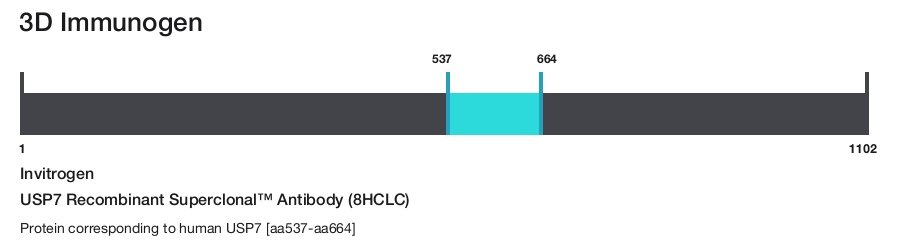
          Protein corresponding to human USP7 [aa537-aa664]
          3D Epitope / Immunogen

          Conjugate

          Unconjugated Unconjugated Unconjugated

          Form

          Liquid

          Concentration

          0.5 mg/mL

          Amount

          100 µg

          Purification

          Protein A

          Storage buffer

          PBS, pH 7.4

          Contains

          0.09% sodium azide

          Storage conditions

          Store at 4°C short term. For long term storage, store at -20°C, avoiding freeze/thaw cycles.

          Shipping conditions

          Wet ice

          RRID

          AB_2734828

          Product Specific Information

          This antibody is predicted to react with Monkey, Pig, Mouse, Rat.

          Recombinant rabbit Superclonal™ antibodies are unique offerings from Thermo Fisher Scientific. They are comprised of a selection of multiple different recombinant monoclonal antibodies, providing the best of both worlds - the sensitivity of polyclonal antibodies with the specificity of monoclonal antibodies - all delivered with the consistency only found in a recombinant antibody. While functionally the same as a polyclonal antibody - recognizing multiple epitope sites on the target and producing higher detection sensitivity for low abundance targets - a recombinant rabbit Superclonal™ antibody has a known mixture of light and heavy chains. The exact population can be produced in every lot, circumventing the biological variability typically associated with polyclonal antibody production. Note: Formerly called “Recombinant polyclonal antibody”, this product is now rebranded as “Recombinant Superclonal™ antibody”. The physical product and the performance remain unchanged.

          Target Information

          USP7 or HAUSP is a ubiquitin specific protease or a deubiquitylating enzyme that cleaves ubiquitin from its substrates. Since ubiquitylation (polyubiquitination) is most commonly associated with the stability and degradation of cellular proteins, HAUSP activity generally stabilizes its substrate proteins. HAUSP is most popularly known as a direct antagonist of Mdm2, the E3 ubiquitin ligase for the tumor suppressor protein, p53. Normally, p53 levels are kept low in part due to Mdm2-mediated ubiquitylation and degradation of p53. Interestingly, in response to oncogenic insults, HAUSP can deubiquitinate p53 and protect p53 from Mdm2-mediated degradation, indicating that it may possess a tumor suppressor function for the immediate stabilization of p53 in response to stress. Another important role of HAUSP function involves the oncogenic stabilization of p53. Oncogenes such as Myc and E1A are thought to activate p53 through a p19 alternative reading frame (p19ARF, also called ARF)-dependent pathway, although some evidence suggests ARF is not essential in this process. An intriguing possibility is that HAUSP provides an alternative pathway for safeguarding the cell against oncogenic insults.

          For Research Use Only. Not for use in diagnostic procedures. Not for resale without express authorization.

          References (0)

          Have you cited this product in a publication?
          Let us know so we can reference it here.
          Cite this product

          Bioinformatics

          Protein Aliases: Chromosome 16p13.2 deletion syndrome; Deubiquitinating enzyme 7; Herpes virus-associated ubiquitin-specific protease; Herpesvirus-associated ubiquitin-specific protease; Ubiquitin carboxyl-terminal hydrolase 7; ubiquitin specific peptidase 7 (herpes virus-associated); ubiquitin specific protease 7 (herpes virus-associated); Ubiquitin thioesterase 7; Ubiquitin-specific-processing protease 7; unnamed protein product; USP7; herpes virus-associated protease

          View more View less

          Gene Aliases: C16DELp13.2; DEL16P13.2; HAFOUS; HAUSP; TEF1; USP7

          View more View less

          UniProt ID: (Human) Q93009

          View more View less

          Entrez Gene ID: (Human) 7874

          View more View less

          Function(s)
          p53 binding cysteine-type endopeptidase activity thiol-dependent ubiquitin-specific protease activity protein binding peptidase activity cysteine-type peptidase activity hydrolase activity ubiquitinyl hydrolase activity Lys48-specific deubiquitinase activity
          Process(es)
          autophagosome assembly DNA repair transcription-coupled nucleotide-excision repair DNA dealkylation involved in DNA repair proteolysis cellular response to DNA damage stimulus negative regulation of autophagy positive regulation of autophagy protein ubiquitination protein deubiquitination regulation of protein stability cellular response to nutrient levels negative regulation of proteasomal ubiquitin-dependent protein catabolic process monoubiquitinated protein deubiquitination TORC1 signaling regulation of circadian rhythm hypermethylation of CpG island negative regulation of gluconeogenesis rhythmic process protein stabilization regulation of sequence-specific DNA binding transcription factor activity regulation of establishment of protein localization to telomere symbiont-mediated disruption of host cell PML body regulation of signal transduction by p53 class mediator negative regulation of TORC1 signaling regulation of telomere capping regulation of retrograde transport, endosome to Golgi
          It has to be done as per old AB suggested Products section.

          Disclaimer

          Close

          Clicking the images or links will redirect you to a website hosted by BenchSci that provides third-party scientific content. Neither the content nor the BenchSci technology and processes for selection have been evaluated by us; we are providing them as-is and without warranty of any kind, including for use or application of the Thermo Fisher Scientific products presented.

          guarantee_icon

          Performance Guarantee

          If an Invitrogen™ antibody doesn't perform as described on our website or datasheet,we'll replace the product at no cost to you, or provide you with a credit for a future purchase.*

          Learn more
          help_icon

          We're here to help

          Get expert recommendations for common problems or connect directly with an on staff expert for technical assistance related to applications, equipment and general product use.

          Contact tech support
          Pedidos Plus Icon Minus Icon
          • Estatus del pedido
          • Ayuda para pedidos
          • Orden Rápida
          • Supply Center
          • eProcurement
          Soporte Plus Icon Minus Icon
          • Ayuda y soporte
          • Entre en Contacto
          • Centros de asistencia técnica
          • Consultar documentos y certificados
          • Informar de un problema en la web
          Recursos Plus Icon Minus Icon
          • Centros de aprendizaje
          • Promociones
          • Eventos & Webinars
          • Medios Sociales
          Acerca de Thermo Fisher Plus Icon Minus Icon
          • Acerca de nosotros Acerca de nosotros
          • Empleo Empleo
          • Inversores Inversores
          • Noticias Noticias
          • Responsabilidad social Responsabilidad social
          • Marcas comerciales
          • Políticas y avisos
          Nuestro Portafolio Plus Icon Minus Icon
          • Thermo Scientific
          • Applied Biosystems
          • Invitrogen
          • Gibco
          • Ion Torrent
          • Fisher Scientific
          • Patheon
          • PPD
          • Terms & Conditions
          • Privacy Policy
          • Price & Freight Policy
          © 2006-2026 Thermo Fisher Scientific Inc. All rights reserved. All trademarks are the property of Thermo Fisher Scientific and its subsidiaries unless otherwise specified.
          México flag icon
          México

          Your items have has been added!


          Host server : magellan-search-blue-67655d8755-b2k9d:80/100.66.79.173:80.
          git-commit: dddaa802cd395f65bf1581942d0e97a089c38f41
          git-url: https://github.com/thermofisher/magellan-search
          git-branch: release/2.46.0-Offline