Search
Proteintech
APAF1 Polyclonal Antibody
{{$productOrderCtrl.translations['antibody.pdp.commerceCard.promotion.promotions']}}
{{$productOrderCtrl.translations['antibody.pdp.commerceCard.promotion.viewpromo']}}
{{$productOrderCtrl.translations['antibody.pdp.commerceCard.promotion.promocode']}}: {{promo.promoCode}} {{promo.promoTitle}} {{promo.promoDescription}}. {{$productOrderCtrl.translations['antibody.pdp.commerceCard.promotion.learnmore']}}
Additional Information:
{{banner.description}}


Product Details
21710-1-AP
Applications
Tested Dilution
Publications
Product Specifications
Published species
Human,
Mouse,
Rat
Host/Isotype
Rabbit
/ IgG
Class
Polyclonal
Type
Antibody
Immunogen
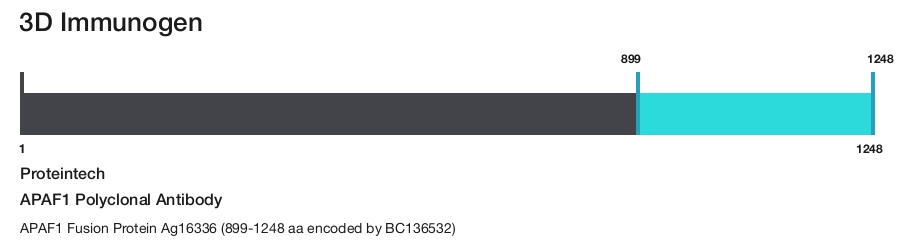
APAF1 Fusion Protein Ag16336 (899-1248 aa encoded by BC136532)
Conjugate
Form
Liquid
Concentration
0.15 mg/mL
Amount
22.5 µg
Storage conditions
-20°C
Shipping conditions
Wet ice (domestic); Dry ice (international)
Product Specific Information
Immunogen sequence: TSSDDQTIR LWETKKVCKN SAVMLKQEVD VVFQENEVMV LAVDHIRRLQ LINGRTGQID YLTEAQVSCC CLSPHLQYIA FGDENGAIEI LELVNNRIFQ SRFQHKKTVW HIQFTADEKT LISSSDDAEI QVWNWQLDKC IFLRGHQETV KDFRLLKNSR LLSWSFDGTV KVWNIITGNK EKDFVCHQGT VLSCDISHDA TKFSSTSADK TAKIWSFDLL LPLHELRGHN GCVRCSAFSV DSTLLATGDD NGEIRIWNVS NGELLHLCAP LSEEGAATHG GWVTDLCFSP DGKMLISAGG YIKWWNVVTG ESSQTFYTNG TNLKKIHVSP DFKTYVTVDN LGILYILQTL E (899-1248 aa encoded by BC136532)
Target Information
APAF1 gene encodes a cytoplasmic protein that initiates apoptosis. This protein contains several copies of the WD-40 domain, a caspase recruitment domain (CARD), and an ATPase domain (NB-ARC). Upon binding cytochrome c and dATP, this protein forms an oligomeric apoptosome. The apoptosome binds and cleaves caspase 9 preproprotein, releasing its mature, activated form. Activated caspase 9 stimulates the subsequent caspase cascade that commits the cell to apoptosis. Alternative splicing results in several transcript variants encoding different isoforms.
For Research Use Only. Not for use in diagnostic procedures. Not for resale without express authorization.
Disclaimer

Clicking the images or links will redirect you to a website hosted by BenchSci that provides third-party scientific content. Neither the content nor the BenchSci technology and processes for selection have been evaluated by us; we are providing them as-is and without warranty of any kind, including for use or application of the Thermo Fisher Scientific products presented.

Performance Guarantee
If an Invitrogen™ antibody doesn't perform as described on our website or datasheet,we'll replace the product at no cost to you, or provide you with a credit for a future purchase.*
Learn more
We're here to help
Get expert recommendations for common problems or connect directly with an on staff expert for technical assistance related to applications, equipment and general product use.
Contact tech support