Search
QED Bioscience
ATM Polyclonal Antibody
{{$productOrderCtrl.translations['antibody.pdp.commerceCard.promotion.promotions']}}
{{$productOrderCtrl.translations['antibody.pdp.commerceCard.promotion.promocode']}}: {{promo.promoCode}} {{promo.promoTitle}} {{promo.promoDescription}}. {{$productOrderCtrl.translations['antibody.pdp.commerceCard.promotion.learnmore']}}
{{$ctrl.translations['antibody.pdp.skuNotes.additionalInformation']}}:

FIGURE: 1 / 2
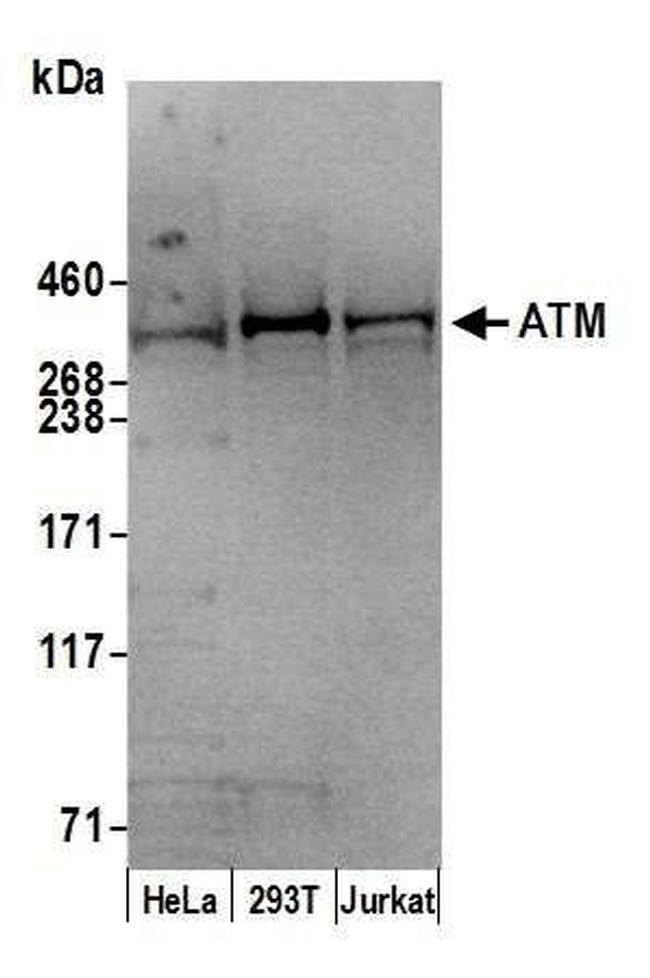
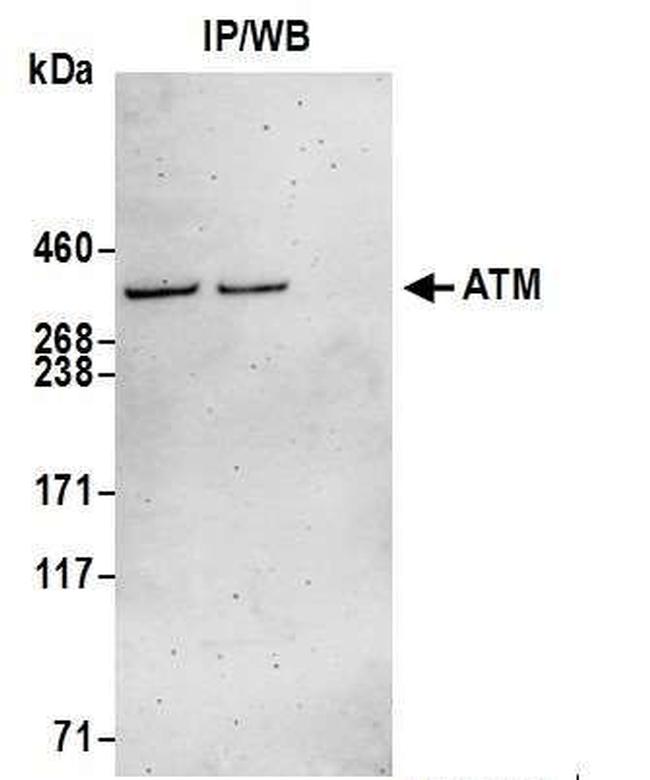
ATM Antibody (13014-100UG) in WB
Detection of human ATM by western blot. Samples: Whole cell lysate (50 µg) from HeLa, HEK293T, and Jurkat cells prepared using NETN lysis buffer. Antibody: Affinity purified goat anti-ATM antibody 13014 (lot 13014-2) used for WB at 0.4 µg/mL. Detection: Chemiluminescence with an exposure time of 30 seconds.


Please note: We are reviewing Western blot images included in the antibody testing data in our catalog, including those provided by third parties. Unless expressly labeled or annotated as “raw-unedited”, Western blot images included in the antibody testing data in our catalog may have been edited, optimized or otherwise adjusted for presentation.
Product Details
13014-100UG
Applications
Tested Dilution
Publications
Product Specifications
Species Reactivity
Human,
Mouse
Host/Isotype
Goat
Class
Polyclonal
Type
Antibody
Immunogen
Synthetic peptide representing a portion of the protein encoded within exon 53 (LocusLink ID 472).
Conjugate
Unconjugated
Unconjugated
Unconjugated
Form
Liquid
Concentration
0.5-1.0 mg/mL
Amount
100 µg
Purification
Protein A
Storage buffer
PBS
Contains
0.1% sodium azide
Storage conditions
2-8°C
Shipping conditions
Ambient (domestic); Wet ice (international)
Target Information
Ataxia-telangiectasia Mutated (ATM) is a protein that belongs to the PI3/PI4 kinase family. Ataxia-telangiectasia is a rare autosomal recessive disorder characterized by progressive neurologic degeneration, immunologic deficiency, and an increased risk of lymphoid cancer. The ATM gene codes for a protein belonging to the phosphoinositide 3-kinase (PI3K) superfamily. ATM phosphorylates proteins instead of lipid and has many downstream targets that act as cell-cycle regulators including: P53, Mdm2, BRCA1, and SMC1. The ATM protein is responsible for repairing double-stranded DNA breaks that occur because of ionizing radiation and other mutagens. The ATM's C-terminal region has extensive homology to the catalytic domains of phosphatidylinositol 3-kinases (PI3 kinases). Studies have shown that ATM becomes autophosphorylated and upregulated by exposure to ionizing radiation. AT cells are hypersensitive to ionizing radiation, impaired in mediating the inhibition of DNA synthesis and display delays in p53 induction. Further, DNA damage caused by ionizing irradiation activates ATM-kinase, leading to a cascade of kinase reactions that regulate cell cycle, apoptosis, and DNA damage repair. Studies have linked ATM to apoptosis along with Nbs1 and Chk2 in the E2F1 pathway.
For Research Use Only. Not for use in diagnostic procedures. Not for resale without express authorization.
References (0)
Have you cited this product in a publication?
Let us know so we can reference it here.
Bioinformatics
Protein Aliases: A-T; A-T mutated; A-T mutated homolog; AT mutated; AT mutated protein; Ataxia t; ataxia telangiectasia gene mutated in human beings; ataxia telangiectasia mutated; ataxia telangiectasia mutated homolog; DKFZp781A0353; EC 2.7.1.37; homolog of the human ataxia telangiectasia gene; MGC74674; mutated in ataxia telangiectasia; serine/threonine kinase ATM; TEL1, telomere maintenance 1, homolog; unnamed protein product
Gene Aliases: AT1; ATA; ATC; ATD; ATDC; ATE; C030026E19Rik; TEL1; TELO1
UniProt ID: (Human) Q13315, (Mouse) Q62388
Entrez Gene ID: (Human) 472, (Mouse) 11920
autophagosome assembly
DNA damage checkpoint
pexophagy
telomere maintenance
double-strand break repair via homologous recombination
DNA double-strand break processing
ovarian follicle development
response to hypoxia
somitogenesis
pre-B cell allelic exclusion
immune system process
DNA repair
double-strand break repair
chromatin remodeling
protein phosphorylation
protein monoubiquitination
cellular response to DNA damage stimulus
response to oxidative stress
mitotic spindle assembly checkpoint
mitotic G2 DNA damage checkpoint
meiosis I
male meiosis
female meiotic division
female gamete generation
brain development
heart development
determination of adult lifespan
female gonad development
intrinsic apoptotic signaling pathway in response to DNA damage
post-embryonic development
response to ionizing radiation
regulation of gene expression
regulation of autophagy
positive regulation of gene expression
DNA damage response, signal transduction by p53 class mediator
positive regulation of cell migration
negative regulation of B cell proliferation
SCF-dependent proteasomal ubiquitin-dependent protein catabolic process
regulation of telomere maintenance via telomerase
positive regulation of telomere maintenance via telomerase
V(D)J recombination
cellular response to stress
cellular response to reactive oxygen species
multicellular organism growth
phosphatidylinositol-3-phosphate biosynthetic process
peptidyl-serine autophosphorylation
lipoprotein catabolic process
response to starvation
signal transduction in response to DNA damage
positive regulation of apoptotic process
proteasome-mediated ubiquitin-dependent protein catabolic process
positive regulation of DNA damage response, signal transduction by p53 class mediator
positive regulation of neuron apoptotic process
meiotic telomere clustering
positive regulation of cell adhesion
positive regulation of transcription from RNA polymerase II promoter
protein autophosphorylation
thymus development
oocyte development
protein stabilization
neuron apoptotic process
regulation of cell cycle
chromosome organization involved in meiotic cell cycle
protein K63-linked ubiquitination
histone mRNA catabolic process
cellular response to retinoic acid
cellular response to ionizing radiation
cellular response to gamma radiation
cellular response to X-ray
cellular response to nitrosative stress
replicative senescence
establishment of RNA localization to telomere
establishment of macromolecular complex localization to telomere
DNA strand resection involved in replication fork processing
cellular response to oxygen-containing compound
negative regulation of signal transduction by p53 class mediator
positive regulation of DNA catabolic process
regulation of microglial cell activation
negative regulation of TORC1 signaling
negative regulation of telomere capping
positive regulation of telomere maintenance via telomere lengthening
positive regulation of telomerase catalytic core complex assembly
positive regulation of double-strand break repair via homologous recombination
protein localization to site of double-strand break
negative regulation of double-strand break repair via homologous recombination
positive regulation of double-strand break repair
regulation of autophagosome assembly
positive regulation of autophagosome assembly
double-strand break repair via nonhomologous end joining
reciprocal meiotic recombination
signal transduction
regulation of apoptotic process
regulation of cellular response to stress
cellular senescence
regulation of cellular response to heat
regulation of signal transduction by p53 class mediator
Disclaimer

Clicking the images or links will redirect you to a website hosted by BenchSci that provides third-party scientific content. Neither the content nor the BenchSci technology and processes for selection have been evaluated by us; we are providing them as-is and without warranty of any kind, including for use or application of the Thermo Fisher Scientific products presented.

Performance Guarantee
If an Invitrogen™ antibody doesn't perform as described on our website or datasheet,we'll replace the product at no cost to you, or provide you with a credit for a future purchase.*
Learn more
We're here to help
Get expert recommendations for common problems or connect directly with an on staff expert for technical assistance related to applications, equipment and general product use.
Contact tech support