Search
Huabio
Amyloid Beta A4 Precursor (APP) Polyclonal Antibody
{{$productOrderCtrl.translations['antibody.pdp.commerceCard.promotion.promotions']}}
{{$productOrderCtrl.translations['antibody.pdp.commerceCard.promotion.viewpromo']}}
{{$productOrderCtrl.translations['antibody.pdp.commerceCard.promotion.promocode']}}: {{promo.promoCode}} {{promo.promoTitle}} {{promo.promoDescription}}. {{$productOrderCtrl.translations['antibody.pdp.commerceCard.promotion.learnmore']}}
Additional Information:
{{banner.description}}


Product Details
1007-5
Applications
Tested Dilution
Publications
Product Specifications
Species Reactivity
Human,
Mouse,
Rat
Host/Isotype
Rabbit
/ IgG
Class
Polyclonal
Type
Antibody
Immunogen
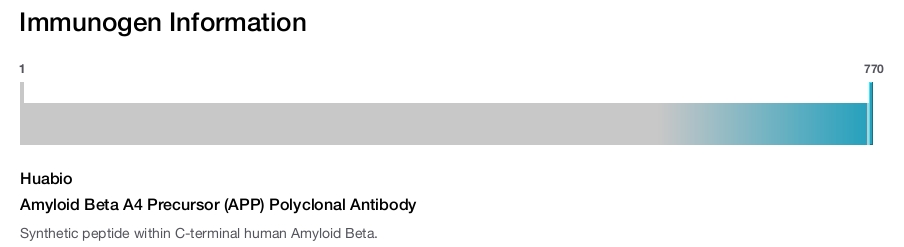
Synthetic peptide within C-terminal human Amyloid Beta.
Conjugate
Form
Liquid
Concentration
1 mg/mL
Amount
100 µg
Purification
Antigen affinity chromatography
Storage buffer
PBS, pH 7.4, with 0.2% BSA, 40% glycerol
Contains
0.05% sodium azide
Storage conditions
Store at 4°C short term. For long term storage, store at -20°C, avoiding freeze/thaw cycles.
Shipping conditions
Ambient (domestic); Wet ice (international)
Target Information
Amyloid Precursor Protein (APP) or Amyloid beta precursor protein functions as a cell surface kinesin I membrane receptor, mediating the axonal transport of beta-secretase and presenilin 1. APP is important for neurite growth, neuronal adhesion and axonogenesis. APP is a 100-140 kDa transmembrane glycoprotein that exists as several isoforms resulting from alternative splicing. Proteolytic cleavage of APP by beta- and gamma-secretases results in the generation of beta amyloid, which is the primary component of senile plaques. Senile plaques are one of the major histopathologic features of Alzheimer's disease. Abnormal regulation and processing of APP also plays a role in Down's syndrome, early onset familial Alzheimer's disease, and cerebral hemorrhage.
For Research Use Only. Not for use in diagnostic procedures. Not for resale without express authorization.
References (0)
Have you cited this product in a publication?
Let us know so we can reference it here.
Bioinformatics
Protein Aliases: ABPP; AG; Alzheimer disease amyloid A4 protein homolog; Alzheimer disease amyloid protein; amyloid A4; Amyloid b precursor protein; amyloid beta (A4) precursor protein; amyloid beta A4 protein; amyloid beta precursor protein (ABPP); amyloid beta protein; amyloid beta-protein precursor; Amyloid precursor protein; amyloid protein; Amyloid β precursor protein; Amyloid-beta (A4) precursor protein; Amyloid-beta A4 protein; Amyloid-beta precursor protein; Amyloidogenic glycoprotein; APP; APPI; appican; beta-amyloid A4; beta-amyloid peptide; beta-amyloid peptide(1-40); beta-amyloid peptide(1-42); beta-amyloid precursor protein; Cerebral vascular amyloid peptide; CVAP; Pan-Abeta; peptidase nexin-II; PN-II; PreA4; protease nexin II; Protease nexin-II; testicular tissue protein Li 2; unnamed protein product
Gene Aliases: A4; AAA; ABETA; ABPP; AD1; Adap; Ag; alpha-sAPP; APP; APPI; betaApp; CTFgamma; CVAP; E030013M08Rik; PN-II; PN2; preA4
UniProt ID: (Human) B2R5V1, (Rat) P08592, (Mouse) P12023
Entrez Gene ID: (Human) 351, (Rat) 54226, (Mouse) 11820
G-protein coupled receptor binding
DNA binding
chromatin binding
serine-type endopeptidase inhibitor activity
receptor binding
frizzled binding
insulin receptor binding
integrin binding
protein binding
heparin binding
peptidase activator activity
enzyme binding
peptidase inhibitor activity
receptor activator activity
acetylcholine receptor activator activity
acetylcholine receptor binding
apolipoprotein binding
chemoattractant activity
identical protein binding
protein homodimerization activity
heparan sulfate proteoglycan binding
metal ion binding
ephrin receptor binding
transition metal ion binding
protein heterodimerization activity
receptor agonist activity
low-density lipoprotein particle receptor binding
RAGE receptor binding
chaperone binding
PTB domain binding
growth factor receptor binding
amylin binding
protein serine/threonine kinase binding
molecular function activator activity
heparan sulfate binding
protease inhibitor
negative regulation of transcription from RNA polymerase II promoter
microglial cell activation
response to yeast
astrocyte activation involved in immune response
regulation of transcription from RNA polymerase II promoter
regulation of translation
cellular copper ion homeostasis
endocytosis
apoptotic process
cell adhesion
G-protein coupled receptor signaling pathway
adenylate cyclase-activating G-protein coupled receptor signaling pathway
adenylate cyclase-inhibiting G-protein coupled receptor signaling pathway
Notch signaling pathway
chemical synaptic transmission
axonogenesis
central nervous system development
learning or memory
learning
memory
mating behavior
locomotory behavior
axo-dendritic transport
negative regulation of cell proliferation
associative learning
adult locomotory behavior
visual learning
response to lead ion
regulation of gene expression
positive regulation of macromolecule metabolic process
positive regulation of gene expression
negative regulation of gene expression
response to auditory stimulus
microglia development
axon midline choice point recognition
neuron remodeling
dendrite development
calcium-mediated signaling
antibacterial humoral response
antifungal humoral response
regulation of Wnt signaling pathway
extracellular matrix organization
neuron projection development
phospholipase D-activating G-protein coupled receptor signaling pathway
positive regulation of chemokine production
positive regulation of interferon-gamma production
positive regulation of interleukin-1 beta production
positive regulation of interleukin-6 production
positive regulation of tumor necrosis factor production
positive regulation of superoxide anion generation
regulation of toll-like receptor signaling pathway
ionotropic glutamate receptor signaling pathway
regulation of multicellular organism growth
lipoprotein metabolic process
positive regulation of apoptotic process
positive regulation of MAPK cascade
positive regulation of neuron apoptotic process
innate immune response
positive regulation of nitric oxide biosynthetic process
positive regulation of neuron differentiation
positive regulation of G-protein coupled receptor protein signaling pathway
positive regulation of Toll signaling pathway
positive regulation of glycolytic process
positive regulation of mitotic cell cycle
positive regulation of transcription from RNA polymerase II promoter
positive regulation of JNK cascade
astrocyte activation
regulation of long-term neuronal synaptic plasticity
collateral sprouting in absence of injury
positive regulation of inflammatory response
regulation of synapse structure or activity
synapse organization
defense response to Gram-negative bacterium
defense response to Gram-positive bacterium
positive regulation of calcium-mediated signaling
positive regulation of cell activation
cognition
positive chemotaxis
positive regulation of membrane protein ectodomain proteolysis
regulation of protein metabolic process
positive regulation of protein metabolic process
protein homooligomerization
protein tetramerization
regulation of neurotransmitter uptake
positive regulation of protein kinase B signaling
low-density lipoprotein particle mediated signaling
antimicrobial humoral immune response mediated by antimicrobial peptide
protein trimerization
positive regulation of ERK1 and ERK2 cascade
response to interleukin-1
cellular response to copper ion
cellular response to manganese ion
cellular response to cAMP
cellular response to norepinephrine stimulus
positive regulation of monocyte chemotaxis
negative regulation of canonical Wnt signaling pathway
modulation of excitatory postsynaptic potential
NMDA selective glutamate receptor signaling pathway
positive regulation of gene expression, epigenetic
positive regulation of cAMP/PKA signal transduction
regulation of spontaneous synaptic transmission
negative regulation of protein localization to nucleus
regulation of beta-amyloid clearance
negative regulation of long-term synaptic potentiation
positive regulation of long-term synaptic potentiation
positive regulation of NIK/NF-kappaB signaling
regulation of calcium ion transmembrane transport via high voltage-gated calcium channel
negative regulation of pri-miRNA transcription from RNA polymerase II promoter
regulation of dendritic spine maintenance
positive regulation of amyloid precursor protein catabolic process
regulation of endoplasmic reticulum stress-induced neuron intrinsic apoptotic signaling pathway
negative regulation of blood circulation
positive regulation of G protein-coupled receptor internalization
positive regulation of endothelin production
positive regulation of protein import
cellular response to beta-amyloid
regulation of presynapse assembly
positive regulation of response to endoplasmic reticulum stress
regulation of amyloid fibril formation
positive regulation of amyloid fibril formation
regulation of response to calcium ion
amyloid fibril formation
cellular response to nerve growth factor stimulus
neuron projection maintenance
positive regulation of T cell migration
positive regulation of excitatory postsynaptic potential
positive regulation of extrinsic apoptotic signaling pathway
suckling behavior
mRNA polyadenylation
protein phosphorylation
response to oxidative stress
regulation of epidermal growth factor-activated receptor activity
cholesterol metabolic process
negative regulation of endopeptidase activity
positive regulation of peptidase activity
positive regulation of G2/M transition of mitotic cell cycle
forebrain development
regulation of protein binding
negative regulation of neuron differentiation
neuromuscular process controlling balance
synaptic growth at neuromuscular junction
neuron apoptotic process
smooth endoplasmic reticulum calcium ion homeostasis
nervous system development
negative regulation of peptidase activity
Disclaimer

Clicking the images or links will redirect you to a website hosted by BenchSci that provides third-party scientific content. Neither the content nor the BenchSci technology and processes for selection have been evaluated by us; we are providing them as-is and without warranty of any kind, including for use or application of the Thermo Fisher Scientific products presented.

Performance Guarantee
If an Invitrogen™ antibody doesn't perform as described on our website or datasheet,we'll replace the product at no cost to you, or provide you with a credit for a future purchase.*
Learn more
We're here to help
Get expert recommendations for common problems or connect directly with an on staff expert for technical assistance related to applications, equipment and general product use.
Contact tech support