Search
Fabgennix
Estrogen Receptor alpha Polyclonal Antibody
{{$productOrderCtrl.translations['antibody.pdp.commerceCard.promotion.promotions']}}
{{$productOrderCtrl.translations['antibody.pdp.commerceCard.promotion.promocode']}}: {{promo.promoCode}} {{promo.promoTitle}} {{promo.promoDescription}}. {{$productOrderCtrl.translations['antibody.pdp.commerceCard.promotion.learnmore']}}
{{$ctrl.translations['antibody.pdp.skuNotes.additionalInformation']}}:


Please note: We are reviewing Western blot images included in the antibody testing data in our catalog, including those provided by third parties. Unless expressly labeled or annotated as “raw-unedited”, Western blot images included in the antibody testing data in our catalog may have been edited, optimized or otherwise adjusted for presentation.

Product Details
ESTRA-121AP
Applications
Tested Dilution
Publications
Product Specifications
Species Reactivity
Human,
Mouse,
Non-human primate,
Rat
Host/Isotype
Rabbit
/ IgG
Class
Polyclonal
Type
Antibody
Immunogen
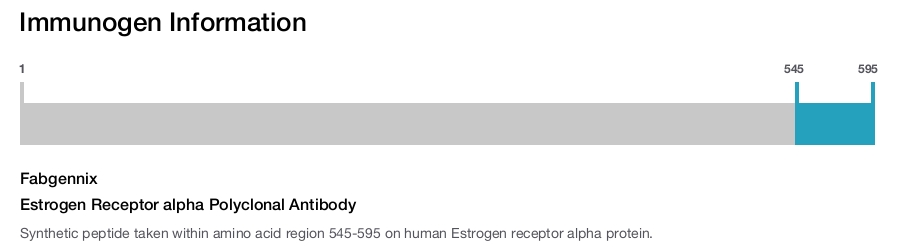
Synthetic peptide taken within amino acid region 545-595 on human Estrogen receptor alpha protein.
Conjugate
Unconjugated
Unconjugated
Unconjugated
Form
Liquid
Concentration
0.5-1.5 mg/mL
Purification
Affinity chromatography
Storage buffer
proprietary buffer, pH 7.4-7.8, with 30% glycerol, 0.5% BSA
Contains
0.02% sodium azide
Storage conditions
-20°C
Shipping conditions
Ambient (domestic); Wet ice (international)
Target Information
Estrogen Receptors (ER) are members of the steroid/thyroid hormone receptor superfamily of nuclear receptors. The estrogen receptor is a ligand-activated transcription factor, that when bound to estrogen hormone, induces a conformational change that allows dimerization and binding to estrogen response elements (ERE) in DNA. When bound to EREs, ER can positively or negatively regulate gene transcription through the recruitment of coactivator or corepressor proteins. There are two different forms of the estrogen receptor, alpha and beta, encoded by separate genes (ESR1 and ESR2, respectively). Due to alternative RNA splicing, at least 4 estrogen receptor-alpha isoforms are known to exist (Isoform 1 (66 kDa), Isoform 2 (53 kDa), Isoform 3 (47 kDa), Isoform 4 (35 kDa)). Estrogen receptors are widely expressed in different tissue types and are essential for sexual development and reproductive function. They also play a role in other tissues such as bone. Estrogen receptors are involved in pathological processes including breast cancer, endometrial cancer, and osteoporosis.
For Research Use Only. Not for use in diagnostic procedures. Not for resale without express authorization.
References (0)
Have you cited this product in a publication?
Let us know so we can reference it here.
Bioinformatics
Protein Aliases: C-terminally-truncated estrogen receptor alpha product-1; C-terminally-truncated estrogen receptor alpha product-4; C-terminally-truncated estrogen receptor alpha product-5; C-terminally-truncated estrogen receptor alpha product-6; C-terminally-truncated estrogen receptor alpha product-7; DKFZp686N23123; E2 receptor alpha; Er alpha; ER delta E7 isoform; ER-alpha; ER-alpha; del.3*,+1*,4,5,6,7* variant; ER-alpha; del.3*,4,5,6,7*/770 variant; ER-alpha; del.3*,4,5,6,7,8*/862 variant; ER-alpha; del.4*,5*,7 variant; ER-alpha; del.4*,5,6*/548 variant; ER-alpha; del.4*,5,6,7*/714 variant; ER-alpha; del.4*,5,6,7,8*/754 variant; ER-alpha; estrogen receptor alpha delta 3*,4,5,6,7*/819 cingulate gyrus isoform; ER-alpha; estrogen receptor alpha delta 3*,4,5,6,7*/833 superior frontal gyrus isoform; ER-alpha; estrogen receptor alpha delta 4*,5,6,7*/747 substantia nigra isoform; ER36; esr 1; esr-1; estradiol receptor; estrogen nuclear receptor alpha; estrogen receptor; estrogen receptor 1 (alpha); estrogen receptor alpha E1-E2-1-2; estrogen receptor alpha E1-N2-E2-1-2; estrogen receptor alpha i45aL; estrogen receptor alpha i45aS; estrogen receptor alpha i45c; estrogen receptor alpha i56a; estrogen receptor alpha i56b; estrogen receptor alpha i56c; estrogen receptor alpha i56dL; estrogen receptor alpha i56dS; estrogen receptor alpha i56e; estrogen receptor alpha variant delta 4; estrogen receptor protein; estrogen receptor-related protein; hER-alpha36; hormone receptor; lacks a part of the exon 3, exons 4-6, and part of exon 7; contains an 822 base in frame deletion; lacks most of the exon 3, exons 4-7, and part of exon 8; lacks most of the exon 4, exons 5-6, and part of exon 7; lacks the end of the exon 3, exons 4-7, and part of exon 8; MB1; nuclear receptor subfamily 3 group A member 1; oestrogen receptor alpha; receptor; RP1-130E4.1; steroid hormone receptor; trunctaed estrogen receptor product-1; unnamed protein product
Gene Aliases: ER; ER-alpha; ERa; ERalpha; ESR; ESRA; Estr; Estra; ESTRR; NR3A1; RNESTROR
UniProt ID: (Human) P03372, (Rat) P06211, (Mouse) P19785
Entrez Gene ID: (Human) 2099, (Rat) 24890, (Mouse) 13982
RNA polymerase II core promoter proximal region sequence-specific DNA binding
RNA polymerase II transcription factor activity, sequence-specific DNA binding
TFIIB-class transcription factor binding
transcription cofactor binding
transcription corepressor binding
transcription coactivator binding
transcriptional activator activity, RNA polymerase II transcription regulatory region sequence-specific binding
DNA binding
chromatin binding
transcription factor activity, sequence-specific DNA binding
steroid hormone receptor activity
RNA polymerase II transcription factor activity, ligand-activated sequence-specific DNA binding
steroid binding
protein binding
calmodulin binding
beta-catenin binding
zinc ion binding
TBP-class protein binding
enzyme binding
protein kinase binding
nitric-oxide synthase regulator activity
estrogen receptor activity
estrogen receptor binding
estrogen response element binding
identical protein binding
sequence-specific DNA binding
ATPase binding
14-3-3 protein binding
sequence-specific double-stranded DNA binding
type 1 metabotropic glutamate receptor binding
phosphatidylinositol 3-kinase regulatory subunit binding
hormone binding
macromolecular complex binding
estrogen binding
promoter-specific chromatin binding
transcription factor binding
negative regulation of transcription from RNA polymerase II promoter
chromatin remodeling
regulation of transcription, DNA-templated
regulation of transcription from RNA polymerase II promoter
signal transduction
phospholipase C-activating G-protein coupled receptor signaling pathway
positive regulation of cytosolic calcium ion concentration
negative regulation of gene expression
intracellular steroid hormone receptor signaling pathway
intracellular estrogen receptor signaling pathway
intracellular receptor signaling pathway
response to estradiol
negative regulation of smooth muscle cell apoptotic process
negative regulation of I-kappaB kinase/NF-kappaB signaling
steroid hormone mediated signaling pathway
response to estrogen
positive regulation of nitric oxide biosynthetic process
positive regulation of transcription, DNA-templated
positive regulation of transcription from RNA polymerase II promoter
stem cell differentiation
positive regulation of nitric-oxide synthase activity
RNA polymerase II transcriptional preinitiation complex assembly
protein localization to chromatin
cellular response to estrogen stimulus
cellular response to estradiol stimulus
negative regulation of pri-miRNA transcription from RNA polymerase II promoter
antral ovarian follicle growth
epithelial cell development
osteoblast development
androgen metabolic process
male gonad development
cellular response to hormone stimulus
regulation of toll-like receptor signaling pathway
regulation of apoptotic process
negative regulation of neuron apoptotic process
positive regulation of epidermal growth factor receptor signaling pathway
negative regulation of glucose import
decidualization
positive regulation of fibroblast proliferation
negative regulation of smooth muscle cell proliferation
regulation of epithelial cell proliferation
positive regulation of epithelial cell proliferation
regulation of inflammatory response
Sertoli cell development
Sertoli cell proliferation
uterus development
vagina development
prostate epithelial cord elongation
prostate epithelial cord arborization involved in prostate glandular acinus morphogenesis
regulation of branching involved in prostate gland morphogenesis
mammary gland branching involved in pregnancy
mammary gland alveolus development
epithelial cell proliferation involved in mammary gland duct elongation
positive regulation of ERK1 and ERK2 cascade
negative regulation of triglyceride metabolic process
cellular response to wortmannin
baculum development
ovarian follicle development
regulation of signal transduction
regulation of cell proliferation
negative regulation of mitotic nuclear division
prostate gland epithelium morphogenesis
cellular response to lipid
Disclaimer

Clicking the images or links will redirect you to a website hosted by BenchSci that provides third-party scientific content. Neither the content nor the BenchSci technology and processes for selection have been evaluated by us; we are providing them as-is and without warranty of any kind, including for use or application of the Thermo Fisher Scientific products presented.

Performance Guarantee
If an Invitrogen™ antibody doesn't perform as described on our website or datasheet,we'll replace the product at no cost to you, or provide you with a credit for a future purchase.*
Learn more
We're here to help
Get expert recommendations for common problems or connect directly with an on staff expert for technical assistance related to applications, equipment and general product use.
Contact tech support