Search
NeoBiotechnologies
FOLH1/PSMA (Prostate Epithelial Marker) Recombinant Rabbit Monoclonal Antibody (FOLH1/9735R)
{{$productOrderCtrl.translations['antibody.pdp.commerceCard.promotion.promotions']}}
{{$productOrderCtrl.translations['antibody.pdp.commerceCard.promotion.viewpromo']}}
{{$productOrderCtrl.translations['antibody.pdp.commerceCard.promotion.promocode']}}: {{promo.promoCode}} {{promo.promoTitle}} {{promo.promoDescription}}. {{$productOrderCtrl.translations['antibody.pdp.commerceCard.promotion.learnmore']}}
Additional Information:
{{banner.description}}

FIGURE: 1 / 4
FOLH1/PSMA (Prostate Epithelial Marker) Antibody (2346-RBM10-P1) in IHC (P)
Formalin-fixed, paraffin-embedded human prostate stained with Prostate Specific Membrane Antigen Recombinant Rabbit Monoclonal Antibody (FOLH1/9735R). Inset: PBS instead of primary antibody; secondary only negative control.


Product Details
2346-RBM10-P1
Applications
Tested Dilution
Publications
Product Specifications
Species Reactivity
Human
Host/Isotype
Rabbit
/ IgG, kappa
Expression System
CHO cells
Class
Recombinant Monoclonal
Type
Antibody
Clone
FOLH1/9735R
Immunogen
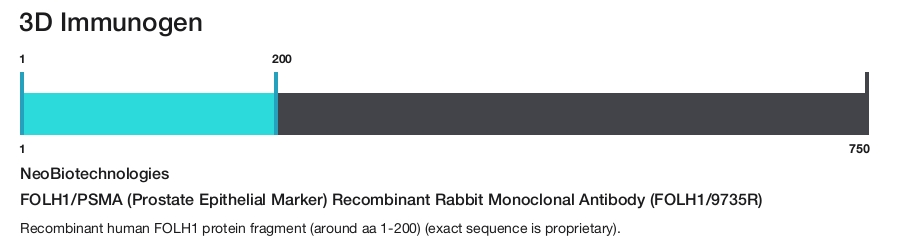
Recombinant human FOLH1 protein fragment (around aa 1-200) (exact sequence is proprietary).
Conjugate
Form
Liquid
Concentration
200 µg/mL
Amount
100 µg
Purification
Protein A
Storage buffer
PBS with 0.05% BSA
Contains
0.05% sodium azide
Storage conditions
4°C
Shipping conditions
Ambient (domestic); Wet ice (international)
Product Specific Information
Product cellular localization: Cell membrane, Cytoplasm.
Positive control: LNCap or HepG2 cells. Prostate Carcinoma.
Tissue specificity: Highly expressed in prostate epithelium. Detected in urinary bladder, kidney, testis, ovary, fallopian tube, breast, adrenal gland, liver, esophagus, stomach, small intestine, colon and brain (at protein level). Detected in the small intestine, brain, kidney, liver, spleen, colon, trachea, spinal cord and the capillary endothelium of a variety of tumors. Expressed specifically in jejunum brush border membranes. In the brain, highly expressed in the ventral striatum and brain stem. Also expressed in fetal liver and kidney. Isoform PSMA' is the most abundant form in normal prostate. Isoform PSMA-1 is the most abundant form in primary prostate tumors. Isoform PSMA-3 is also found in normal prostate as well as in brain and liver. Isoform PSMA-9 is specifically expressed in prostate cancer.
Target Information
This gene encodes a type II transmembrane glycoprotein belonging to the M28 peptidase family. The protein acts as a glutamate carboxypeptidase on different alternative substrates, including the nutrient folate and the neuropeptide N-acetyl-l-aspartyl-l-glutamate and is expressed in a number of tissues such as prostate, central and peripheral nervous system and kidney. A mutation in this gene may be associated with impaired intestinal absorption of dietary folates, resulting in low blood folate levels and consequent hyperhomocysteinemia. Expression of this protein in the brain may be involved in a number of pathological conditions associated with glutamate excitotoxicity. In the prostate the protein is up-regulated in cancerous cells and is used as an effective diagnostic and prognostic indicator of prostate cancer. This gene likely arose from a duplication event of a nearby chromosomal region. Alternative splicing gives rise to multiple transcript variants encoding several different isoforms.
For Research Use Only. Not for use in diagnostic procedures. Not for resale without express authorization.
References (0)
Have you cited this product in a publication?
Let us know so we can reference it here.
Bioinformatics
Protein Aliases: Cell growth-inhibiting gene 27 protein; FGCP; Folate hydrolase 1; Folylpoly-gamma-glutamate carboxypeptidase; GCPII; GIG27; glutamate carboxylase II; Glutamate carboxypeptidase 2; Glutamate carboxypeptidase II; glutamate carboxypeptidase II; folate hydrolase; Membrane glutamate carboxypeptidase; mGCP; N-acetylated alpha-linked acidic dipeptidase 1; N-acetylated-alpha-linked acidic dipeptidase I; NAALADase I; prostate specific membrane antigen; Prostate-specific membrane antigen; PSM; PSM-E; PSM-F; Pteroylpoly-gamma-glutamate carboxypeptidase; unnamed protein product
Gene Aliases: FGCP; FOLH; FOLH1; GCP2; GCPII; GIG27; mGCP; NAALAD1; PSM; PSMA
UniProt ID: (Human) Q04609
Entrez Gene ID: (Human) 2346
Disclaimer

Clicking the images or links will redirect you to a website hosted by BenchSci that provides third-party scientific content. Neither the content nor the BenchSci technology and processes for selection have been evaluated by us; we are providing them as-is and without warranty of any kind, including for use or application of the Thermo Fisher Scientific products presented.

Performance Guarantee
If an Invitrogen™ antibody doesn't perform as described on our website or datasheet,we'll replace the product at no cost to you, or provide you with a credit for a future purchase.*
Learn more
We're here to help
Get expert recommendations for common problems or connect directly with an on staff expert for technical assistance related to applications, equipment and general product use.
Contact tech support