Search
Bioss
LPPR4 Polyclonal Antibody
{{$productOrderCtrl.translations['antibody.pdp.commerceCard.promotion.promotions']}}
{{$productOrderCtrl.translations['antibody.pdp.commerceCard.promotion.promocode']}}: {{promo.promoCode}} {{promo.promoTitle}} {{promo.promoDescription}}. {{$productOrderCtrl.translations['antibody.pdp.commerceCard.promotion.learnmore']}}
{{$ctrl.translations['antibody.pdp.skuNotes.additionalInformation']}}:
Product Details
BS-11875R
Applications
Tested Dilution
Publications
Product Specifications
Species Reactivity
Human,
Mouse,
Rat
Host/Isotype
Rabbit
/ IgG
Class
Polyclonal
Type
Antibody
Immunogen
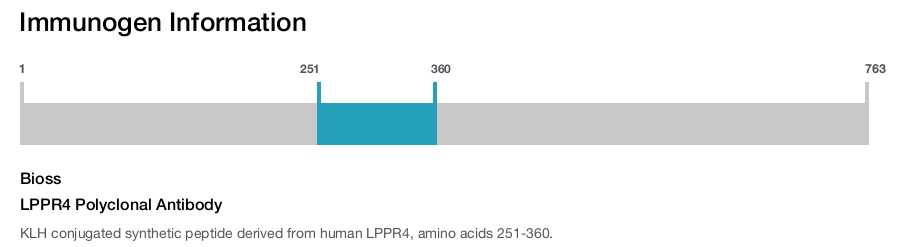
KLH conjugated synthetic peptide derived from human LPPR4, amino acids 251-360.
Conjugate
Unconjugated
Unconjugated
Unconjugated
Form
Liquid
Concentration
1 mg/mL
Amount
100 µg
Purification
Protein A
Storage buffer
0.01M TBS, pH 7.4, with 1% BSA, 50% glycerol
Contains
0.02% ProClin 300
Storage conditions
-20°C
Shipping conditions
Ambient (domestic); Wet ice (international)
Target Information
Phospholipid-mediated signalling on neurons provokes diverse responses such as neurogenesis, pattern formation and neurite remodelling. A recently uncovered novel set of molecules in the mammalian brain, named plasticity-related genes (PRGs) mediate lipid phosphate phosphatase activity and provide evidence for their involvement in mechanisms of neuronal plasticity.
For Research Use Only. Not for use in diagnostic procedures. Not for resale without express authorization.
References (0)
Have you cited this product in a publication?
Let us know so we can reference it here.
Bioinformatics
Protein Aliases: 2-lysophosphatidate phosphatase PLPPR4; brain-specific phosphatidic acid phosphatase-like protein 1; ecto-phosphatase; inactive 2-lysophosphatidate phosphatase PLPPR4; lipid phosphate phosphatase-related protein type 4; PHP1; membrane protein; N-terminus similar to PAP-2 family of phosphatidic acid phosphatases; contains C-terminal cytoplasmic domain; plasticity related gene 1; plasticity-related gene 1 protein; PRG1; RP4-788L13.1; unnamed protein product
Gene Aliases: A330086D10; D3Bwg0562e; LPPR4; LPR4; mKIAA0455; PHP1; PRG-1; PRG1
UniProt ID: (Human) Q7Z2D5, (Mouse) Q7TME0
Entrez Gene ID: (Human) 9890, (Rat) 295401, (Mouse) 229791
phospholipid metabolic process
signal transduction
G-protein coupled receptor signaling pathway
axonogenesis
phospholipid dephosphorylation
inner ear development
modulation of synaptic transmission
regulation of synaptic transmission, glutamatergic
regulation of postsynapse organization
lipid import into cell
Disclaimer

Clicking the images or links will redirect you to a website hosted by BenchSci that provides third-party scientific content. Neither the content nor the BenchSci technology and processes for selection have been evaluated by us; we are providing them as-is and without warranty of any kind, including for use or application of the Thermo Fisher Scientific products presented.

Performance Guarantee
If an Invitrogen™ antibody doesn't perform as described on our website or datasheet,we'll replace the product at no cost to you, or provide you with a credit for a future purchase.*
Learn more
We're here to help
Get expert recommendations for common problems or connect directly with an on staff expert for technical assistance related to applications, equipment and general product use.
Contact tech support