Search
Invitrogen
PINK1 Polyclonal Antibody
{{$productOrderCtrl.translations['antibody.pdp.commerceCard.promotion.promotions']}}
{{$productOrderCtrl.translations['antibody.pdp.commerceCard.promotion.promocode']}}: {{promo.promoCode}} {{promo.promoTitle}} {{promo.promoDescription}}. {{$productOrderCtrl.translations['antibody.pdp.commerceCard.promotion.learnmore']}}
{{$ctrl.translations['antibody.pdp.skuNotes.additionalInformation']}}:

FIGURE: 1 / 4
PINK1 Antibody (PA5-13402) in IHC (P)
Immunohistochemistry analysis of PINK1 in formalin-fixed and paraffin-embedded human cancer tissue. Samples were incubated with PINK1 polyclonal antibody (Product # PA5-13402) which was peroxidase-conjugated to the secondary antibody, followed by AEC staining. This data demonstrates the use of this antibody for immunohistochemistry; clinical relevance has not been evaluated. BC = breast carcinoma; HC = hepa... View More


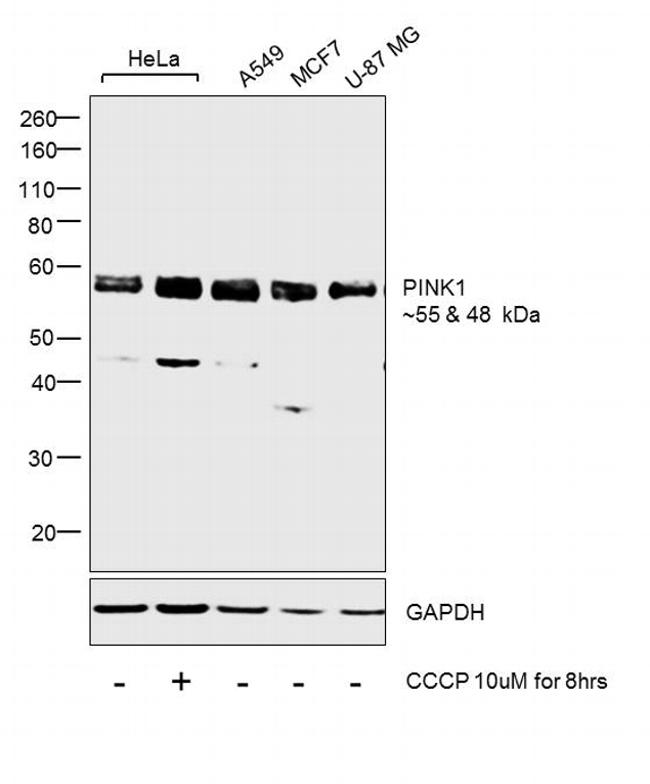
Please note: We are reviewing Western blot images included in the antibody testing data in our catalog, including those provided by third parties. Unless expressly labeled or annotated as “raw-unedited”, Western blot images included in the antibody testing data in our catalog may have been edited, optimized or otherwise adjusted for presentation.


Product Details
PA5-13402
Applications
Tested Dilution
Publications
Product Specifications
Species Reactivity
Human
Published species
Human
Host/Isotype
Rabbit
/ IgG
Class
Polyclonal
Type
Antibody
Immunogen
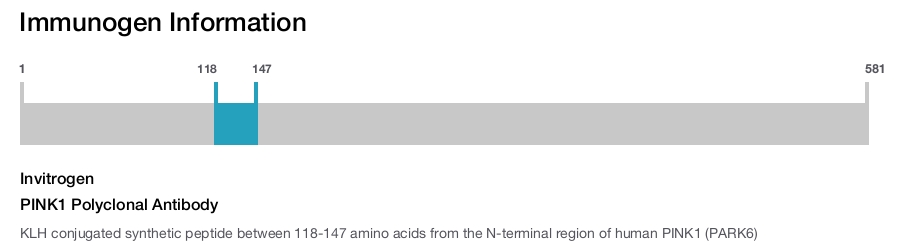
KLH conjugated synthetic peptide between 118-147 amino acids from the N-terminal region of human PINK1 (PARK6)
Conjugate
Unconjugated
Unconjugated
Unconjugated
Form
Liquid
Concentration
2 mg/mL
Amount
800 µg
Purification
Size-exclusion - Dialysis, Ammonium sulfate precipitation
Storage buffer
PBS, pH 7.4
Contains
0.09% sodium azide
Storage conditions
Store at 4°C short term. For long term storage, store at -20°C, avoiding freeze/thaw cycles.
Shipping conditions
Ambient (domestic); Wet ice (international)
RRID
Target Information
PINK1 (PTEN-induced putative kinase 1) protects from mitochondrial dysfunction in cells by conferring different autophosphorylation activity to mitochondrial genes. The kinase domain of PINK1 appears to be critical in its protective effects. Mitochondrial proteins are critical for the regulation of cellular energy and adaptation to stress. Particularly in brain cells, mitochondrial demand is extraordinarily high, in order to accommodate aerobic and anaerobic support of high energy processes. When mitochondrial structure and/or function is disrupted in the brain, neurodegenerative diseases like Parkinson's disease are triggered.
For Research Use Only. Not for use in diagnostic procedures. Not for resale without express authorization.
Bioinformatics
Protein Aliases: FLJ27236; PINK 1; PINK-1; protein kinase BRPK; PTEN induced putative kinase 1; PTEN-induced putative kinase protein 1; unnamed protein product
Gene Aliases: BRPK; PARK6
UniProt ID: (Human) Q9BXM7
Entrez Gene ID: (Human) 65018
magnesium ion binding
protease binding
protein kinase activity
protein serine/threonine kinase activity
protein binding
ATP binding
kinase activity
peptidase activator activity
kinase binding
ubiquitin protein ligase binding
protein kinase B binding
macromolecular complex binding
C3HC4-type RING finger domain binding
protein serine kinase activity
mitophagy
mitophagy
regulation of oxidative phosphorylation
response to ischemia
protein phosphorylation
ubiquitin-dependent protein catabolic process
response to stress
response to oxidative stress
mitochondrion organization
regulation of hydrogen peroxide metabolic process
negative regulation of gene expression
regulation of mitochondrion organization
macroautophagy
positive regulation of macroautophagy
negative regulation of macroautophagy
protein ubiquitination
respiratory electron transport chain
hemopoiesis
positive regulation of cell migration
regulation of protein ubiquitination
positive regulation of protein ubiquitination
cellular response to oxidative stress
intracellular signal transduction
TORC2 signaling
regulation of apoptotic process
negative regulation of apoptotic process
positive regulation of I-kappaB kinase/NF-kappaB signaling
regulation of protein complex assembly
regulation of neuron apoptotic process
negative regulation of neuron apoptotic process
positive regulation of translation
positive regulation of transcription from RNA polymerase II promoter
negative regulation of JNK cascade
protein stabilization
regulation of mitochondrial membrane potential
positive regulation of protein kinase B signaling
regulation of proteasomal protein catabolic process
protein localization to mitochondrion
cellular response to hypoxia
maintenance of protein location in mitochondrion
positive regulation of mitochondrial fission
positive regulation of release of cytochrome c from mitochondria
negative regulation of mitochondrial fission
cellular response to toxic substance
mitochondrion to lysosome transport
regulation of cellular response to oxidative stress
negative regulation of macromitophagy
regulation of synaptic vesicle transport
negative regulation of autophagosome assembly
positive regulation of mitochondrial electron transport, NADH to ubiquinone
regulation of mitophagy
negative regulation of hypoxia-induced intrinsic apoptotic signaling pathway
negative regulation of oxidative stress-induced neuron intrinsic apoptotic signaling pathway
negative regulation of hydrogen peroxide-induced neuron intrinsic apoptotic signaling pathway
regulation of protein localization to mitochondrion
positive regulation of establishment of protein localization to mitochondrion
negative regulation of intrinsic apoptotic signaling pathway in response to hydrogen peroxide
positive regulation of cristae formation
positive regulation of free ubiquitin chain polymerization
cellular response to hydrogen sulfide
positive regulation of type 2 mitophagy
regulation of reactive oxygen species metabolic process
negative regulation of reactive oxygen species metabolic process
positive regulation of ATP biosynthetic process
negative regulation of intrinsic apoptotic signaling pathway
Disclaimer

Clicking the images or links will redirect you to a website hosted by BenchSci that provides third-party scientific content. Neither the content nor the BenchSci technology and processes for selection have been evaluated by us; we are providing them as-is and without warranty of any kind, including for use or application of the Thermo Fisher Scientific products presented.

Performance Guarantee
If an Invitrogen™ antibody doesn't perform as described on our website or datasheet,we'll replace the product at no cost to you, or provide you with a credit for a future purchase.*
Learn more
We're here to help
Get expert recommendations for common problems or connect directly with an on staff expert for technical assistance related to applications, equipment and general product use.
Contact tech support