Search
Invitrogen
Phospho-ASAP2 (Ser701) Polyclonal Antibody
{{$productOrderCtrl.translations['antibody.pdp.commerceCard.promotion.promotions']}}
{{$productOrderCtrl.translations['antibody.pdp.commerceCard.promotion.viewpromo']}}
{{$productOrderCtrl.translations['antibody.pdp.commerceCard.promotion.promocode']}}: {{promo.promoCode}} {{promo.promoTitle}} {{promo.promoDescription}}. {{$productOrderCtrl.translations['antibody.pdp.commerceCard.promotion.learnmore']}}
Additional Information:
{{banner.description}}
Product Details
PA5-64752
Product Specifications
Host/Isotype
Rabbit
/ IgG
Class
Polyclonal
Type
Antibody
Immunogen
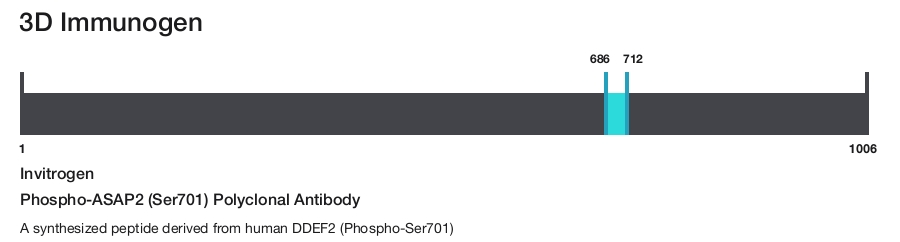
A synthesized peptide derived from human DDEF2 (Phospho-Ser701)
Conjugate
Form
Liquid
Concentration
1 mg/mL
Amount
100 µg
Storage conditions
-20°C
Shipping conditions
Wet ice
RRID
Product Specific Information
Phospho-PAG3 (Ser701) Polyclonal Antibody detects endogenous levels of PAG3 only when phosphorylated at Ser701.
Target Information
ASAP2 is a multidomain protein belonging to the beta family with two ANK repeats, an Arf-GAP domain, a PH domain and a SH3 domain. This protein localizes in the Golgi apparatus and also at the plasma membrane where it colocalizes with protein tyrosine kinase 2-beta (PYK2) and forms a stable complex with PYK2 in vivo. ASAP2 is tyrosine phosphorylated by activated PYK2. It functions as a substrate and downstream target for PYK2 and SRC, a pathway that may be involved in the regulation of vesicular transport. ASAP2 activates the small GTPases ARF1, ARF5 and ARF6 and regulates the formation of post-Golgi vesicles and modulates constitutive secretion. It modulates phagocytosis mediated by Fc gamma receptor and ARF6. Usually detected in heart, brain, placenta, kidney, monocytes and pancreas, it is up-regulated during monocyte maturation. Multiple transcript variants encoding different isoforms have been found.
For Research Use Only. Not for use in diagnostic procedures. Not for resale without express authorization.
References (0)
Have you cited this product in a publication?
Let us know so we can reference it here.
Disclaimer

Clicking the images or links will redirect you to a website hosted by BenchSci that provides third-party scientific content. Neither the content nor the BenchSci technology and processes for selection have been evaluated by us; we are providing them as-is and without warranty of any kind, including for use or application of the Thermo Fisher Scientific products presented.

Performance Guarantee
If an Invitrogen™ antibody doesn't perform as described on our website or datasheet,we'll replace the product at no cost to you, or provide you with a credit for a future purchase.*
Learn more
We're here to help
Get expert recommendations for common problems or connect directly with an on staff expert for technical assistance related to applications, equipment and general product use.
Contact tech support