Search
Invitrogen
RARA/RARB/RARG Recombinant Rabbit Monoclonal Antibody (PSH08-74)
{{$productOrderCtrl.translations['antibody.pdp.commerceCard.promotion.promotions']}}
{{$productOrderCtrl.translations['antibody.pdp.commerceCard.promotion.promocode']}}: {{promo.promoCode}} {{promo.promoTitle}} {{promo.promoDescription}}. {{$productOrderCtrl.translations['antibody.pdp.commerceCard.promotion.learnmore']}}
{{$ctrl.translations['antibody.pdp.skuNotes.additionalInformation'] || 'Additional Information'}}:
{{$ctrl.translations['antibody.pdp.skuNotes.additionalInformation']}}:
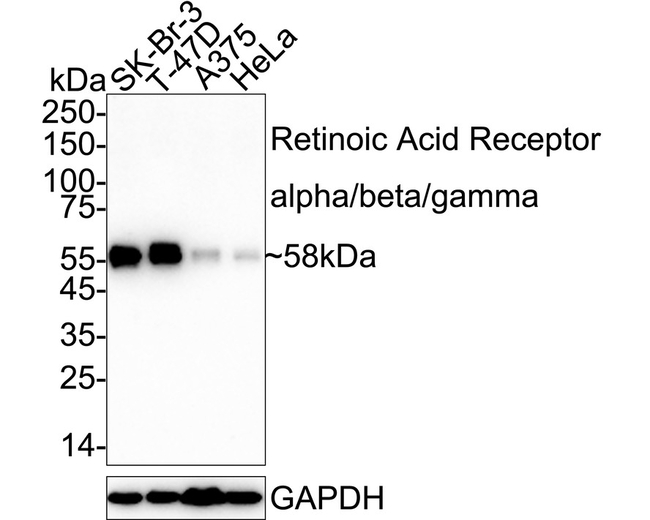
FIGURE: 1 / 3
RARA/RARB/RARG Antibody (MA570053) in WB
Western blot analysis of RARA/RARB/RARG in various lysates. Samples were incubated with RARA/RARB/RARG monoclonal antibody (Product # MA570053) using a dilution of 1:1,000 in 5% NFDM/TBST at 4°C overnight followed by Goat Anti-Rabbit IgG - HRP Secondary Antibody at a dilution of 1:50,000 for 1 hour at room temperature. Lane 1: SK-Br-3 cell lysate; Lane 2: T-47D cell lysate; Lane 3: A375 cell lysate; Lane 4: HeLa cell lysate. Lysates/proteins at 20 µg/Lane. Predicted band size: 50 kDa; Observed band size: 58 kDa. Exposure time: 3 minutes; E... View More
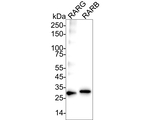
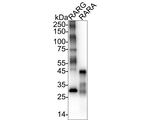
Please note: We are reviewing Western blot images included in the antibody testing data in our catalog, including those provided by third parties. Unless expressly labeled or annotated as “raw-unedited”, Western blot images included in the antibody testing data in our catalog may have been edited, optimized or otherwise adjusted for presentation.


Product Details
MA570053
Product Specifications
Species Reactivity
Human
Host/Isotype
Rabbit
/ IgG
Expression System
HEK293 cells
Class
Recombinant Monoclonal
Type
Antibody
Clone
PSH08-74
Immunogen
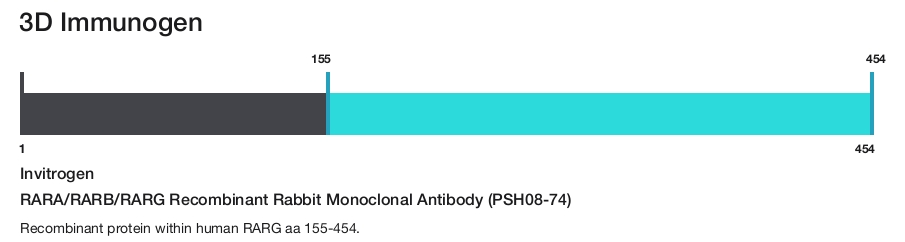
Recombinant protein within human RARG aa 155-454.
Conjugate
Unconjugated
Unconjugated
Unconjugated
Form
Liquid
Concentration
1 mg/mL
Amount
100 µg
Purification
Protein A
Storage buffer
PBS, pH 7.4, with 0.1% BSA, 40% glycerol
Contains
0.05% sodium azide
Storage conditions
Store at 4°C short term. For long term storage, store at -20°C, avoiding freeze/thaw cycles.
Shipping conditions
Ambient (domestic); Wet ice (international)
Product Specific Information
Positive control: SK-Br-3 cell lysate, T-47D cell lysate, A375 cell lysate, HeLa cell lysate.
Subcellular location: Nucleus, Cytoplasm.
Target Information
All three genes are part of the nuclear receptor family and are crucial in regulating cell growth, differentiation, and apoptosis. They share structural similarities, including a DNA-binding domain and a ligand-binding domain, allowing them to bind to specific DNA sequences and regulate target gene expression. RARA (Retinoic Acid Receptor Alpha) is a nuclear receptor that mediates the effects of retinoic acid (a metabolite of vitamin A) by regulating gene transcription. It is located on chromosome 17q21.2. RARB (Retinoic Acid Receptor Beta) also functions as a nuclear receptor for retinoic acid and is involved in gene activation. It is located on chromosome 3p24. RARG (Retinoic Acid Receptor Gamma) plays a similar role in mediating retinoic acid effects and is found on chromosome 12q13.
For Research Use Only. Not for use in diagnostic procedures. Not for resale without express authorization.
References (0)
Have you cited this product in a publication?
Let us know so we can reference it here.
Bioinformatics
Protein Aliases: HBV-activated protein; hepatitis B virus activated protein; nuclear receptor; nuclear receptor subfamily 1 group B member 1; nuclear receptor subfamily 1 group B member 2; nuclear receptor subfamily 1 group B member 3; nuclear receptor; RAR beta; nucleophosmin-retinoic acid receptor alpha fusion protein NPM-RAR long form; open reading frame 1; putative; PML gene product; PML-DDX5-RARA fusion; PML-DDX5-RARA fusion protein; RAR beta 1'; RAR-alpha; RAR-beta; RAR-epsilon; RAR-gamma; RARA; RARB; RARbeta isoform 5; retinoic acid receptor gamma; retinoic acid receptor gamma 2; retinoic acid receptor, alpha polypeptide; retinoic acid receptor, beta polypeptide; TTMV/RARA fusion; TTMV/RARA fusion protein; unnamed protein product
Gene Aliases: HAP; MCOPS12; NR1B1; NR1B2; NR1B3; RAR; RARalpha; RARbeta; RARbeta1; RARC; RARgamma; RRB2
UniProt ID: (Human) P10276, (Human) P10826, (Human) P13631
Entrez Gene ID: (Human) 5914, (Human) 5915, (Human) 5916
translation repressor activity, nucleic acid binding
transcription regulatory region sequence-specific DNA binding
RNA polymerase II regulatory region sequence-specific DNA binding
RNA polymerase II core promoter proximal region sequence-specific DNA binding
RNA polymerase II transcription factor activity, sequence-specific DNA binding
bacterial-type RNA polymerase transcriptional repressor activity, sequence-specific DNA binding
transcription coactivator binding
retinoic acid binding
DNA binding
chromatin binding
transcription factor activity, sequence-specific DNA binding
RNA polymerase II transcription factor activity, ligand-activated sequence-specific DNA binding
receptor binding
protein binding
zinc ion binding
enzyme binding
protein domain specific binding
chromatin DNA binding
histone deacetylase binding
protein kinase B binding
sequence-specific DNA binding
retinoic acid-responsive element binding
mRNA 5'-UTR binding
protein kinase A binding
alpha-actinin binding
heterocyclic compound binding
sequence-specific double-stranded DNA binding
retinoid X receptor binding
negative regulation of transcription from RNA polymerase II promoter
liver development
regulation of transcription, DNA-templated
protein phosphorylation
germ cell development
female pregnancy
positive regulation of cell proliferation
negative regulation of cell proliferation
male gonad development
positive regulation of gene expression
negative regulation of translation
hippocampus development
cell differentiation
prostate gland development
negative regulation of granulocyte differentiation
regulation of myelination
response to estradiol
response to retinoic acid
negative regulation of interferon-gamma production
negative regulation of tumor necrosis factor production
positive regulation of interleukin-13 production
positive regulation of interleukin-4 production
positive regulation of interleukin-5 production
response to vitamin A
response to cytokine
mRNA transcription from RNA polymerase II promoter
regulation of apoptotic process
apoptotic cell clearance
response to ethanol
positive regulation of T-helper 2 cell differentiation
positive regulation of neuron differentiation
positive regulation of cell cycle
negative regulation of transcription, DNA-templated
positive regulation of transcription, DNA-templated
positive regulation of transcription from RNA polymerase II promoter
regulation of synaptic plasticity
retinoic acid receptor signaling pathway
positive regulation of binding
Sertoli cell fate commitment
cellular response to lipopolysaccharide
cellular response to retinoic acid
cellular response to estrogen stimulus
negative regulation of pri-miRNA transcription from RNA polymerase II promoter
chondrocyte development
growth plate cartilage chondrocyte growth
regulation of cell size
embryonic hindlimb morphogenesis
positive regulation of apoptotic process
positive regulation of programmed cell death
embryonic eye morphogenesis
canonical Wnt signaling pathway
limb development
bone development
signal transduction
embryonic digestive tract development
Disclaimer

Clicking the images or links will redirect you to a website hosted by BenchSci that provides third-party scientific content. Neither the content nor the BenchSci technology and processes for selection have been evaluated by us; we are providing them as-is and without warranty of any kind, including for use or application of the Thermo Fisher Scientific products presented.

Performance Guarantee
If an Invitrogen™ antibody doesn't perform as described on our website or datasheet,we'll replace the product at no cost to you, or provide you with a credit for a future purchase.*
Learn more
We're here to help
Get expert recommendations for common problems or connect directly with an on staff expert for technical assistance related to applications, equipment and general product use.
Contact tech support