Search
Invitrogen
SIRT1 Polyclonal Antibody
{{$productOrderCtrl.translations['antibody.pdp.commerceCard.promotion.promotions']}}
{{$productOrderCtrl.translations['antibody.pdp.commerceCard.promotion.viewpromo']}}
{{$productOrderCtrl.translations['antibody.pdp.commerceCard.promotion.promocode']}}: {{promo.promoCode}} {{promo.promoTitle}} {{promo.promoDescription}}. {{$productOrderCtrl.translations['antibody.pdp.commerceCard.promotion.learnmore']}}
Additional Information:
{{banner.description}}

FIGURE: 1 / 6
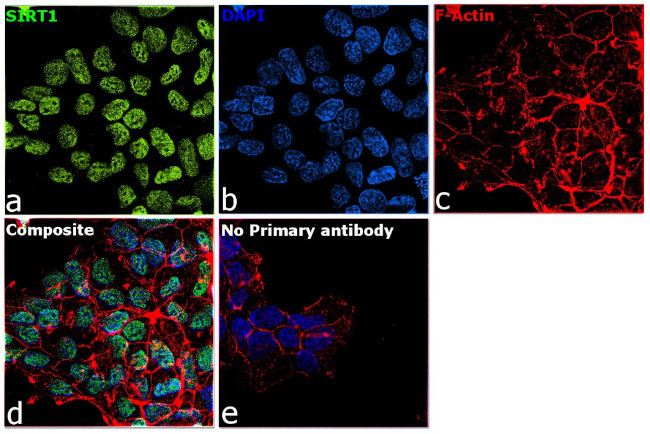
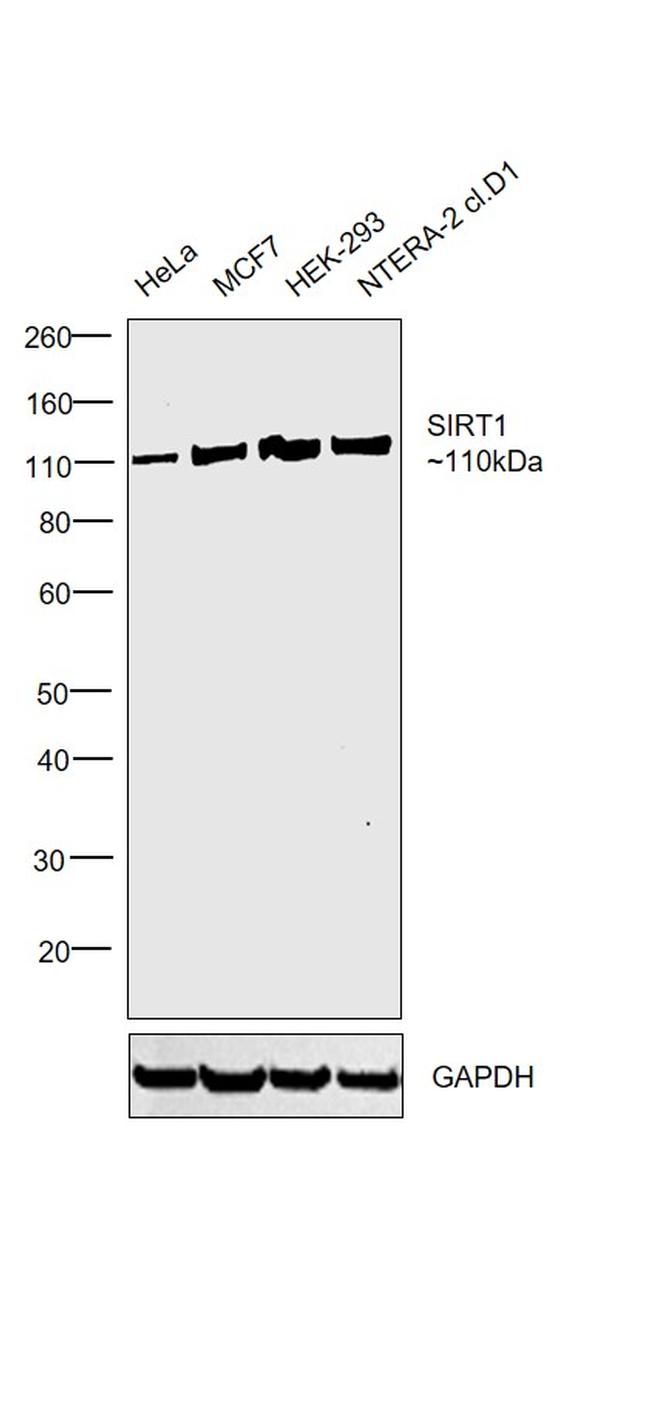
SIRT1 Antibody (PA5-17232) in ICC/IF
Immunofluorescence analysis of SIRT1 was performed using 70% confluent log phase HEK-293 cells. The cells were fixed with 4% paraformaldehyde for 10 minutes, permeabilized with 0.1% Triton™ X-100 for 15 minutes, and blocked with 2% BSA for 1 hour at room temperature. The cells were labeled with SIRT1 Polyclonal Antibody (Product # PA5-17232) at 1:100 dilution in 0.1% BSA, incubated at 4 degree Celsius overnight and then labeled with Donkey anti-Rabbit IgG (H+L) Highly Cross-Adsorbed Secondary Antibody, Alexa Fluor Plus 488 (Product # A3279... View More





Product Details
PA5-17232
Applications
Tested Dilution
Publications
Product Specifications
Species Reactivity
Human,
Non-human primate
Host/Isotype
Rabbit
/ IgG
Class
Polyclonal
Type
Antibody
Immunogen
Synthetic peptide corresponding to the carboxy terminus of human SirT1
Conjugate
Form
Liquid
Concentration
21 µg/mL
Amount
2.1 µg
Purification
Antigen affinity chromatography, Protein A
Storage buffer
0.01M HEPES, pH 7.5, with 0.15M NaCl, 100µg/mL BSA, 50% glycerol
Contains
no preservative
Storage conditions
-20°C
Shipping conditions
Ambient (domestic); Wet ice (international)
RRID
Product Specific Information
It is not recommended to aliquot this antibody.
This antibody is not cross-reactive with other sirtuin proteins.
Target Information
NAD-dependent protein deacetylase sirtuin-1 (SIRT1) links transcriptional regulation directly to intracellular energetics and participates in the coordination of several separated cellular functions such as cell cycle, repsonse to DNA damage, metabolism, apoptosis, and autophagy. SIRT1 can modulate chromatin function through deacetylation of histones and can promote alterations in the methylation of histone and DNA, leading to transcriptional repression. It is essential in skeletal muscle cell differentiation and in response to low nutrients mediates the inhibitory effect on skeletal myoblast differentiation which also involves 5'-AMP-activated protein kinase (AMPK) and nicotinamide phosphoribosyltransferase (NAMPT).
For Research Use Only. Not for use in diagnostic procedures. Not for resale without express authorization.
Bioinformatics
Protein Aliases: domain has histone deacetylase activity; hSIR2; hSIRT1; NAD-dependent protein deacetylase sirtuin-1; NAD-dependent protein deacylase sirtuin-1; OTTHUMP00000198111; OTTHUMP00000198112; Regulatory protein SIR2 homolog 1; RP11-57G10.3; SIR2-like protein 1; SIRT 1; SIRT-1; sirtuin type 1; unnamed protein product; yeast silent information regulator 2 (Sir2p) homolog
Gene Aliases: SIR2; SIR2alpha; SIR2L1; SIRT1
UniProt ID: (Human) Q96EB6
Entrez Gene ID: (Human) 23411
RNA polymerase II core promoter proximal region sequence-specific DNA binding
p53 binding
transcription coactivator activity
transcription corepressor activity
NAD+ ADP-ribosyltransferase activity
histone deacetylase activity
enzyme inhibitor activity
protein binding
enzyme activator activity
transferase activity
ligand-dependent nuclear receptor binding
NAD-dependent histone deacetylase activity
deacetylase activity
enzyme binding
protein domain specific binding
NAD-dependent histone deacetylase activity (H3-K14 specific)
protein deacetylase activity
NAD-dependent protein deacetylase activity
histone binding
identical protein binding
HLH domain binding
bHLH transcription factor binding
metal ion binding
NAD-dependent histone deacetylase activity (H3-K9 specific)
NAD-dependent histone deacetylase activity (H4-K16 specific)
mitogen-activated protein kinase binding
NAD+ binding
NAD-dependent protein-lysine depropionylase activity
DNA-binding transcription factor binding
transcription regulator inhibitor activity
histone H4K12 deacetylase activity, hydrolytic mechanism
histone H3K deacetylase activity
NAD-dependent protein lysine delactylase activity
NAD-dependent protein decrotonylase activity
NAD-dependent histone decrotonylase activity
keratin filament binding
protein ADP-ribosylase activity
promoter-specific chromatin binding
single strand break repair
negative regulation of transcription from RNA polymerase II promoter
chromatin silencing at rDNA
pyrimidine dimer repair by nucleotide-excision repair
DNA synthesis involved in DNA repair
angiogenesis
ovulation from ovarian follicle
cellular glucose homeostasis
positive regulation of protein phosphorylation
positive regulation of endothelial cell proliferation
positive regulation of adaptive immune response
gluconeogenesis
chromatin organization
methylation-dependent chromatin silencing
protein deacetylation
triglyceride mobilization
apoptotic process
cellular response to DNA damage stimulus
response to oxidative stress
transforming growth factor beta receptor signaling pathway
spermatogenesis
regulation of mitotic cell cycle
muscle organ development
circadian rhythm
positive regulation of cell proliferation
intrinsic apoptotic signaling pathway in response to DNA damage
cellular response to starvation
negative regulation of gene expression
regulation of centrosome duplication
negative regulation of triglyceride biosynthetic process
positive regulation of cholesterol efflux
regulation of lipid storage
regulation of glucose metabolic process
positive regulation of macroautophagy
protein ubiquitination
peptidyl-lysine acetylation
triglyceride biosynthetic process
cell differentiation
macrophage differentiation
negative regulation of transforming growth factor beta receptor signaling pathway
endoplasmic reticulum unfolded protein response
negative regulation of prostaglandin biosynthetic process
heterochromatin assembly
telomeric heterochromatin assembly
protein destabilization
negative regulation of TOR signaling
regulation of endodeoxyribonuclease activity
negative regulation of NF-kappaB transcription factor activity
positive regulation of proteasomal ubiquitin-dependent protein catabolic process
response to insulin
circadian regulation of gene expression
leptin-mediated signaling pathway
regulation of smooth muscle cell apoptotic process
hippo signaling
negative regulation of hippo signaling
cellular triglyceride homeostasis
regulation of peroxisome proliferator activated receptor signaling pathway
regulation of cell proliferation
cellular response to glucose starvation
negative regulation of phosphorylation
response to hydrogen peroxide
behavioral response to starvation
cholesterol homeostasis
intrinsic apoptotic signaling pathway in response to DNA damage by p53 class mediator
regulation of apoptotic process
positive regulation of apoptotic process
negative regulation of apoptotic process
negative regulation of I-kappaB kinase/NF-kappaB signaling
proteasome-mediated ubiquitin-dependent protein catabolic process
negative regulation of DNA damage response, signal transduction by p53 class mediator
negative regulation of neuron apoptotic process
positive regulation of blood vessel endothelial cell migration
response to leptin
positive regulation of MHC class II biosynthetic process
negative regulation of fat cell differentiation
positive regulation of gluconeogenesis
positive regulation of DNA repair
positive regulation of angiogenesis
negative regulation of cell cycle
negative regulation of transcription, DNA-templated
positive regulation of transcription from RNA polymerase II promoter
regulation of transcription by glucose
positive regulation of insulin receptor signaling pathway
regulation of lipid biosynthetic process
rhythmic process
regulation of developmental process
white fat cell differentiation
positive regulation of smooth muscle cell differentiation
regulation of multicellular organismal process
attachment of mitotic spindle microtubules to kinetochore
maintenance of nucleus location
positive regulation of protein kinase B signaling
negative regulation of protein kinase B signaling
fatty acid homeostasis
negative regulation of androgen receptor signaling pathway
positive regulation of macrophage cytokine production
positive regulation of small molecule metabolic process
cellular response to hydrogen peroxide
regulation of bile acid biosynthetic process
UV-damage excision repair
cellular response to tumor necrosis factor
cellular response to hypoxia
cellular response to ionizing radiation
signal transduction by p53 class mediator
tricarboxylic acid metabolic process
regulation of brown fat cell differentiation
stress-induced premature senescence
energy homeostasis
protein depropionylation
DNA repair-dependent chromatin remodeling
regulation of cellular response to heat
negative regulation of signal transduction by p53 class mediator
negative regulation of protein acetylation
negative regulation of intrinsic apoptotic signaling pathway in response to DNA damage by p53 class mediator
negative regulation of oxidative stress-induced intrinsic apoptotic signaling pathway
positive regulation of endoplasmic reticulum stress-induced intrinsic apoptotic signaling pathway
negative regulation of attachment of mitotic spindle microtubules to kinetochore
positive regulation of adipose tissue development
cellular response to leukemia inhibitory factor
positive regulation of macrophage apoptotic process
positive regulation of cAMP-dependent protein kinase activity
negative regulation of cellular response to testosterone stimulus
negative regulation of peptidyl-lysine acetylation
negative regulation of cellular senescence
positive regulation of cellular senescence
positive regulation of double-strand break repair
Disclaimer

Clicking the images or links will redirect you to a website hosted by BenchSci that provides third-party scientific content. Neither the content nor the BenchSci technology and processes for selection have been evaluated by us; we are providing them as-is and without warranty of any kind, including for use or application of the Thermo Fisher Scientific products presented.

Performance Guarantee
If an Invitrogen™ antibody doesn't perform as described on our website or datasheet,we'll replace the product at no cost to you, or provide you with a credit for a future purchase.*
Learn more
We're here to help
Get expert recommendations for common problems or connect directly with an on staff expert for technical assistance related to applications, equipment and general product use.
Contact tech support