Search
Fabgennix
STAT3 Polyclonal Antibody
{{$productOrderCtrl.translations['antibody.pdp.commerceCard.promotion.promotions']}}
{{$productOrderCtrl.translations['antibody.pdp.commerceCard.promotion.promocode']}}: {{promo.promoCode}} {{promo.promoTitle}} {{promo.promoDescription}}. {{$productOrderCtrl.translations['antibody.pdp.commerceCard.promotion.learnmore']}}
{{$ctrl.translations['antibody.pdp.skuNotes.additionalInformation']}}:


Please note: We are reviewing Western blot images included in the antibody testing data in our catalog, including those provided by third parties. Unless expressly labeled or annotated as “raw-unedited”, Western blot images included in the antibody testing data in our catalog may have been edited, optimized or otherwise adjusted for presentation.

Product Details
STAT3-301AP
Applications
Tested Dilution
Publications
Product Specifications
Species Reactivity
Human,
Mouse,
Rat
Host/Isotype
Rabbit
/ IgG
Class
Polyclonal
Type
Antibody
Immunogen
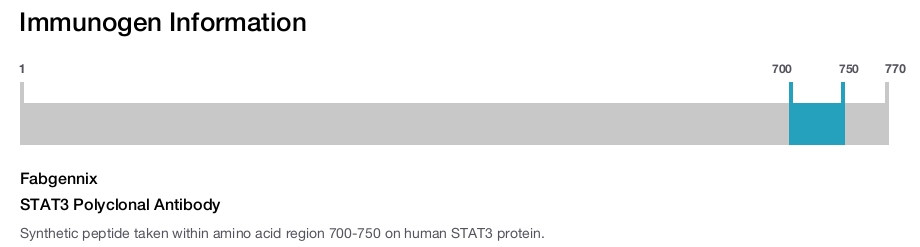
Synthetic peptide taken within amino acid region 700-750 on human STAT3 protein.
Conjugate
Unconjugated
Unconjugated
Unconjugated
Form
Liquid
Concentration
0.5-1.5 mg/mL
Purification
Affinity chromatography
Storage buffer
proprietary buffer, pH 7.4-7.8, with 0.5% BSA, 30% glycerol
Contains
0.02% sodium azide
Storage conditions
-20°C
Shipping conditions
Ambient (domestic); Wet ice (international)
Target Information
STAT3 belongs to the family of STAT (signal transducers and activators of transcription) proteins which are phosphorylated by receptor associated kinases, translocate to the nucleus, and act as transcription factors in response to cytokines and growth factors. Coactivators such as CREB-binding protein are required for the transcriptional activation by STAT3. STAT3 can also be activated by Interferon-alpha, Interferon-gamma, EGF, PDGF and IL6. Phosphorylation on tyrosine 705 by JAK1 and JAK2 is essential for STAT3 dimer formation, nuclear translocation, and DNA binding activity. In humans, the STAT3 gene is located on the q arm of chromosome 17. STAT3 has been shown to be activated by IFN-alpha but not IFN-beta. The transcription factors associated with STAT3 are c-Jun and cyclic AMP-responsive enhancer binding protein (CREB). STAT3 mediates the expression of a variety of genes in response to cell stimuli, and thus plays a key role in many cellular processes such as cell growth and apoptosis. The small GTPase Rac1 has been shown to bind and regulate the activity of STAT3 while the PIAS3 protein is a specific inhibitor of STAT3. Three alternatively spliced transcript variants encoding distinct isoforms of STAT3 have been described. Deletion of the STAT3 gene in knock-out mice was lethal at the early embryonic stage.
For Research Use Only. Not for use in diagnostic procedures. Not for resale without express authorization.
References (0)
Have you cited this product in a publication?
Let us know so we can reference it here.
Bioinformatics
Protein Aliases: acute phase response factor; acute-phase response factor; DNA-binding protein APRF; FLJ20882; MGC16063; signal transducer and activator of transcription 3 (acute-phase response factor); STAT; Stat3; transcription factor; unnamed protein product
Gene Aliases: 1110034C02Rik; ADMIO; ADMIO1; APRF; HIES
UniProt ID: (Human) P40763, (Mouse) P42227, (Rat) P52631
Entrez Gene ID: (Human) 6774, (Mouse) 20848, (Rat) 25125
transcription regulatory region sequence-specific DNA binding
RNA polymerase II core promoter proximal region sequence-specific DNA binding
RNA polymerase II transcription factor activity, sequence-specific DNA binding
transcriptional activator activity, RNA polymerase II transcription regulatory region sequence-specific binding
DNA binding
transcription factor activity, sequence-specific DNA binding
RNA binding
RNA polymerase II transcription factor activity, ligand-activated sequence-specific DNA binding
receptor binding
protein binding
protein kinase binding
protein phosphatase binding
chromatin DNA binding
CCR5 chemokine receptor binding
glucocorticoid receptor binding
signaling adaptor activity
identical protein binding
protein homodimerization activity
sequence-specific DNA binding
protein dimerization activity
RNA polymerase II sequence-specific DNA binding transcription factor binding
primary miRNA binding
lncRNA binding
DNA-binding transcription factor binding
protein sequestering activity
RNA sequestering activity
acetylation-dependent protein binding
temperature homeostasis
eye photoreceptor cell differentiation
regulation of cytokine production
plasma cell differentiation
response to ischemia
regulation of transcription, DNA-templated
regulation of transcription from RNA polymerase II promoter
transcription from RNA polymerase II promoter
protein import into nucleus
defense response
inflammatory response
signal transduction
transforming growth factor beta receptor signaling pathway
I-kappaB kinase/NF-kappaB signaling
JAK-STAT cascade
cell proliferation
positive regulation of cell proliferation
negative regulation of cell proliferation
gene expression
negative regulation of autophagy
positive regulation of vascular endothelial growth factor production
positive regulation of gene expression
negative regulation of gene expression
negative regulation of hydrogen peroxide biosynthetic process
cytokine-mediated signaling pathway
stem cell population maintenance
signal transduction involved in regulation of gene expression
cell differentiation
positive regulation of cell migration
intracellular receptor signaling pathway
endoplasmic reticulum unfolded protein response
response to estradiol
positive regulation of interleukin-1 beta production
positive regulation of interleukin-10 production
positive regulation of interleukin-6 production
positive regulation of interleukin-8 production
positive regulation of tumor necrosis factor production
cellular response to hormone stimulus
leptin-mediated signaling pathway
response to cytokine
interleukin-15-mediated signaling pathway
interleukin-2-mediated signaling pathway
interleukin-9-mediated signaling pathway
interleukin-11-mediated signaling pathway
interleukin-23-mediated signaling pathway
oncostatin-M-mediated signaling pathway
regulation of multicellular organism growth
regulation of cell proliferation
glucose homeostasis
eating behavior
mRNA transcription from RNA polymerase II promoter
regulation of I-kappaB kinase/NF-kappaB signaling
positive regulation of I-kappaB kinase/NF-kappaB signaling
negative regulation of I-kappaB kinase/NF-kappaB signaling
response to peptide hormone
protein kinase B signaling
negative regulation of neuron apoptotic process
cellular response to leptin stimulus
response to leptin
positive regulation of erythrocyte differentiation
positive regulation of Notch signaling pathway
positive regulation of angiogenesis
negative regulation of glycolytic process
positive regulation of transcription, DNA-templated
positive regulation of transcription from RNA polymerase II promoter
regulation of mitochondrial membrane permeability
astrocyte differentiation
leukemia inhibitory factor signaling pathway
negative regulation of inflammatory response
positive regulation of inflammatory response
positive regulation of phagocytosis
modulation of synaptic transmission
positive regulation of multicellular organismal process
regulation of cell cycle
radial glial cell differentiation
regulation of feeding behavior
growth hormone receptor signaling pathway
JAK-STAT cascade involved in growth hormone signaling pathway
interleukin-6-mediated signaling pathway
ciliary neurotrophic factor-mediated signaling pathway
cellular response to cytokine stimulus
T-helper 17 type immune response
T-helper 17 cell lineage commitment
positive regulation of extracellular matrix disassembly
inflammatory response to wounding
energy homeostasis
cellular response to interleukin-17
receptor signaling pathway via STAT
postsynapse to nucleus signaling pathway
negative regulation of inflammatory response to wounding
interleukin-10-mediated signaling pathway
negative regulation of cytokine production involved in inflammatory response
positive regulation of cytokine production involved in inflammatory response
regulation of cellular response to hypoxia
positive regulation of growth factor dependent skeletal muscle satellite cell proliferation
positive regulation of pri-miRNA transcription from RNA polymerase II promoter
regulation of ATP metabolic process
positive regulation of vascular endothelial cell proliferation
negative regulation of 3'-UTR-mediated mRNA stabilization
negative regulation of primary miRNA processing
negative regulation of stem cell differentiation
positive regulation of ATP biosynthetic process
negative regulation of neuron migration
negative regulation of intrinsic apoptotic signaling pathway
negative regulation of transcription from RNA polymerase II promoter
response to hypoxia
acute-phase response
immune response
nervous system development
response to ethanol
Disclaimer

Clicking the images or links will redirect you to a website hosted by BenchSci that provides third-party scientific content. Neither the content nor the BenchSci technology and processes for selection have been evaluated by us; we are providing them as-is and without warranty of any kind, including for use or application of the Thermo Fisher Scientific products presented.

Performance Guarantee
If an Invitrogen™ antibody doesn't perform as described on our website or datasheet,we'll replace the product at no cost to you, or provide you with a credit for a future purchase.*
Learn more
We're here to help
Get expert recommendations for common problems or connect directly with an on staff expert for technical assistance related to applications, equipment and general product use.
Contact tech support