Quantifying steroids in biological matrices has always presented analytical challenges. Complex structures, isobaric interferences, and matrix effects often limit accuracy and throughput — demanding a new approach beyond incremental improvements.

The Thermo Scientific Stellar MS redefines how analysts approach steroid quantification, enabling rapid method optimization through advanced scanning flexibility, complementary fragmentation mechanisms, and enhanced selectivity.
Rather than focusing on a single metric, this application note demonstrates how researchers can quickly develop more effective methods by leveraging the full capability of the Stellar MS to characterize compounds comprehensively in a single acquisition.
A new paradigm for analytical quantitation
Traditional LC-MS approaches often rely on incremental improvements in sensitivity or speed.
Stellar MS instead provides a new analytical framework, designed to optimize every parameter of quantitative method creation.
Key attributes include:
- PRM vs. SRM/MRM — improving instrument efficiency
Parallel Reaction Monitoring (PRM) on Stellar MS provides comprehensive ion information for each target steroid, improving quantitation accuracy and efficiency over traditional MRM methods. - Complementary dissociation mechanisms — HCD and CID
Stellar’s unique ability to combine beam-type (HCD) and resonant (CID) dissociation ensures full coverage of all 17 targeted steroids. This dual-mode approach effectively overcomes neutral water loss product ions — one of the key challenges in steroid analysis. - Next-level selectivity — MS² to MS³ transition
The platform’s ability to perform MS³ experiments enhances selectivity and confidence, particularly in complex biological matrices, where interferences are common. - Product ion accumulation vs. dwell time — improved ion ratios and sensitivity
By accumulating product ions rather than relying on fixed dwell times, Stellar MS achieves superior ion ratio precision and reproducibility — even at low spiking levels — without sacrificing throughput.
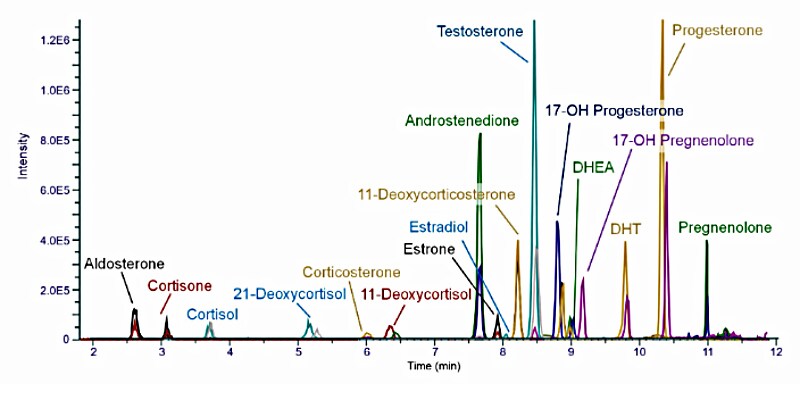
Figure 1. Representative EIC of 17 steroids in human serum using the Thermo Scientific Stellar mass spectrometer.
From characterization to confident method creation
The power of Stellar MS lies in its comprehensive acquisition strategy. In this application note, a single injection per spiking level generated 125 distinct scan events, combining:
- HCD and CID MS² experiments
- Targeted MS³ scans
- Positive/negative polarity switching
This workflow enables analysts to rapidly evaluate:
- Which dissociation mechanism produces the most informative spectra
- Whether MS² or MS³ is best suited for each compound
- The optimal product ions for confident post-acquisition quantitation
By providing this complete dataset in a single run, Stellar MS dramatically accelerates method optimization and validation, supporting more efficient and reliable quantitation strategies.
Driving method development efficiency
The real strength of the Stellar MS isn’t just its speed or sensitivity — it’s the ability to experiment, compare, and decide in one workflow.
Through simultaneous HCD/CID fragmentation, MS² and MS³ switching, and polarity control, users can determine the optimal analytical conditions across complex steroid panels quickly and confidently.
This approach helps labs:
- Reduce development time
- Maximize data quality
- Improve long-term robustness and reproducibility
Conclusion
The Stellar MS platform empowers analytical scientists to move beyond incremental performance metrics toward methodological innovation.
By integrating comprehensive characterization and advanced scanning control, it enables faster, more confident decisions in quantitative steroid analysis — setting a new benchmark for flexibility and precision in LC-MS.
Ask the Experts: On-Demand Webinar
Learn more about how Stellar MS enhances steroid profiling and quantitative workflows.
Watch the on-demand webinar where Thermo Fisher scientists discuss:
- Advanced method development strategies
- Insights from the steroid panel dataset
- Practical examples of leveraging Stellar’s flexibility for confident quantitation
Watch now: Unlocking the Power of Quantitative Analysis with Stellar MS
Read the full application note: Selective and sensitive measurement of 17 steroids in human serum using a Stellar mass spectrometer
Learn more about Stellar Mass Spectrometer applications
Visit us on LinkedIn: #MassSpectrometry #ClinicalResearch #LCMS #StellarMS
Breaking Sensitivity Barriers: How MS³ is Transforming Biomarker Discovery for ALS and Beyond
Introduction At the recent Thermo Fisher Scientific sponsore...
Read More
Thermo Fisher Scientific at ICRAV 2026
March 22 to 29, 2026 | Visit us at booth #28 Thermo Fisher S...
Read More
Boosting Productivity in Toxicology Labs
In today’s forensic and clinical toxicology labs, producti...
Read More
Beyond Blood: Sheffield Teaching Hospitals NHS Foundation Trust Develops HRAM-Powered Method for Post-Mortem Toxicology Analysis
In a recent study published in the Journal of Analytical Tox...
Read More