As the aviation industry continues to evolve toward greener solutions with Sustainable Aviation Fuels (SAF), there’s growing interest in bio-derived blends. Accurate analysis of Fatty Acid Methyl Esters (FAMEs) in jet fuel becomes increasingly critical to ensure fuel quality, safety, and regulatory compliance. Advanced GC-MS techniques now enable FAME analysis that will help accelerate jet fuel testing and improve stability over extended testing periods.

The challenge of modern aviation fuel analysis
Analyzing FAMEs helps ensure controlled and intentional blending, rather than accidental contamination. With the current allowable limit for unintentional FAMEs content within jet fuel at 5 mg/kg, laboratories need reliable, efficient methods to ensure aviation safety. Traditional analysis methods have been time-consuming and sometimes challenging to implement, especially when dealing with complex petroleum hydrocarbon matrices.
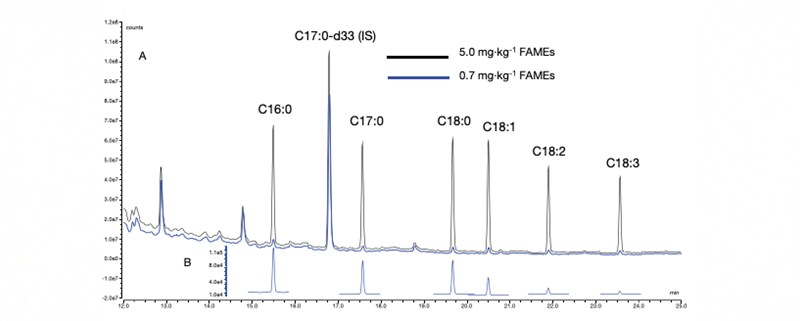
Figure 1. (A) Full scan acquisition of 0.7 and 5 mg∙kg-1 FAMEs in kerosene and (B) t-SIM acquisition of FAMEs of 0.7 mg∙kg-1 FAMEs in kerosene
Breakthrough in analysis time and accuracy
IP 585 method is commonly used to test for FAMEs in jet fuel using gas chromatography with flame ionization detection (GC-FID).
Our latest application note demonstrates a significant advancement in FAME analysis by using GC-MS, achieving:
- 20-minute reduction in analysis time compared to standard Method IP 585
- Efficient separation of all targeted compounds in under 24 minutes
- Accurate quantification at trace levels (below 1 mg/kg)
- Exceptional stability over extended testing periods
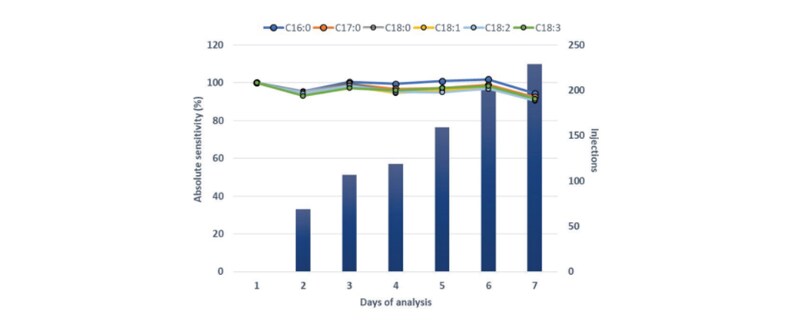
Figure 2. Absolute sensitivity robustness with continuous analysis over 7 days. The number of injections (bar graphs) represents the total number of injections from the start of the analysis (day 1).
Key benefits for your laboratory:
- Enhanced efficiency: Faster analysis times mean higher sample throughput
- Superior accuracy: Precise quantification across both low and high concentration ranges
- Robust performance: Stable response over multiple injection sequences
- Regulatory compliance: Meets and exceeds current industry standards
- Reduced maintenance: Extended uptime with minimal source maintenance
This innovative approach to FAME analysis represents a significant step forward in fuel quality control, offering laboratories the tools they need to meet increasing demands for faster, more accurate results while maintaining the highest safety standards in aviation fuel testing.
Learn how this revolutionary approach can enhance your laboratory’s capabilities and efficiency in jet fuel analysis. The comprehensive application note includes detailed method parameters, validation data, and complete system specifications.
Download the full application note, Stay ahead in developing green energy solutions: Fatty acid methyl ester (FAME) analysis for jet fuel using gas chromatography-mass spectrometry, to discover how you can implement this advanced FAME analysis method in your laboratory.
Visit us on LinkedIn: #GCMS #FAME #Aviation #GasChromatography

From the Ocean to the Laboratory: How Scalable Pyrolysis-GC/MS Reveals the Hidden Story of Microplastics
Plastics have become part of everything we touch — from th...
Read More
When “Fairy Lights” Turn Toxic: The Hidden Hazard of Chlorinated Paraffins
Are you looking forward to the holidays and a lot of cozy ev...
Read More
Chromeleon CDS: Hints and Tips to Help Optimize your GC-MS Workflows
Gas Chromatography-Mass Spectrometry (GC-MS) is a workhorse ...
Read More
Stay Ahead in Developing Green Energy Solutions with FAME Analysis for Jet Fuel
Biofuels, particularly biodiesel, are an attractive, cleaner...
Read More