In today’s forensic and clinical toxicology labs, productivity is more than just speed—it’s about accuracy, flexibility, and the ability to keep pace with an ever-expanding universe of analytes. Whether processing high-throughput urine samples or evaluating oral fluid, labs are under pressure to deliver reliable results faster, with fewer resources, and across a wide range of complex drug panels. Thermo Fisher Scientific is addressing this challenge head-on, delivering complete LC-MS/MS workflows, solution guides, and databases that prioritize throughput and robustness without sacrificing sensitivity or selectivity. Workflows that include over 100 to 2000 drugs allow for single injection assays that mitigate the need to extract and analyze each drug class individually. The fast speed of the mass spectrometers gives users the ability to speed up gradients, leading to shorter run times.

A unified workflow for broad drug coverage in urine
Urine remains the cornerstone matrix for drug testing, offering a long detection window for many commonly abused substances. However, with over 100 frequently tested drugs and a growing list of synthetic analogs, labs need streamlined methods capable of handling this analytical diversity. A recent method developed by application scientist Courtney Patterson using Thermo Scientific SOLAµ SPE plates, Thermo Scientific Vanquish UHPLC, and both Thermo Scientific HRAM Orbitrap and Thermo Scientific TSQ triple quadrupole mass spectrometry platforms, delivers a compelling solution.
This workflow (linked in the resources section below), utilizes both HRAM Orbitrap and triple quadrupole mass spectrometers, quantified 106 drugs—including 15 isomers—across 10 drug classes, including drugs in both positive and negative polarities, in just 7 minutes per sample. Notably, it demonstrated strong chromatographic resolution for challenging isomeric pairs like codeine/hydrocodone and methamphetamine/phentermine. Lower limits of quantitation (LOQs) ranged from 0.1 to 100 ng/mL, meeting stringent ANSI and forensic standards. Wide dynamic ranges, such as 0.5 to 5,000 ng/mL for norbuprenorphine, enabled labs to confidently report both trace and high-concentration results with minimal rework.
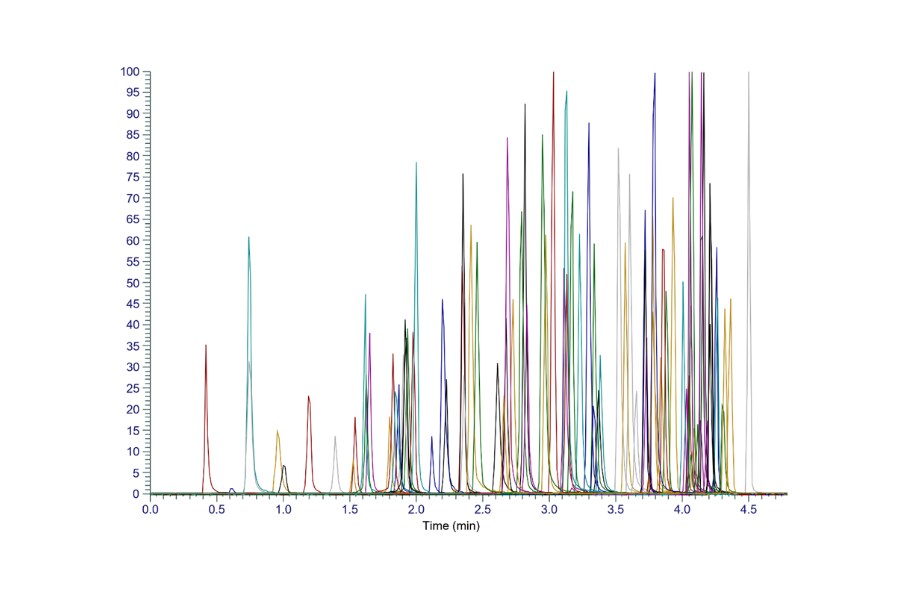
Figure 1 Extracted ion chromatogram of 106 drugs of abuse in urine from TN002363
What makes this method stand out is its dual-platform compatibility. The same sample preparation and chromatography approach has been validated on both high-resolution Orbitrap and triple quadrupole systems, giving laboratories the freedom to select instrumentation that best aligns with their throughput needs and budget constraints.
And speaking of budgets… Be sure to explore our latest promotions, including complete LC-MS toxicology configurations and affordability programs. You can aim high without overspending by:
- Investing in certified refurbished instruments at a fraction of the cost
- Trading in older instruments for credit toward the latest models, regardless of manufacturer
- Taking advantage of flexible leasing and financing options, including 0% interest and deferred payment plans
Meeting new demands in oral fluid testing with Stellar MS
As oral fluid gains traction for workplace drug testing, roadside evaluations, and rapid screening, labs face a different set of challenges—chief among them, the need for highly sensitive and selective methods to meet SAMHSA detection thresholds. Patterson’s oral fluid workflow, powered by the Thermo Scientific Stellar mass spectrometer, addresses these needs with precision in a 5-minute method.
Using DPX Technology’s INTip™ SCX/WAX SPE tips for extraction and an Accucore Biphenyl column for separation, this method quantified 31 drugs—including THC, opioids, stimulants, and cocaine—at LOQs as low as 0.25 ng/mL. The Stellar system’s targeted-MS2 (tMS2) acquisition mode delivered confident identification with full-scan MS2 spectra, resolving issues like matrix suppression common in oral fluid analysis.
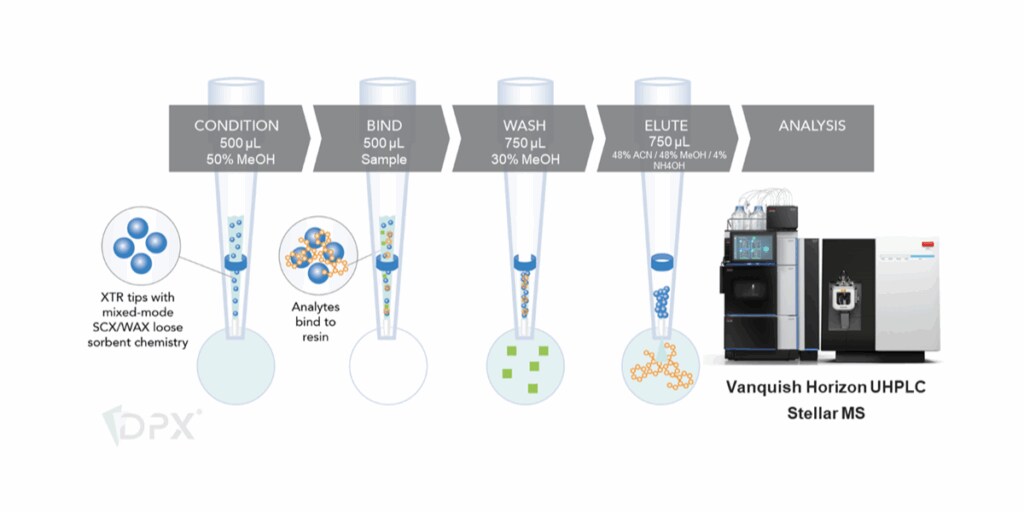
Figure 2 Schematic of XTR tip extraction protocol with mixed mode SCX/WAX chemistry for INTip dispersive solid phase extraction followed by analysis using the Vanquish Horizon UHPLC system and Stellar Mass Spectrometer from TN003851. Artwork provided by DPX Technologies.
Importantly, the method achieved baseline separation of structural isomers and provided flexibility in fragmentation, using either HCD or CID based on compound-specific needs. Ten real-world case study samples were analyzed successfully, confirming all compounds with robust retention times and fragment ion ratios.
Productivity without compromise
Together, these two workflows—one for urine and one for oral fluid—showcase how Thermo Fisher Scientific is redefining productivity in toxicology. By combining smart sample preparation, fast chromatography, and high-resolution mass spectrometry platforms, these solutions enable:
- Rapid turnaround times with sub-10-minute methods
- High-confidence results for complex drug panels, including isomers
- Flexible instrumentation to meet the needs of both high-resolution and triple quadrupole users
- Regulatory readiness with LOQs meeting ANSI and SAMHSA guidelines
In a world where toxicology labs must do more with less, Thermo Fisher’s comprehensive solutions empower teams to work faster, smarter, and with greater confidence.
Learn more about how Thermo Fisher Scientific’s toxicology solutions can help your lab stay ahead: Forensic Toxicology
Resources
- Past blogs in this series
- Sample prep – Sample Preparation Strategies Demystified: Choosing the Right Fit for Your Toxicology Workflow
- Tox Explorer – Beyond Blood: Sheffield Teaching Hospitals NHS Foundation Trust Develops HRAM-Powered Method for Post-Mortem Toxicology Analysis
- VeriSpray – Advancing Drug Analysis with PaperSpray MS
- On-demand workshop – Next-Generation Workflows for Small Molecule Quantitation Using the Thermo Scientific Stellar Mass Spectrometer
- Technical note – Quantitation of an oral fluid drug panel including THC using the new Stellar mass spectrometer
- Technical note – Utilizing HRAM Orbitrap mass spectrometry to quantitate 106 drugs of abuse in urine
- Technical note – Utilizing triple quadrupole mass spectrometry to quantitate 106 drugs of abuse in urine
- Drug screening and confirmation workflows
- Promotions
- Mass spectrometer affordability programs
- Refurbished MS
- Trade-in
- Financing/ leasing
- Mass spectrometer affordability programs
Visit us on LinkedIn: #ForensicToxicology #MassSpectrometry #LabProductivity

Sharper, Faster, Smarter: HRAM Orbitrap Mass Spectrometry Meets Postmortem Toxicology
In forensic toxicology, understanding what is in a sample an...
Read More
Behind the Bench: Tips to Simultaneously Analyze THC, Its Metabolites, and Other Drugs of Abuse Using LC-MS
Continuing the conversation on toxicology innovation In our ...
Read More
Maximize Performance with Specialized LC-MS Workflows — and Save Up to 40%!
When it comes to clinical research, precision, reliability, ...
Read More
Upcoming LC-MS Events to Watch this Fall
Mass spectrometry professionals in clinical research, forens...
Read More