Welcome back to our series on Charged Aerosol Detection (CAD) in High-Performance Liquid Chromatography (HPLC). In our first episode, we explored the fundamentals of CAD. Today, we’ll take a closer look at how CAD stacks up against other universal detectors, specifically Evaporative Light Scattering Detection (ELSD) and Multi-Angle Light Scattering (MALS). By the end of this episode, you’ll understand why CAD is often the preferred choice for a wide range of analytical applications and the benefits of CAD over its competitors.

Recap: What is charged aerosol detection (CAD)?
To briefly recap, Charged Aerosol Detection (CAD) is a universal detection method used in HPLC that provides a consistent response for non-volatile and semi-volatile analytes. CAD works by nebulizing the liquid eluent from the HPLC column, drying the aerosol, charging the particles, and then detecting the charged particles. The signal generated is proportional to the mass of the analyte.
Understanding ELSD and MALS
Before we dive into the comparison, let’s briefly describe ELSD and MALS:
Evaporative Light Scattering Detection (ELSD): ELSD nebulizes the eluent and evaporates the solvent, detecting the analyte particles by measuring the light scattered as they pass through a light beam. The response can be influenced by the size and refractive index of the particles.
Multi-Angle Light Scattering (MALS): MALS measures the intensity of light scattered at multiple angles by particles or macromolecules in a solution. It is often used to determine molecular weight and size, requiring complex data analysis.
The benefits of CAD over ELSD and MALS
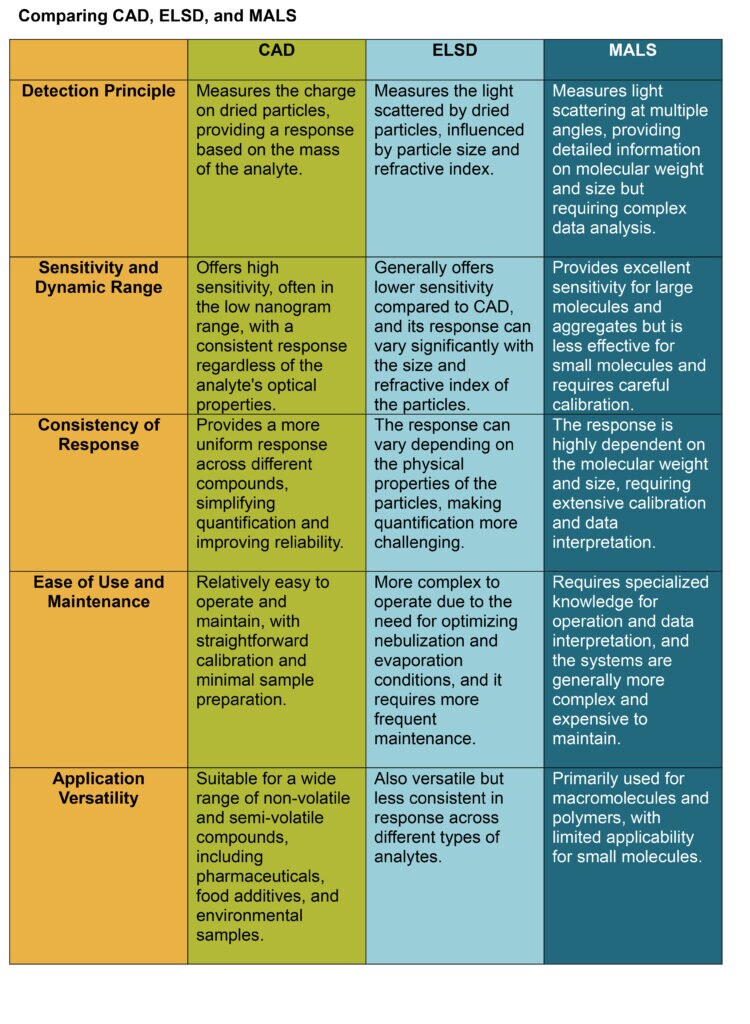
- Uniform response: One of the most significant advantages of CAD is its consistent response across different analytes. Unlike ELSD, which can be influenced by particle size and refractive index, CAD provides a more uniform signal, simplifying quantification.
- Higher sensitivity: CAD generally offers higher sensitivity compared to ELSD, making it suitable for trace analysis. While MALS can be highly sensitive for large molecules, it is less effective for small molecules.
- Ease of use: CAD systems are user-friendly, with straightforward calibration and minimal sample preparation. This contrasts with ELSD, which requires careful optimization of nebulization and evaporation conditions, and MALS, which demands specialized knowledge for data interpretation.
- Versatility: CAD can detect a broad range of non-volatile and semi-volatile compounds, making it applicable in various industries, from pharmaceuticals to environmental analysis. While ELSD is also versatile, its inconsistent response can be a limitation. MALS is primarily suited for macromolecules and polymers, limiting its applicability for small molecules.
- Robustness: CAD is less prone to matrix effects, providing reliable data even in complex sample matrices. This robustness is a significant advantage in applications such as pharmaceutical impurity profiling and environmental testing.
Charged aerosol detection and evaporative light scattering detection – fundamental differences affecting analytical performance
When comparing detection methods in liquid chromatography, Charged Aerosol Detection (CAD) stands out for its unique advantages. CAD charges aerosol particles, providing a consistent and uniform response regardless of particle size. This attribute simplifies calibration processes and enhances sensitivity, making CAD particularly effective for detecting a wide range of analytes with high precision. Unlike Evaporative Light Scattering Detection (ELSD), which measures light scattering and can result in non-linear calibration curves due to varying particle sizes, CAD ensures a more straightforward and reliable analytical performance. This consistency in response is crucial for achieving accurate and reproducible results, making CAD the preferred choice for many chromatographic analyses. For more details: Charged Aerosol Detection and Evaporative Light Scattering Detection – Fundamental Differences Affecting Analytical Performance

You can find more information on why to choose Charged Aerosol Detection for your HPLC analysis ›
Conclusion
While ELSD and MALS have their unique strengths and applications, Charged Aerosol Detection (CAD) stands out for its consistent response, high sensitivity, ease of use, versatility, and robustness. These advantages make CAD a superior choice for many HPLC applications, offering reliable and accurate detection across a wide range of analytes.
As the field of analytical chemistry continues to evolve, incorporating CAD into your HPLC workflow can significantly enhance your analytical capabilities, providing deeper insights and more reliable data. Whether you are dealing with pharmaceuticals, food additives, environmental samples, or biotechnological compounds, CAD offers a powerful and versatile solution that can meet the demands of modern analytical challenges.
Stay tuned for the next episode in our series, where we will explore specific case studies and practical applications of CAD in various industries.
Visit us on LinkedIn: #CAD, #ChargedAerosolDetection #HPLC
Episode 4: Introducing a More Confident Era in HPLC-CAD Analysis
The first Charged Aerosol Detector (launched in 2005) set ne...
Read More
How to Get More Accurate HPLC Quantitation of Semi-Volatiles
Struggling to accurately measure semi-volatile analytes? Str...
Read More
Episode 3: Understanding How Charged Aerosol Detection (CAD) Works
Welcome back to our series on Charged Aerosol Detection (CAD...
Read More
Episode 1: The Benefits of Charged Aerosol Detection (CAD) in High-Performance Liquid Chromatography (HPLC)
High-Performance Liquid Chromatography (HPLC) is a cornersto...
Read More