The first Charged Aerosol Detector (launched in 2005) set new performance standards for near-universal detection in HPLC analysis. Now our revamped detector is here, ready to help your lab analyze complex solutions with even greater confidence.
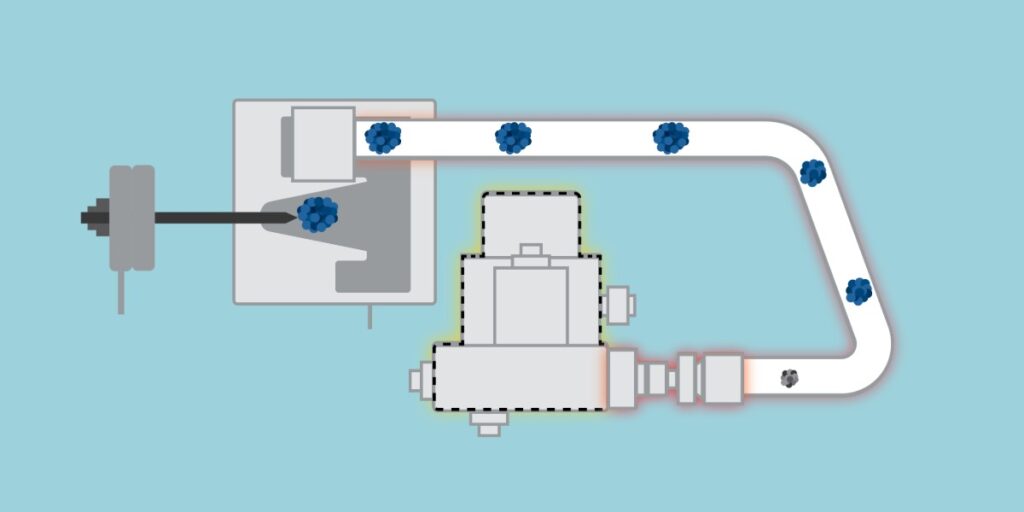
Welcome to Episode 4 of our series, where we explore the latest advancements in near-universal HPLC detection technology. Today, we are excited to introduce the Thermo Scientific Vanquish Charged Aerosol Detector P Series.
Over the past two decades, Charged Aerosol Detection has undergone significant advancements, incorporating several new hardware and software features designed to facilitate method development, increase flexibility, and streamline method transfer.
This innovative detector brings unprecedented levels of sensitivity, versatility, and reliability to your laboratory, making it essential for a wide range of applications. It is the detector to use when your analyte lacks a chromophore or if a certified standard is unavailable.
Key performance upgrades in the Vanquish CAD P Series
1. Integrated diverter valve for increased detection versatility
One of the standout features of the Vanquish CAD P Series is the integrated diverter valve (Figure 1).
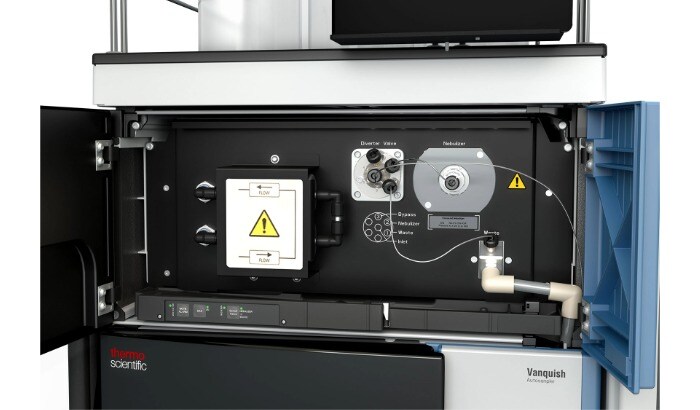
Figure 1. Close-up view of the Vanquish CAD P Series integrated diverter valve.
This valve enhances robustness by preventing detector contamination and improves peak integration by diverting the matrix to waste.
This function is particularly beneficial for the accurate quantitation of early eluting analytes, ensuring cleaner and more accurate results. By reducing the risk of contamination, the diverter valve extends the detector lifespan and maintains robust performance over time.
Removing unwanted matrix is especially useful in complex samples, where the risk of contamination is higher, and accurate quantitation is critical.
Watch on YouTube: Meet the Vanquish HPLC-CAD P Series
2. New default power value settings to simplify calibration curves
The Vanquish CAD P Series introduces new default power value (PV) settings, making it easier to find your ideal linear range. In case you do not know, the power value is a mathematical transformation that extends the linear range of calibration curves.
Previously, determining the optimal PV for a given method was a time-consuming process, as each PV was determined sequentially. Now you can measure up to four power function values simultaneously, significantly reducing the time and effort required for method development! Collecting multiple PVs at once simplifies the process of optimizing analytical methods, ensuring accurate and reliable quantitation across a wide range of analytes.
This improvement not only saves time but also enhances the overall efficiency of your laboratory workflow.
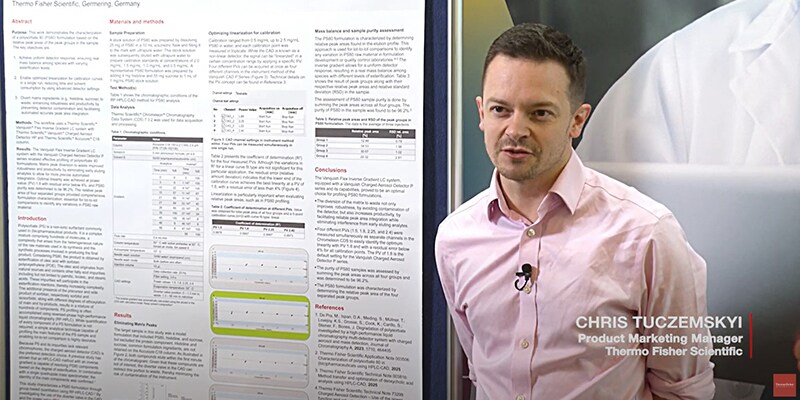
Learn from Chris Tuczemskyi about the power function in HPLC-CAD with the Polysorbate 80 example. Watch on YouTube today!
3. Improved sensitivity for detecting and quantifying semi-volatile analytes with confidence
The Vanquish CAD P Series also offers improved sensitivity for detecting and quantifying semi-volatile analytes.
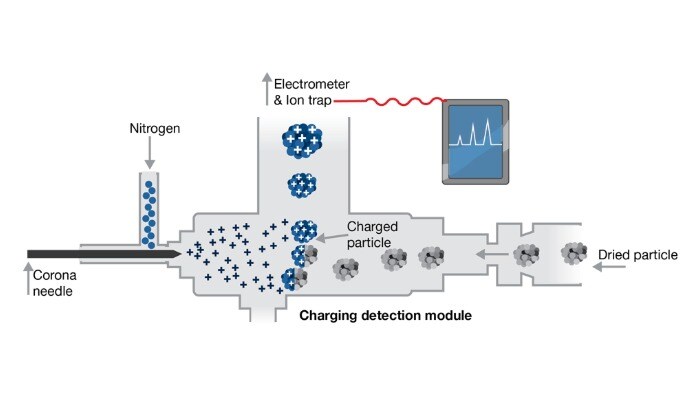
Figure 2. Illustration of the Vanquish CAD P Series charging detection module.
This enhancement is achieved through the new Temperature Coupling Mode, which supports the detection of semi-volatile compounds by fine-tuning the evaporation temperature (EvapT) and coupling with the Charging Detection Module temperature (Figure 2).
For instance, setting the EvapT to 25°C with the Temperature Coupling Mode on minimizes additional evaporation of semi-volatile analytes, resulting in an improved signal-to-noise (S/N) ratio. A better S/N ratio is particularly beneficial for detecting low-level semi-volatile drug impurities and other semi-volatile compounds, providing users with a more complete profile of sample components.
This increased sensitivity ensures that even the most challenging analytes can be accurately quantified, enhancing confidence in your results.
Uncover the benefits of optimized temperature control in HPLC-CAD with Florian Broghammer. Watch the video on characterizing saturated fatty acids!
4. New method transfer and development tools to help you save time and master compliance
The Vanquish CAD P Series includes new method transfer and development tools that streamline the process of transferring methods from previous CAD models.
The built-in method translation tool ensures seamless method transfer with familiar method settings, providing a consistent user experience. This feature is particularly useful for regulated laboratories looking to upgrade their detection capabilities without extensive revalidation efforts.
Additionally, the Vanquish CAD P Series supports the acquisition of data at four different power values simultaneously, simplifying method development and transfer. This capability makes it easier to optimize and validate compliant analytical methods, ensuring accurate and reliable results across various applications.
The ability to transfer methods effortlessly means that laboratories can quickly adapt to new projects and demands, maintaining productivity and efficiency.
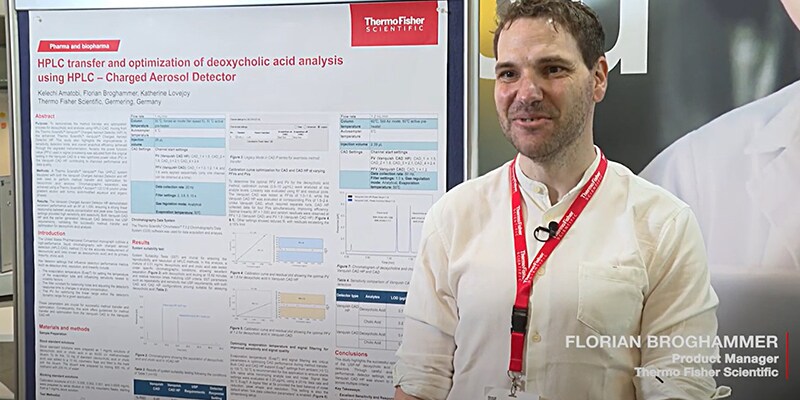
Discover new method tools and optimized gradient HPLC-CAD for fatty acids with Florian Broghammer. Watch the video now!
Save time, gain confidence, and meet stringent compliance requirements
The Vanquish CAD P Series represents a significant advancement in analytical detection technology. Its integrated diverter valve, new default power value settings, improved sensitivity for semi-volatile analytes, and new method transfer, and development tools make it a powerful tool for a wide range of applications.
Whether you are working in pharmaceuticals, biomolecules, food and beverage, or specialty chemicals, this detector provides the accuracy and reliability to achieve fast, confident, and clearer results. For more information, you can watch our on-demand webinar: “A Look at the Past & Future Impacts of HPLC-CAD Technology” with one of the technology founders to learn more details about the new advancements presented today.
Stay tuned for the next episode in our series, where we will continue to explore the latest innovations in analytical technology.
FAQs
- How does the power value work in Charged Aerosol Detection?
The power value (previously called the power function value) is just a mathematical transformation that extends the linear range of calibration curves. - What is the typical LOQ I can expect in HPLC-CAD analysis?
A typical LOQ for the CAD is around 1-20 ng on a column. - What compounds are compatible with the CAD?
The CAD is able to detect all non-volatile and many semi-volatile analytes. You can now expand the range of detection for semi-volatiles with Temperature Coupling Mode in the Vanquish CAD P Series.
Visit us on LinkedIn: #HPLC #ChargedAerosolDetection

Join Thermo Fisher Scientific at ASCLD 2026
The forensic science landscape is evolving rapidly—and sta...
Read More
Electrospray 101: What to Know About LC-MS Sources – and a First Look at Optispray
1. What exactly is a “source” in mass spectrometry? Whet...
Read More
How to Cut HPLC Sample Preparation Time for Derivatizing Amino Acids
Derivatizing amino acids doesn’t have to take hours to do....
Read More
Upgrade Smarter: Trade In Your Current LC-MS System and Boost Lab Performance Without Breaking Budget
Is your current mass spectrometer limiting your lab’s capa...
Read More