Hey everyone! The response to my second blog with Brooklynn McNeil was incredible. A huge thank you to Brooklynn for sharing her story and fascinating exposomics research at Columbia University.
With three blogs under our belt, let’s keep this momentum going – welcome to the GC Orbitrap Guru Series! For me, and hopefully for you as well, it has been a pleasure to learn about these incredible careers and see how this technology has played a pivotal role in their science. I can’t wait to share more interviews and perhaps inspire you to dive deeper into these topics or even pursue a similar science career path.
A common thread among all these scientists is the GC Orbitrap technology. Now in its 10th year, it has made some truly powerful impacts, and I’m excited to explore them with you. This time, we’re off to one of my favorite countries – Spain! I had an insightful chat with Dr Araceli Rivera-Pérez about her journey to the University of Almeria and her work on food authenticity using GC Orbitrap. You’re going to love it!
Enjoy!
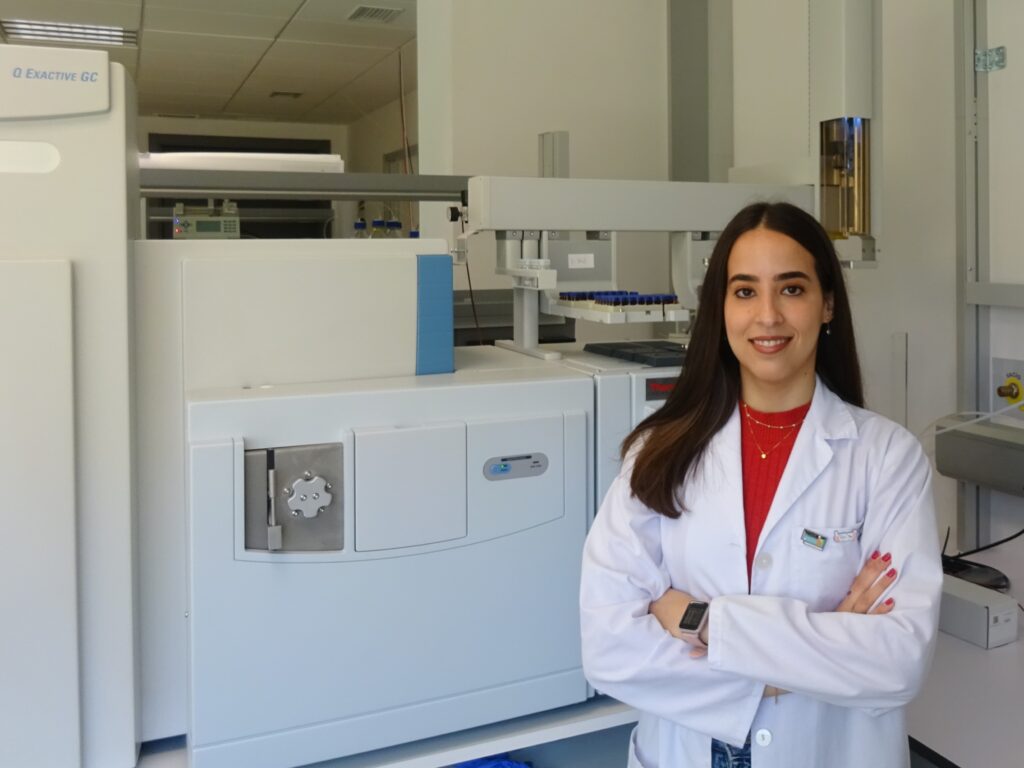
Name: Dr Araceli Rivera-Pérez
Organisation: Research group ‘Analytical Chemistry of Contaminants’, Department of Chemistry and Physics, University of Almería (UAL)
Job title: Ph.D. in Chemistry, postdoctoral researcher and university teacher at UAL
Years with GC Orbitrap: 6
Top Applications: Metabolomics, natural compounds, food authentication, fingerprint analysis
A Stepping stone into the analytical chemistry lab
Dom Roberts (Interviewer): Let’s start at the start – What subject did you study at university, where, and why that one?
Araceli: I studied Chemistry at the University of Almería in southern Spain. From the very beginning, I felt deeply connected to the world of analytical chemistry, particularly when applied to real-life issues like food quality and safety. The Mediterranean environment I grew up in, especially rich in agricultural production such as fruits, vegetables, spices, etc., inspired me to use chemistry to explore what we eat and how we can ensure the integrity and authenticity of foodstuffs.
Dom: Great motivation! So, when and how did you move from education to your first science job? What did you like about that role?
Araceli: My first real contact with scientific research came during the final year of my Chemistry studies when I was awarded a highly competitive collaboration scholarship from the Spanish Ministry of Education, Culture, and Sports to work at UAL’s Department of Chemistry and Physics. That opportunity allowed me to determine the presence of natural flavoring compounds in condiments using GC and low-resolution MS. Then, after my master’s degree studies, I became a Ph.D. student under a prestigious national research grant. What excited me most was the feeling that my work had real-world applications. My Ph.D. research included using cutting-edge metabolomics approaches to guarantee the authenticity of high-value spices like thyme and black pepper, and developing and validating advanced analytical methods for detecting harmful contaminants in these globally appreciated food products, both using advanced analytical techniques like UHPLC and GC coupled to high-resolution MS (Orbitrap analyzers).
Dom: You had early access to some great technology, but can you tell us what was the first mass spectrometer technology that you used?
Araceli: The first mass spectrometer that I used during my collaboration scholarship was a triple quadrupole GC-MS/MS system to determine myristicin and trans-anethole (natural flavoring compounds) in tea and infusion products. Although it was a powerful tool, I soon realized that the complexity of some food matrices and the occurrence of emerging contaminants required more versatile platforms such as high-resolution MS. Later, GC Orbitrap MS became a central piece of my research.

The importance of food analysis and authentication
Dom: Aside from the economic reasons, why should we be interested in food authenticity?
Araceli: Food is not only a basic need, but it also carries deep cultural, economic, and health implications. When food is mislabeled, adulterated, or fraudulently sold, it breaks the trust between producers and consumers. For example, adding synthetic dyes to spices or selling lower-quality honey as a premium one can have both economic and health consequences. With adequate analytical tools, we can detect subtle differences in chemical profiles that act as fingerprints of authenticity. My research aims to develop methods that are reliable and capable of distinguishing, for instance, between origin or processing techniques in foodstuffs, to protect consumers and support transparent food systems.
Dom: So with it being 10 years since launch, when did you first use the Thermo Scientific GC Orbitrap MS and for what application?
Araceli: Firstly, happy birthday GC Orbitrap! I used it during my first Ph.D. research to develop a novel analytical strategy for detecting alkenylbenzenes in various pepper varieties (e.g. black, white, green, pink, long pepper, etc.). This method, combining GC with Orbitrap MS, enabled the accurate identification and quantification of these naturally occurring compounds, which are known for their potential genotoxic and carcinogenic effects, contributing to food safety assessments.
Supporting food metabolomics with GC high-resolution MS
Dom: Why did you need high-resolution MS for your food authenticity studies?
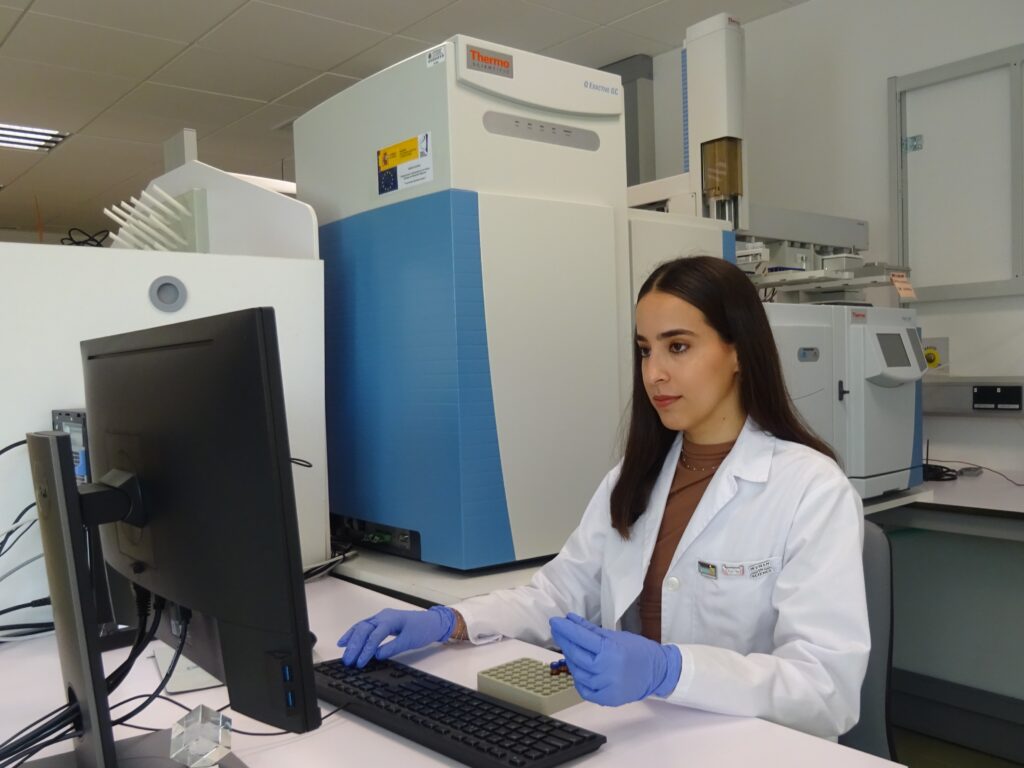
Araceli: High-resolution MS through Orbitrap analyzers is essential in omics work because many authenticity markers are unknown or present at trace levels. Unlike targeted methods, HRMS enables full scan analysis (as well as retrospective one) and thus, it performs untargeted analysis to uncover the ‘foodome’ of the study in a truly fingerprinting way. For instance, in a recent novel research project that I led, which was focused on honey samples sold in the Spanish market, GC Orbitrap MS technology allowed us to discover novel key botanical origin markers with high identification reliability (mass accuracy < 1 ppm) for authenticity purposes.
Dom: I saw you recently published an article looking at data processing strategies in GC-HRMS – What are the main hurdles in detecting compounds in untargeted GC-HRMS data, and what do we need to improve compound detection?
Araceli: In our recent study, we highlighted key challenges in untargeted GC-HRMS data processing, such as the complexity of food matrices leading to co-eluting compounds and similar mass spectra, difficulties in spectral deconvolution under low signal-to-noise conditions, and limitations due to existing spectral libraries built from EI low-resolution data. To enhance compound detection, improvements would be welcomed in high-resolution libraries, advanced algorithms for data reduction and prioritization, and tools that integrate retention index filtering or spectral pattern analysis to support compound identification.
Dom: If you could improve one thing on GC Orbitrap, what would it be?
Araceli: Honestly, I would love the instrument to have easier maintenance features, especially when it comes to cleaning the ion source and replacing the column. The NeverVent system is great for fast vent-free removal of the ion source and changing column, but these days, with ‘plug and play’, an even simpler system would be helpful. Sometimes these tasks are time-consuming and require a lot of care, which can slow down routine workflows. Additionally, enhancing the integration between data acquisition and chemometric processing would be fantastic.
The curved ball questions
Dom: I’m going to throw in an odd question (Sorry!) – favourite analyte? (We all have one as chemistry geeks)
Araceli: One compound I particularly enjoy working with is thymol. It’s a volatile compound present in various spices, aromatic herbs, and other plant-derived matrices, and its aroma and role as a botanical marker make it both analytically interesting and highly relevant in food profiling.
Dom: When I worked in the lab, my horror matrix was oleoresins! I think I’m still stained. But what’s your worst sample matrix to work with?
Araceli: I would say honey is one of the trickiest matrices to work with in untargeted metabolomics. Its high sugar content and complex composition can cause contamination and carryover in long analytical sequences, requiring extensive clean-up and frequent maintenance to keep the system optimally performing.
Science crossing borders
Dom: Recommended conference for a new scientist to go to?
Araceli: A highly recommended conference for early-career scientists in chemistry is Euroanalysis 2025. It offers an excellent international platform for networking, knowledge exchange, and exposure to cutting-edge research on analytical chemistry applied to different topics such as omics sciences, food or environmental analysis. I will be attending this summer and I highly encourage participation.
Dom: And finally, which conference city would you like to return to for vacation?
Araceli: I would love to return to northern Italy, especially Milan. During my Ph.D., I spent several wonderful months on a research stay at the Piacenza University campus (close to Milan), and it was an unforgettable experience. I absolutely fell in love with Italian culture, the food, and the warmth of the people! It’s a place that feels like a second home.
Dom: Super location, and of course, Milan is the Thermo Fisher Scientific home of gas chromatography.
It was an absolute pleasure to have the chance to chat with Araceli for my third GC Orbitrap Gurus blog. I certainly appreciate the challenges of food profiling. I’m eager to connect with more GC Orbitrap enthusiasts, so if you have a story to share or just want to talk about your experiences, please get in touch! You can reach me at dominic.roberts@thermofisher.com—I’d love to hear from you!
Want to learn more?
Check out the Thermo Scientific Orbitrap Exploris GC
Blog #1 GC Orbitrap Guru: Kerstin Krätschmer – POPs in food
Blog #2 GC Orbitrap Guru: Brooklynn McNeil – Exposomics
Additional references
Visit us on LinkedIn: #GCMS #DecadeofDiscovery #GCOrbitrapGuru

Simplifying Fuel Analysis: Why Laboratories Are Moving From Reformulyzer to GC-VUV
Fuel analysis laboratories are facing a growing challenge: d...
Read More
When Resolution Changes the Story: Single Quadrupole vs. HRAM GC-MS
In analytical chemistry, there are moments when your instrum...
Read More
VOC Analysis in Drinking Water: Achieving ppt-Level Sensitivity with ITEX Dynamic Headspace GC-MS
The quality of drinking water is under closer scrutiny than ...
Read More
How Bitter Acid Analysis Helps Brewers Better Control Beer Flavors
Tasty beer starts with knowing what’s in your hops. Explor...
Read More