Hey there GC Orbitrap enthusiasts! Welcome to blog number 4 in the Gurus series. First off, I want to give a big shoutout to the amazing GC Orbitrap gurus who’ve shared their fascinating stories with us so far. I’ve absolutely loved hearing about their incredible careers and seeing how GC Orbitrap technology has been a game-changer in their scientific journeys. Today, we’re going to dive into the fascinating journey of Scott Borden, a Research Associate at BC Cancer Research Institute, and explore how he’s using the Thermo Scientific GC Orbitrap MS in his groundbreaking work in breathomics. Get comfy, maybe grab a coffee, and let’s hear Scott’s story in his own words!

Name: Scott A. Borden
Current Department/Organisation: Integrative Oncology / BC Cancer Research Institute, Canada
Job title: Research Associate
Top applications: Breathomics and unknowns identification
Years using GC Orbitrap: 5
Q: Scott, let’s kick things off with your background. How did you venture into the world of science?
Scott: Absolutely! My journey began at Thompson Rivers University in Kamloops, BC, where I completed my Bachelor’s in Chemical Biology. I was lucky enough to have Dr. Kingsley Donkor as my professor; he really ignited my interest in analytical chemistry. During a gap year, I took the chance to travel and work, which broadened my perspective and reinforced my passion for science. After this break, I pursued a Master’s degree at the University of Victoria, which quickly transitioned into a Ph.D. My research with my supervisor, Dr. Chris Gill, centered around using paper spray mass spectrometry for harm reduction in street drug analysis—it was an exciting time, especially during the height of the opioid crisis. I realized that we could make a real-world impact by improving methodologies for detecting and identifying harmful substances.
Q: What was your first scientific gig?
Scott: During my undergrad, I worked as a research assistant in Dr. Donkor’s lab. It was fantastic. I got to play with some pretty advanced instrumentation and learn from seasoned scientists. This experience gave me a solid foundation and honed my skills in analytical techniques. It was during this time that I got my first publication—definitely a milestone I cherish. The thrill of seeing your name in a scientific journal for the first time is something every scientist remembers!

Q: When did mass spectrometry first catch your eye?
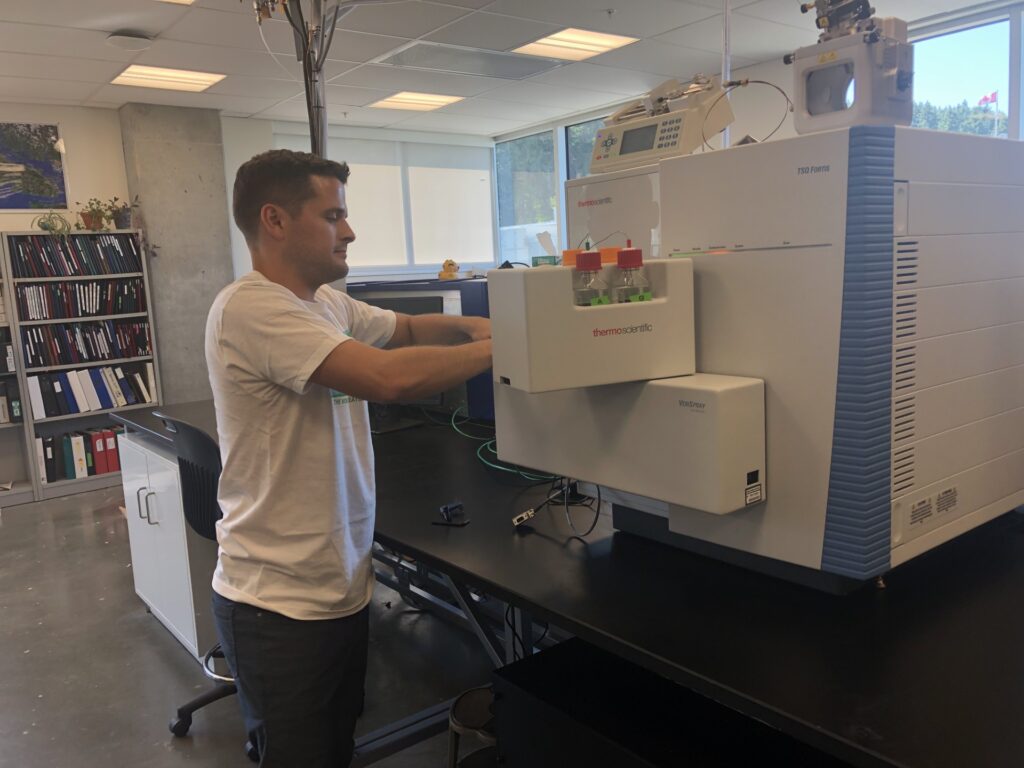
Scott: My real introduction to mass spectrometry was during my graduate days at UVic. We had this old mass spectrometer, nicknamed ‘Max,’ donated by a local hospital. Believe it or not, it was used in newborn screening across British Columbia before landing in our lab. The story goes that if you were born in BC, there’s a good chance your blood was screened by Max! We did a lot with Max, including some creative 3D-printed modifications to keep him operational. It was a steep learning curve, but incredibly rewarding. We were using Max to test out paper spray mass spectrometry, a relatively novel technique at the time, which taught me a lot about the versatility and power of mass spectrometry. Basically, this involved ripping off the front end of the instrument then using an external power supply, an xyz stage, various 3-D printed parts, and meticulously cut paper triangles from basic filter paper to begin directly analyzing small samples deposited onto the paper strips by applying solvent and high voltage, then parking the paper strips directly in front of the inlet. Eventually, we began working with Thermo Fisher and were supplied with the Thermo Scientific VeriSpray PaperSpray ion source and a Thermo Scientific TSQ Fortis QQQ mass spectrometer, which was a very welcome upgrade!
Q: Now, tell us about your encounter with the GC Orbitrap MS.
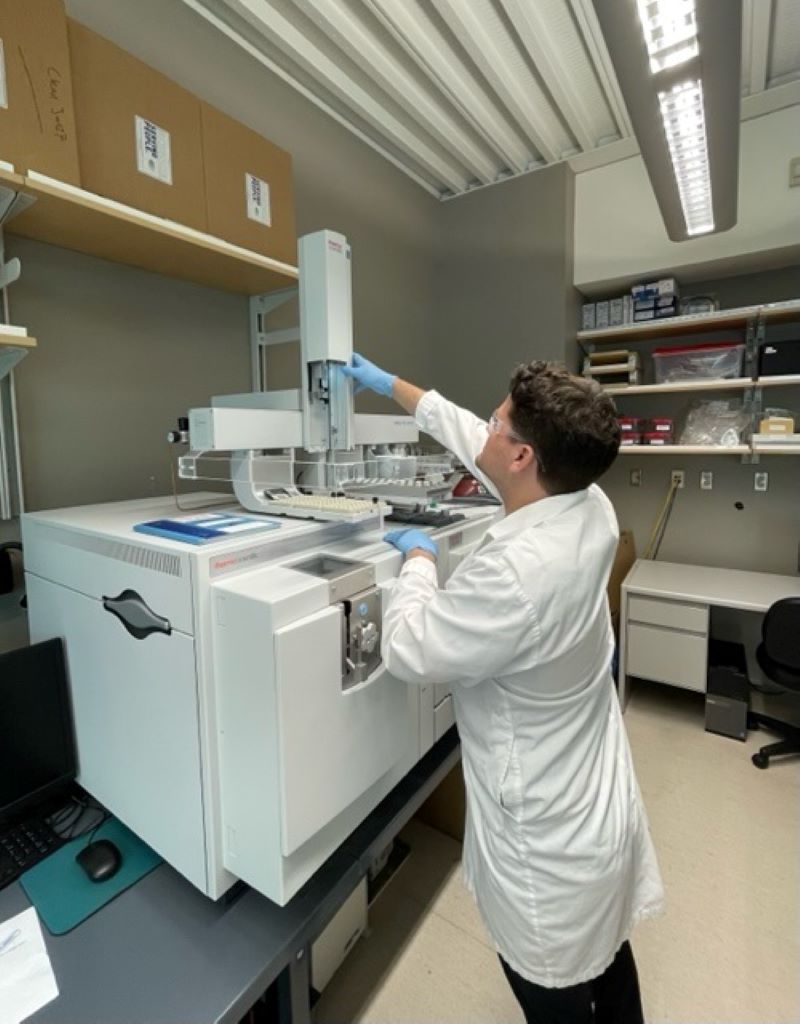
Scott: My first experience with the Orbitrap technology wasn’t actually with GC, but instead with an electrospray ionization source. Near the end of my Ph.D, I was analyzing our routine drug testing data and noticed something peculiar. Approximately 50% of samples that contained the extremely potent synthetic opioid carfentanil also presented with two other strong peaks in the full scan mass spectrum. I was not seeing these in fentanyl or other samples that did not contain carfentanil, so I presumed that these compounds must be related to carfentanil in some way. I dissolved the drug in solution and then used electrospray to introduce the sample to the MS. This allowed me to fragment my molecules of interest and obtain the high-resolution accurate-mass fragments. From here, I was able to assign chemical formulae to the mass fragments and eventually piece together the complete structure of my two unknowns. Using the Orbitrap technology, I was able to confidently identify the structure of my two unknowns, which turned out to be two previously unreported (as far as I am aware) carfentanil analogs and may actually have similar toxic effects as carfentanil based on µ-opioid receptor modelling. My first experience with GC coupled to Orbitrap MS explicitly was in my current position at the Breathomics Lab and BC Cancer Research Institute, where we analyze breath samples captured onto thermal desorption tubes by TD-GC-MS.
Q: Can you demystify breathomics for us?
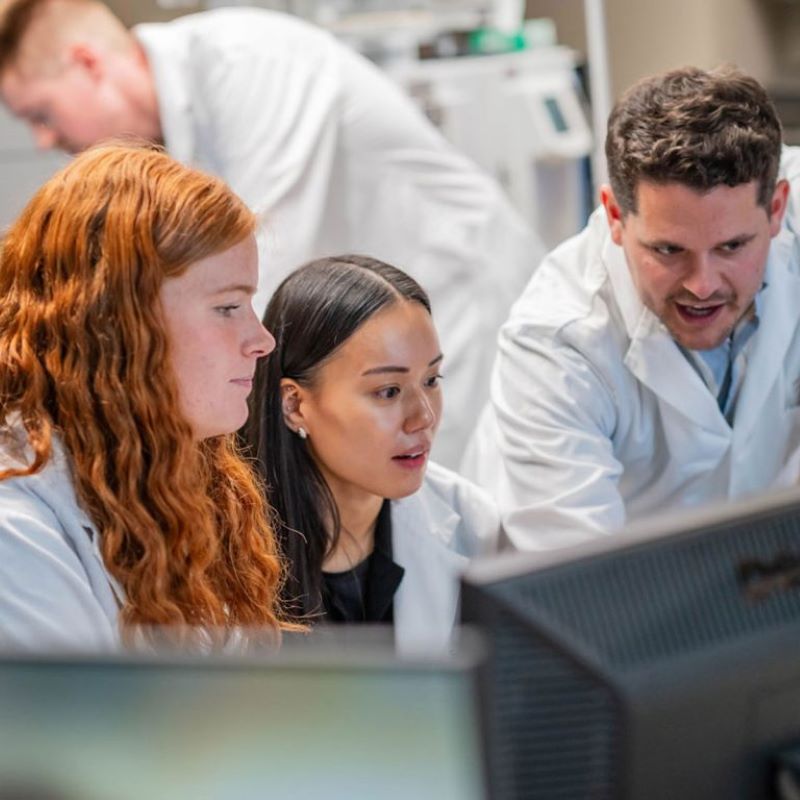
Scott: Well, I think a lot of scientists can relate to the fact that most of their friends and family don’t really understand what it is that they actually do (no matter how many times you try to explain). Breathomics is a bit easier to describe than mass spectrometry as a general concept since many people can relate to disease diagnosis. Breathomics is all about examining the compounds in exhaled breath. Essentially, we’re looking at someone’s ‘breathprint’ to detect health conditions. For example, we’re trying to see if there are specific breath markers that differentiate healthy individuals from those with early-stage lung cancer. It’s like using a breathalyzer, but way more advanced! The beauty of breathomics is that it’s non-invasive and can provide real-time insights into a person’s health status. We collect the breath samples onto thermal desorption tubes and then analyze them using our TD-GC-MS system.
Q: How crucial is high-resolution mass spectrometry (HR-MS) in your research?
Scott: HR-MS is indispensable. It allows us to identify the exact structure of unknown compounds with confidence. Breath samples are incredibly complex, often containing hundreds or thousands of compounds. HR-MS helps us sort through this complexity by pinpointing exact masses, ensuring we can accurately identify and analyze each compound. The Orbitrap’s capability to provide high-resolution data is crucial, as it allows us to detect even the slightest differences in the mass of compounds, which can be key in identifying specific biomarkers for diseases.
Q: What’s your take on the robustness of the GC Orbitrap MS?
Scott: Honestly, it’s been amazing. The GC Orbitrap MS is robust and user-friendly, especially when it comes to cleaning and swapping out the ion source without having to vent. Given our lab’s high sample throughput (we’re practically running 24/7), this reliability is a game-changer. We even keep two ion sources on hand for quick swaps, minimizing our downtime. The instrument’s ability to handle such a high workload without compromising performance is a testament to its engineering. We’ve been able to maintain consistent results and uptime, which is critical in a research setting.
Q: If you could improve one aspect of the GC Orbitrap, what would it be?
Scott: Mostly, my suggestions are software-related. For instance, incorporating deconvolution into Chromeleon would be a huge plus, given its importance in GC applications. Deconvolution helps separate co-eluting compounds, which is essential when analyzing complex mixtures like breath samples. I’d also love to see more flexibility in setting voltage optimization windows during autotune. These changes could streamline our workflow even further and improve our analytical accuracy. I’m always on the lookout for ways to make our processes more efficient – it’s part of being a scientist, always seeking improvement.
Q: Any memorable conference tales to share?
Scott: Oh, definitely! Shortly after starting my current job, I attended a conference in Pisa, Italy. It was a whirlwind trip, but visiting the Leaning Tower was worth every bit of the rush. Conference trips are such a fantastic opportunity to network and learn about the latest advancements in the field. A word to the wise, though—don’t wear dress shoes when you’re climbing the tower’s slippery stairs! The views were spectacular, and the experience reminded me of the importance of global collaboration in science.
Q: What has been one of the most rewarding moments in your career so far?
Scott: One of the highlights was definitely the discovery of those two new carfentanil analogs during my PhD. It was such an unexpected find, and it highlighted the power of high-resolution mass spectrometry in detecting substances that might otherwise go unnoticed. Additionally, seeing the real-world impact of our research on harm reduction and public health has been incredibly fulfilling. Knowing that our work could help save lives and inform safer drug policies is a powerful motivator.
Q: From your experience, what advice would you give to upcoming scientists interested in mass spectrometry?
Scott: Stay curious and keep pushing the boundaries. Mass spectrometry is a field that’s constantly evolving, with endless learning opportunities. Be open to experimenting and trying new techniques. Never underestimate the importance of networking and collaboration—some of the best ideas come from discussions with peers. And remember, if dogs can sniff out diseases, our advanced instruments should be up to the challenge too!
Q: Any final closing thoughts or aspirations for the future?
Scott: I’m excited about the future of mass spectrometry and its potential applications in various fields. Breathomics is just scratching the surface; there’s so much more to explore. I’d love to see more integration of AI and machine learning in data analysis, improving our ability to interpret complex datasets. Ultimately, my goal is to contribute to the development of non-invasive diagnostic tools that could revolutionize healthcare. It’s an exciting time to be in this field, and I’m looking forward to what’s next.
And there you have it! Scott Borden’s journey from a curious student to a pioneering researcher in breathomics and mass spectrometry. His work with the GC Orbitrap MS illustrates the power of innovative technology in pushing scientific boundaries. Thanks for reading, and stay tuned for more insightful chats with brilliant minds in the field!
I’m on the lookout for more GC Orbitrap enthusiasts, so if you have a story to tell or just want to share your experiences, please get in touch! You can reach me at dominic.roberts@thermofisher.com. I’d love to hear from you!
Want to learn more?
Blog #1 GC Orbitrap Guru: Kerstin Krätschmer – POPs in food
Blog #2 GC Orbitrap Guru: Brooklynn McNeil – Exposomics
Blog #3 GC Orbitrap Guru: Araceli Riveria Perez – Food authenticity
Need to know more? Please take a look at the Thermo Scientific Orbitrap Exploris GC
Visit us on LinkedIn: #GCOrbitrapGurus #gcms #DecadeofDiscovery

GC Orbitrap Guru Series #3: Dr Araceli Rivera-Pérez
Hey everyone! The response to my second blog with Brooklynn ...
Read More
GC Orbitrap Guru Series #2: Brooklynn McNeil
Hey everyone! Welcome to the second post in the GC Orbitrap ...
Read More
GC Orbitrap Guru Series: Dr. Kerstin Krätschmer
It’s been 10 years! Yes, in 2015 “gas chromatography...
Read More
The Spirit of Christmas: Ensuring the Quality and Authenticity of Whisky
It’s Christmas! Again! A time of year to celebrate and ref...
Read More