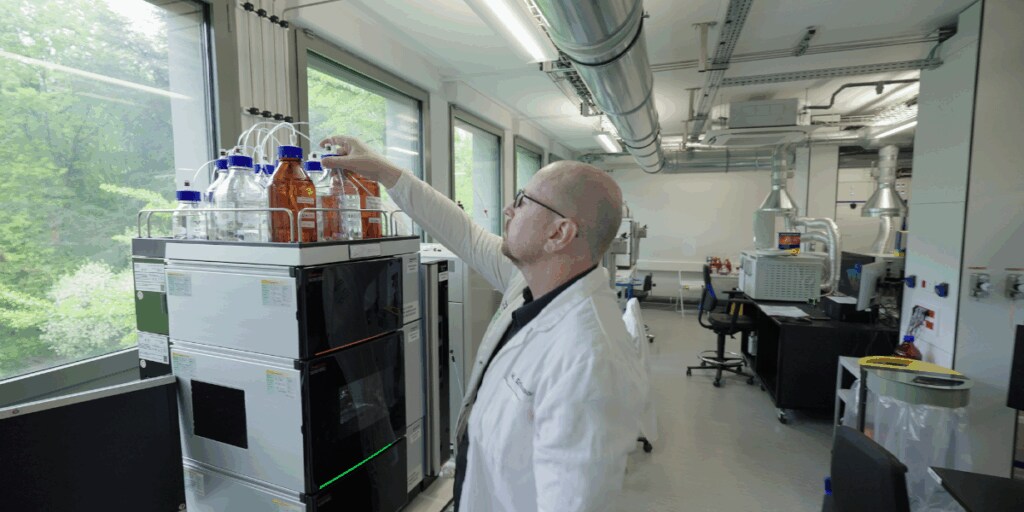
At the forefront of global anti-doping efforts, the Laboratoire Anti-Dopage Français (LADF) plays a critical role in ensuring fair play and integrity in elite sports. We spoke with Dr. Magnus Ericsson, Director of LADF and a leading expert in analytical chemistry, to explore how the lab detects banned substances, manages high-throughput workflows, and leverages advanced Thermo Fisher Scientific technologies to stay ahead of constantly evolving challenges in anti-doping science.
Screening and confirmation: A rigorous two-step approach
Every year, LADF analyzes tens of thousands of biological samples using a workflow aligned with World Anti-Doping Agency (WADA) guidelines. This two-step process—screening and confirmation—forms the backbone of modern doping analysis.
During the screening phase, high-throughput, non-targeted assays detect a broad spectrum of compounds. This aligns with recent advancements in mass spectrometry that allow LC-HRAM (high-resolution accurate mass) systems to scan for hundreds of substances in a single run, ensuring rapid and comprehensive coverage of the WADA Prohibited List (1).
Suspicious samples then undergo confirmation testing using validated targeted methods that meet WADA’s stringent sensitivity and specificity criteria. LADF employs the Thermo Scientific TSQ 9610 Triple Quadrupole GC-MS/MS system for this task. Introduced in 2023, this triple quadrupole instrument has already supported the analysis of over 40,000 urine samples, ensuring reliable confirmatory data.
“The TSQ 9610 mass spectrometer has helped us to improve our workflow in the lab,” says Dr. Ericsson. “We started using it in 2023 and today we have analyzed more than 40,000 samples… with great success.”
Implementation of Thermo Scientific TraceFinder software has also enabled seamless software continuity with LADF’s existing LC-MS and GC-MS platforms—minimizing training needs and ensuring consistent operations.
Unlocking historical insights with retrospective analysis
Modern anti-doping labs benefit not just from real-time detection but also from retrospective analysis, enabled by HRAM technology. LADF leverages the high-resolution Thermo Scientific Orbitrap Exploris 120 mass spectrometer to re-mine stored HRAM data and search for newly -banned substances.
This capability aligns with a broader trend in doping control. HRAM instruments now routinely provide resolution >60,000 FWHM and mass accuracy <2 ppm, allowing researchers to revisit past datasets and identify emerging doping agents without reanalyzing physical samples (1).
“Working with high-resolution mass spectrometry, we have the possibility to go back and search in previously analyzed data,” Dr. Ericsson explains.
Retrospective analysis is becoming increasingly vital as WADA continues to expand its list of monitored substances.
Speeding up turnaround times without sacrificing accuracy
During major competitions, laboratories are under intense pressure to deliver results rapidly. LADF tackles this challenge using Thermo Scientific Vanquish Duo UHPLC paired with the Orbitrap Exploris 120 mass spectrometer, enabling parallel workflows and multiplexed analyses in 96-well formats.
“We are able to save maybe a couple of hours of time. And this is a huge benefit for us,” notes Dr. Ericsson.
Recent advances support this approach. New UHPLC and HRAM technologies allow scan-to-scan polarity switching at >1 Hz, making it possible to detect a wide array of acidic and basic substances simultaneously—significantly speeding up comprehensive screening workflows (1).
Building toward a one-stop shop
LADF aims to become a true “one-stop shop” for anti-doping services—mirroring Thermo Fisher Scientific’s role as their trusted, all-in-one partner for laboratory technologies by consolidating their analytical infrastructure under a single provider.
“It’s nice to have a one-stop shop… which means that you work mostly with one major provider,” says Dr. Ericsson.
Thermo Fisher Scientific has delivered leading technologies for the analysis of performance-enhancing drugs and other prohibited substances for more than a quarter century. In line with its commitment to advance the field, the technologies the company offers bolster the analytical arsenal of doping control laboratories, enabling them to provide multiple perspectives to enhance the reliability of results.
This strategic alignment not only reduces system fragmentation and compatibility issues but also enables rapid method implementation and consistent training across staff. Such standardization is key as doping tests grow more complex, involving both small molecules and peptide-based substances.
Looking ahead: The future of anti-doping analysis
As doping methods evolve, so must detection technologies. LADF continues to invest in instruments that deliver robustness, low maintenance, and ultra-sensitivity.
“It’s the sensitivity and the selectivity… and the possibility to increase the selectivity by doing, for instance, different MS/MS experiments,” says Dr. Ericsson.
The industry trend supports this need. New approaches like stable isotope-labeled (SIL) internal standards, supercritical fluid chromatography (SFC), and top-down proteomics with Thermo Scientific Orbitrap instruments are being developed to quantify complex peptides and detect gene doping or biologics (1).
In addition, growing concerns around unintentional doping—via contaminated supplements, food, or even environmental exposure—are pushing labs to adopt even higher sensitivity assays and more advanced data interpretation protocols (1).
With a clear vision and cutting-edge technology, LADF is not only keeping pace with modern anti-doping demands but also setting a gold standard for scientific excellence in sport. Discover Thermo Fisher Scientific’s anti-doping solutions and watch Dr. Ericsson’s complete testimonial here.
Reference(s)
- Thomas A, Thevis M. Recent advances in mass spectrometry for the detection of doping. Expert Rev Proteomics. 2024 Jan-Mar;21(1-3):27-39. doi: 10.1080/14789450.2024.2305432. Epub 2024 Jan 17. PMID: 38214680.
Additional resources
- Video – Mass Spectrometry Enables Top WADA Lab to Beat the Cheats: Athlete Doping Control
- BBC Video – How can technology maintain sports integrity?
- Testimonial – LCH Ludovic Bailly-Chouriberry Testimonial video for TSQ Altis Plus MS
- TN000304 – Analysis of testosterone from human serum using FAIMS technology
- TN001896 – Staying ahead of regulations for the analysis of steroids in urine with GC-MS/MS
Visit us on LinkedIn: #Antidoping, #LADF, #WADA, #SportsIntegrity

Maximize Performance with Specialized LC-MS Workflows — and Save Up to 40%!
When it comes to clinical research, precision, reliability, ...
Read More
Upcoming LC-MS Events to Watch this Fall
Mass spectrometry professionals in clinical research, forens...
Read More
Advancing Drug Analysis with VeriSpray PaperSpray Mass Spectrometry
At the January 2025 CFSRE Seized Drugs Symposium, a Thermo F...
Read More
Beyond Blood: Sheffield Teaching Hospitals NHS Foundation Trust Develops HRAM-Powered Method for Post-Mortem Toxicology Analysis
In a recent study published in the Journal of Analytical Tox...
Read More