Haloacetic acids (HAAs) are disinfection byproducts (DBPs) formed when drinking water is chlorinated to remove microbial contents. Chlorine reacts with naturally occurring organic and inorganic matters (decaying vegetation) in water leading to formation of DBPs that include HAAs. There are nine different HAAs anticipated, of which five HAAs are currently regulated: monochloroacetic acid (MCAA), dichloroacetic acid (DCAA), trichloroacetic acid (TCA), monobromoacetic acid (MBA), and dibromoacetic acid (DBA). The remaining four HAAs, which are not regulated, include bromochloroacetic acid (BCAA), bromodichloroacetic acid (BDCAA), dibromochloroacetic acid (DBCAA) and tribromoacitic acid (TBAA). However, they are also of health concern and are often analyzed along with five regulated HAAs.

According to the U.S. Environmental Protection Agency (EPA), there is increased risk of cancer associated with long-term consumption of water containing a level of HAAs that exceeds 0.06 mg/L. EPA methods 552.1, 552.2, and 552.3 are used to determine all 9 HAAs in drinking water and require derivatization and multiple extraction steps followed by gas chromatography (GC) with electron capture detection (ECD). In comparison to the GC method, the combination of ion chromatography and mass spectrometry (IC-MS) provides sensitive and rapid analysis without the need for sample pre-treatment. To facilitate a simple and easy-to-use direct injection method, the U.S. EPA published EPA Method 557 for the analysis of haloacetic acids, bromate, and dalapon in drinking water by IC-MS/MS.
Column selection for HAAs analysis
The Thermo Scientific Dionex IonPac AS24 column was specifically designed to separate HAAs from the matrix components (chloride, nitrate, carbonate, and sulfate) in drinking water samples. The Dionex IonPac AS24 column provides high capacity, allowing large loop injection of complex samples without overloading the column, while maintaining excellent peak shapes for lower concentration analytes, which eliminates the need for sample pretreatment when analyzing HAAs in high-ionic strength matrices. The Dionex IonPac AS24 column (in 250 mm × 2 mm i.d. format) was the first column written into EPA Method 557. While the Dionex IonPac AS24 column meets all the requirements for EPA Method 557, the analysis time for this column is close to 1 hour. For increasing the sample throughput, it was advantageous to design a new column for the HAAs analysis to reduce overall run time, therefore, research and development efforts were focused on designing a new high-capacity column with optimized selectivity to allow direct injection of high ionic strength samples and reduced analysis time closer to 30 minutes.
That new column, launched under the name of Thermo Scientific Dionex IonPac AS31 column, was designed to provide optimum selectivity for 9 HAAs relative to matrix ions at 15°C for reproducible recoveries of HAAs and to allow chloride, carbonate, and sulfate to elute as a single peak (Figure 1) with an optimum hydroxide eluent gradient profile. Advanced stationary phase chemistry resulting in unique selectivity helped to reduce the analysis time without compromising column capacity and provided the opportunity to divert high concentration matrix anions from the MS source, thus avoiding signal suppression in mass spectrometry detection. The column capacity of the Dionex IonPac AS31 column is comparable to that of the Dionex IonPac AS24 column, thus also enabling large loop injection of high concentration samples without straining the column while preserving superb peak shapes and resolution for all 9 HAAs.
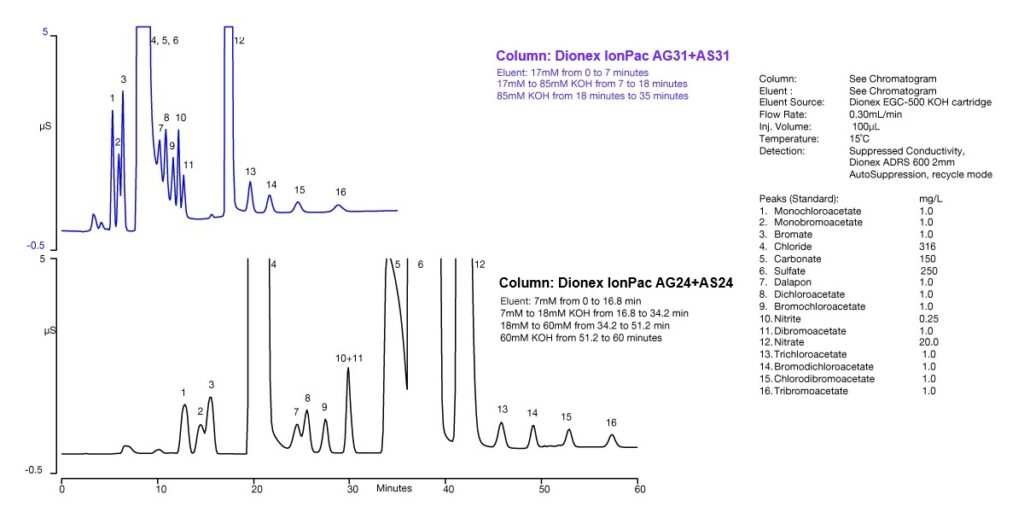
Figure 1: Comparison of Dionex IonPac AS31 and Dionex IonPac AS24 column sets
One of the key advantages is that Dionex IonPac AS31 column provides approximately 39% shorter run times relative to the Dionex IonPac AS24 column, reducing U.S. EPA Method 557 run time from 57 minutes to approximately 35 minutes.
Since the release of Dionex IonPac AS31 column, several application notes have been published to take advantage of this column for the analysis of HAAs, bromate and dalapon (Table 1). As demonstrated in AN73343, the Dionex IonPac AS31 column meets or exceeds the EPA Method 557 requirements using the Thermo Scientific TSQ Fortis MS.
Table 1: Application notes for HAAs analysis using Dionex IonPac AS31 column.
The unique selectivity and high capacity of the Dionex IonPac AS31 column makes it an ideal column for the development of specialized applications. Using gradient elution with KOH eluent, this column provides excellent separation of environmental anions including inorganic anions, oxyhalides, oxyanions, and organic acids (Figure 2).
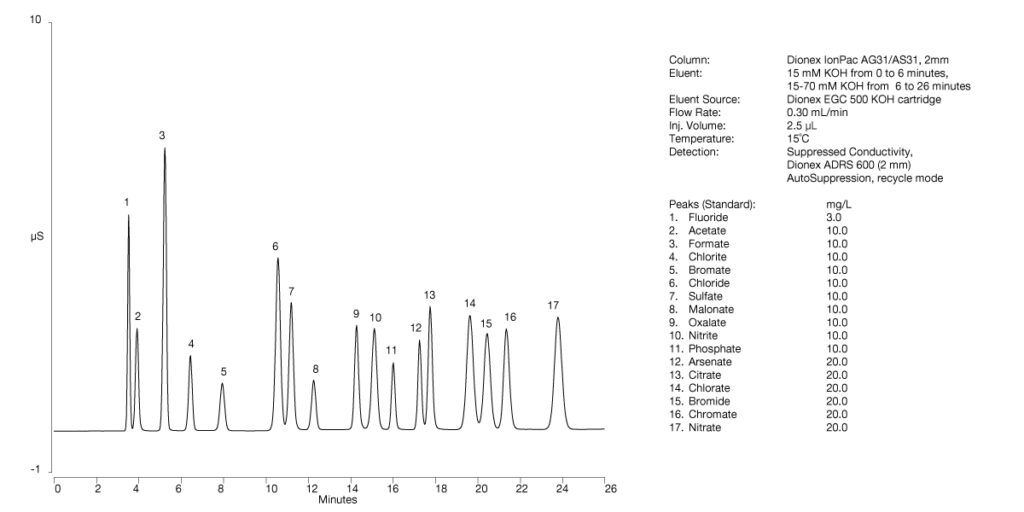
Figure 2: Capabilities of the Dionex IonPac AS31 column Ion Chromatography & Mass Spectrometry for HAAs analysis
To fully utilize the advantages of Dionex IonPac AS31 column and support its backpressure under the standard operating conditions, it is recommended to use Thermo Scientific Dionex ICS-6000 HPIC system equipped with an electrolytic eluent generator and Low Temperature DC Detector/Chromatography Compartment capable of maintaining a column temperature of 15 °C. Samples can be injected directly for trace HAAs analysis. A Thermo Scientific Dionex ADRS 600 Anion Dynamically Regenerating Suppressor should be placed in line after the column to electrolytically convert hydroxide eluent into water and remove cations present in the drinking water and eluent, thus allowing connection of the IC to MS detectors. A matrix diversion valve is placed in line prior to the mass spectrometer to divert the sample matrix anions from the MS source minimizing unwanted sensitivity loss resulting from signal suppression.
Respective IC-MS/MS method using the Dionex IonPac AS31 column provides a sensitive and selective solution with a high degree of automation for the rapid analysis of HAAs, bromate, and dalapon in drinking water (see AN73343) without the need for sample pretreatment. The Dionex IonPac AS31 column can be used as direct replacement for Dionex IonPac AS24 column for the EPA Method 557 to reduce analysis time per sample, while meeting all analytical method validation requirements. The excellent resolution between the matrix peaks and haloacetic acids minimizes detection interference and ensure a cleaner ion source of the mass spectrometer.
Additional information
1. Microbial Health Effects Tables: Potential Adverse Health Effects from High/Long-term Exposure to Hazardous Chemicals in Drinking Water; U.S. Environmental Protection Agency, 2002.
2. Method 552.1, Determination of Haloacetic Acids and Dalapon in Drinking Water by Ion Exchange Liquid-Solid Extraction and Gas Chromatography with Electron Capture Detection (Rev. 1.0); U.S. Environmental Protection Agency, 1992.
3. Method 552.2, Determination of Haloacetic Acids and Dalapon in Drinking Water by Liquid-Liquid Extraction, Derivatization, and Gas Chromatography with Electron Capture Detection (Rev. 1.0); U.S. Environmental Protection Agency, 1995.
4. Method 552.3, Determination of Haloacetic Acids and Dalapon in Drinking Water Liquid-Liquid Microextraction, Derivatization, and Gas Chromatography with Electron Capture Detection (Rev. 1.0); U.S. Environmental Protection Agency, 2003.
5. Method 557, Determination of Haloacetic Acids, Bromate, and Dalapon in Drinking Water by Ion Chromatography Electrospray Ionization Tandem Mass Spectrometry (IC-ESI-MS/MS) (Rev. 1.0); U.S. Environmental Protection Agency, 2009.
Visit us on LinkedIn: #IonChromatography #HaloaceticAcids #ICMS #DisinfectionByproducts

Enhancing PFAS Analysis in Food Contact Materials Using Combustion Ion Chromatography
Per- and polyfluoroalkyl substances (PFAS) have been used in...
Read More
Understanding PFAS and Combustion-Ion Chromatography
Per- and polyfluoroalkyl substances (PFAS) comprise more tha...
Read More
Stay Ahead in Developing Green Energy Solutions with FAME Analysis for Jet Fuel
Biofuels, particularly biodiesel, are an attractive, cleaner...
Read More
What is the Ion Chromatography Golden Jubilee? Celebrating 50 Years of IC Innovation
The year 2025 marks the golden jubilee of ion chromatography...
Read More