Are you performing environmental analysis? Check out our
Common Problems in Sample Handling and How to Solve Them
 Samples need to be taken, transported and stored before they can be analyzed in a lab. The most important part of analyzing down to the last fg is to use the right glass quality. The first hydrolytic class, as described in the Pharmacopeia, chapter 3.2., is used for glass vials of all kinds used in labs. However, there are differences. The difference is the amount of free silanol groups on the surface of the glass. These EPA storage vials provide a highly inert surface with only 33% free silanol groups (51% for brown glass).
It is also important to use glass that is not too thin. Storage vials are used for stirring, shaking, freezing and heating. If a vial brakes, it can contaminate the fridge, lab, or even employees.
A lot of samples are filtered before going into further steps of sample preparation. This can be a filtration for particles or microorganisms. However, it is important to use plastic materials that are tested for extractables and leachables. If this is not the case, a high background can result in GCMS or ion suppression in LCMS. This means a loss of sensitivity and round-robin tests are not passed. At the end of the day, labs can lose reputation with their customers as a result of low-quality glass in the lab.
Another big issue with filters is poor design of the filter itself. If there is an uneven distribution over the membrane, a lot of sample still sits on the filter and only a low amount goes through. In a worst-case scenario, the filters can burst.
The use of wrong membranes can also lead to bad results.
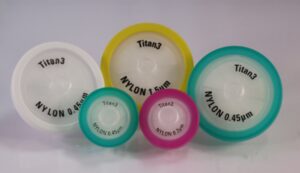
Using Thermo Scientific Titan3 filters can prevent these problems. They have an engineered design for the distribution of samples over the membrane and can stand up to 15 bar pressure. A special burst ring provides bursting. In addition to those benefits, the filters are color-coded to prevent wrong usage.
Get your free samples today at www.thermofisher.com/filter
More information is available at www.thermofisher.com/syringefilters

Sample Preparation Strategies Demystified: Choosing the Right Fit for Your Toxicology Workflow
Smarter sample preparation for LC-MS: from simplicity to sel...
Read More
Robust Analysis of Halogens and Sulfur in Industrial and Environmental Samples
In industrial processes, accurately determining halogens and...
Read More
Unveiling the Advanced Workflow for PAH Analysis in Smoke Flavored Foods
Introduction Polycyclic aromatic hydrocarbons (PAHs) are a p...
Read More
Benefits of Automating Your Antibody QC Analytical Workflows
Want a less stressed QC lab? Discover how automation c...
Read More