Thermo Fisher Scientific

Your educational resource for biopharma, pharma, environmental, food and agriculture, industrial, and clinical labs

  • Categories
    • Advancing Materials
    • Advancing Mining
    • AnalyteGuru
    • Analyzing Metals
    • Ask a Scientist
    • Behind the Bench
    • Biotech at Scale
    • Clinical Conversations
    • Examining Food
    • Identifying Threats
    • Illuminating Semiconductors
    • Life in Atomic Resolution
    • Life in the Lab
    • OEMpowered
    • The Connected Lab
  • About Us
  • Contact
Accelerating ScienceAnalyteGuru / Gas Chromatography / Sports Doping How Isotopes Help to Fight the Crime - Part 2

Sports Doping How Isotopes Help to Fight the Crime – Part 2

By AnalyteGuru Staff, 04.09.2020

Performance-enhancing drugs are substances that have the capability to improve performance in humans. In sports, those substances are sometimes referred to endogenic aids and one highly popular reference is anabolic steroids or their precursors with the colloquial term steroids.

In our previous article, Sports Doping — How Isotopes Help to Fight the Crime, we were talking about the history of performance-enhancing drugs, about challenges of doping analysis and how isotope fingerprints help distinguish between naturally-produced steroids and synthetic analogues. The simple answer and the summery is€¦ We are what we eat and the stable isotopes signature in our bodies represents our diet and eating behavior.

The isotope fingerprint, found in plants, for example, can vary according to plant type, but also according to region or rainfall. By eating those plants, carbon, hydrogen, and other elements are taken up by our bodies and converted into our own body tissue. Our own isotope fingerprint resembles therefore the fingerprint of our nutrition. Similarly, isotope fingerprints of our naturally produced steroids equals the isotope fingerprint of our body tissue. However, synthetic steroids do not! So, if the athlete is clean, stable isotope composition should remain identical among all steroids in his body. But if the athlete was taking synthetic testosterone, we will be able to see a difference in stable isotope value in the testosterone sample.

Check out this whiteboard video about doping control with stable isotopes to get a great overview of how isotope analysis works.

The analysis of testosterone misuses in sports is usually done with carbon isotopes (13C/12C). Here, samples of testosterone are collected from urine and analyzed after sample preparation. Isotope-ratio mass spectrometry (IRMS) is the analytical technique for stable isotope analysis in organic compounds. In contrast to the standard mass spectrometry, as in example quadrupole MS or Orbitrap MS, IRMS is capable of measuring the smallest differences in the isotope composition with high accuracy. And this is quite important since differences in isotope ratio occur in per mill range. Therefore, too small to detect with a standard MS.

The IRMS is usually coupled to a gas chromatography (GC) or liquid chromatography (HPLC) for a prior separation of a compound mixture. Especially, this is useful for biological and environmental samples.

Achieving the high accuracy isotope composition can only be measured after online compound conversion to a simple analyte gas — i.e. carbon to carbon dioxide. Carbon dioxide retains the isotopic information and is subsequently analyzed with IRMS with high precision.

However, we must take into consideration the destructive nature of the methodology. To achieve the high accuracy, isotope composition can only be measured after online compound conversion to a simple analyte gas — i.e. carbon to carbon dioxide. One creative solution is coupling GC-IRMS with high-resolution mass spectrometry for final confirmation in sports drug testin…. This way structural information and stable isotopes can be measured simultaneously. Coupling mass spectrometers provides a tool to measure stable isotopes and performs structural elucidation simultaneously. Find out more about the final confirmation in sports drug testing here.

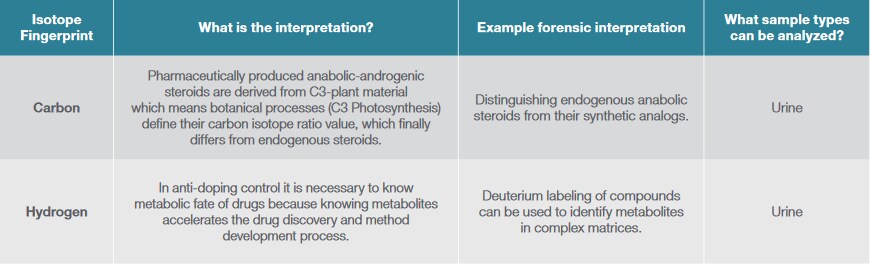
Table: Elements for stable isotope analysis of doping. Source and interpretation.

Except for carbon, hydrogen also can be applied for metabolite research. Identification of steroid metabolites in complex matrices can be time-consuming and challenging due to the requirement to both identify and quantify hundreds of different compounds with limited prior knowledge of the metabolites. Here compound-specific stable isotope analysis can be used to provide insights into the metabolism of many compounds in plants, animals and humans. Deuterium labeling of compounds has long been recognized as a valuable means to identify metabolites. GC-IRMS enables the compound-specific hydrogen isotope analysis at natural abundance and deuterium enrichment. Find out more about metabolite research here.

Are you performing analysis to uncover origins and authenticity of your samples?

Access the e-learning collection of presentations and interviews of the Isotope Hunters, who are using isotope fingerprints to uncover the real history of their samples for:

    • food integrity and adulteration cases
    • environmental studies for the research of pollution origins and past climates
    • forensics applications for tracing animal and human movements
    • … and much more

Become an Isotope Hunter! Attend the Isotope Fingerprints e-learning sessions.

Additional resources:

Smart Note: How do isotope fingerprints support doping control investigations?

Application brief: GC-IRMS: Combat emerging threats in drug abuse with isotope fingerprints

e-learning: Chapter about Isotope Fingerprints in Doping Control Investigations

Webinar Series: Specific identification of exogenous steroids in urine by GC-IRMS

Webinar Series: Isotope Hunter session – Uncover origin and authenticity of your samples

Sheffield teaching hospital NHS foundation

Beyond Blood: Sheffield Teaching Hospitals NHS Foundation Trust Develops HRAM-Powered Method for Post-Mortem Toxicology Analysis

In a recent study published in the Journal of Analytical Tox...

Read More
Food packaging

Enhancing PFAS Analysis in Food Contact Materials Using Combustion Ion Chromatography

Per- and polyfluoroalkyl substances (PFAS) have been used in...

Read More
Dr. Magnus Ericsson

Inside Laboratoire Anti-Dopage Français (LADF): An Interview with Director Dr. Magnus Ericsson

At the forefront of global anti-doping efforts, the Laborato...

Read More
US EPA Method 1621_1200x600

Understanding PFAS and Combustion-Ion Chromatography

Per- and polyfluoroalkyl substances (PFAS) comprise more tha...

Read More

AnalyteGuru Staff

Challenging Pharmaceutical Impurity Analysis Part 2: Can IC and IC-MS Fill the Gaps?
Spring Cleaning Why It s Time to Update to the New Carbonate

Privacy StatementTerms & ConditionsLocationsSitemap

© 2025 Thermo Fisher Scientific. All Rights Reserved.

Talk to us