Thermo Fisher Scientific

Your educational resource for biopharma, pharma, environmental, food and agriculture, industrial, and clinical labs

  • Categories
    • Advancing Materials
    • Advancing Mining
    • AnalyteGuru
    • Analyzing Metals
    • Ask a Scientist
    • Behind the Bench
    • Biotech at Scale
    • Clinical Conversations
    • Examining Food
    • Identifying Threats
    • Illuminating Semiconductors
    • Life in Atomic Resolution
    • Life in the Lab
    • OEMpowered
    • The Connected Lab
  • About Us
  • Contact
Accelerating ScienceAnalyteGuru / Ion Chromatography / The Role of Suppression in Ion Chromatography

The Role of Suppression in Ion Chromatography

By Gemma Ellison, Thermo Fisher Scientific 05.29.2019

The introduction of the suppressor in 1975 brought ion chromatography (IC) to the forefront of modern analytical techniques for inorganic analysis. The history of IC and suppressors is well documented, from its humble beginnings more than 40 years ago to the current day.

Understanding suppression is the key to understanding analytical IC. The suppressor doesn’t need to be shrouded in mystery and while there is some clever chemistry happening inside, the mystery can easily be unraveled. Some of the main questions around suppression are touched upon below, but for a more detailed account of suppression and how it works, download the latest free on-demand webinar “Suppression Unravelled” and learn at your leisure.
What does the suppressor do?

The suppressor forms part of the detector which is formally known as ‘suppressed conductivity.’

The suppressor has three main functions:

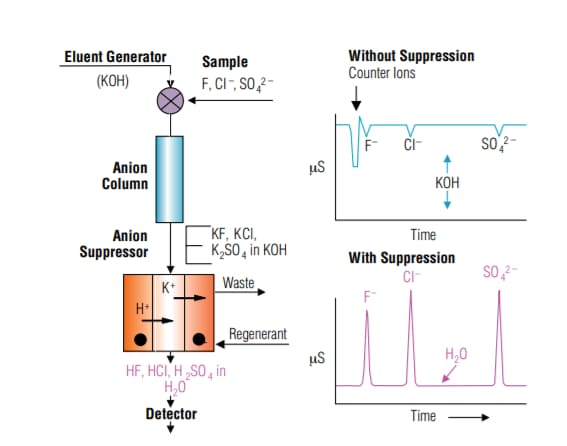
    • to remove conductive ions from the eluent, thus reducing the background and in turn, increasing the sensitivity
    • to remove the counter ions in the sample; this is removing cations from samples where anions are of interest and vice versa. This removes any breakthrough (large peaks) at the start of the chromatogram
    • to convert the ion of interest into a more conductive form, also increasing the sensitivity

Without a suppressor, we would have tiny or negative peaks sitting on a large background of conductivity from the eluent. The diagram below demonstrates the difference of suppressed and non-suppressed conductivity in an anion separation using KOH from an eluent generator.

What’s in the box?

There is a lot happening inside this little device. To put into simple and generic terms, inside a typical electrolytic suppressor there are layers of permeable ion-exchange membranes and resins. Situated at the top and bottom of the suppressor are electrodes, which are activated when a current is applied through the external plug. The current causes migration of the ions towards the respective electrodes. The unwanted ions pass through the membranes and are attracted away, either off to waste or to be recycled back into the suppressor as a regenerant. Ions of interest are able to pass through to the conductivity cell. These layered designs and dynamic flow paths have evolved over time to aid efficiency and increase capacity. Read more on suppressor types and how they function on the IC and RFIC suppressor webpage.

Why are there many types of suppressor?

The simple answer is that there is no “one fits all.” IC covers a wide range of analytes, samples and applications of varying complexity, which is why we need the right suppressor optimized for the job in hand. Whether analyzing anions (by hydroxide or carbonate eluents), cations or other analytes such as organic acids by ion exclusion, there is a suppressor designed for that use. Depending on sample type and application, there are different regenerant modes available (dynamic, chemical, external water) and different flow path sizes, so choosing the right suppressor is similar to selecting the right column, method conditions, etc. Which you choose depends on what you are doing, there is a handy suppressor selection guide to help find your perfect match.

Why do suppressors keep changing?

Technology and requirements keep changing! The original batch column suppressor was patented more than 40 years ago! Modern laboratories work now with higher throughputs, more complex analyses and greater demands on their instruments. Continuous research into suppressors allows developments and improvements in efficiency, capacity and robustness which are designed to meet the constantly changing needs of the analytical laboratory. Read more on the role of the next generation suppressors in this white paper.

For more in-depth suppression unravelling you can watch the FREE on-demand webinar ‘Suppression Unravelled’ plus other educational topics here.

Or you can always Contact Us for more information on IC products and services.

1975 text image

Innovations of 1975 and the Birth of the First Commercialized Suppressed Ion Chromatograph

The year 1975 was a remarkable period in the history of tech...

Read More
Food packaging

Enhancing PFAS Analysis in Food Contact Materials Using Combustion Ion Chromatography

Per- and polyfluoroalkyl substances (PFAS) have been used in...

Read More
Robust Analysis of Halogens and Sulfur in Industrial and Environmental Samples

Robust Analysis of Halogens and Sulfur in Industrial and Environmental Samples

In industrial processes, accurately determining halogens and...

Read More

IC Golden Jubilee blog header image

What is the Ion Chromatography Golden Jubilee? Celebrating 50 Years of IC Innovation

The year 2025 marks the golden jubilee of ion chromatography...

Read More

Gemma Ellison

Top 3 Questions When Evaluating a Triple Quadrupole Mass Spec
ICP MS Its Time for an Upgrade

Privacy StatementTerms & ConditionsLocationsSitemap

© 2025 Thermo Fisher Scientific. All Rights Reserved.

Talk to us