
Thermo Fisher Scientific

Your educational resource for biopharma, pharma, environmental, food and agriculture, industrial, and clinical labs

  • Categories
    • Advancing Materials
    • Advancing Mining
    • AnalyteGuru
    • Analyzing Metals
    • Ask a Scientist
    • Behind the Bench
    • Biotech at Scale
    • Clinical Conversations
    • Examining Food
    • Identifying Threats
    • Illuminating Semiconductors
    • Life in Atomic Resolution
    • Life in the Lab
    • OEMpowered
    • The Connected Lab
  • About Us
  • Contact
Accelerating ScienceAnalyteGuru / GC-MS / Volatile Organic Compounds (VOCs) Are All Around Us

Volatile Organic Compounds (VOCs) Are All Around Us

By Dr. Daniela Cavagnino, Product Marketing Manager, GC/Autosampler, Thermo Fisher Scientific 10.19.2021

Volatile Organic Compounds (VOCs) and semi-volatile organic compounds (sVOCs) are all around us, emitted by industrial chimneys and vehicle exhaust pipes, as well as materials such as paints, cleaning supplies, building materials and adhesives. In addition, petroleum combustion, or vapors from contaminated soils and water, are continuous sources of organic compounds responsible for air pollution.

Over the last few years, we have helped increase awareness about the problem of environmental pollution and the impact it is having on our planet’s health. Together for Our Planet was the strong message that is resonating loudly in view of the COP26 Climate Change Conference in the UK in November 2021.
In our analytical testing world, many efforts are spent to develop new methods, improve the current ones, and advance in analytical technologies, to increase knowledge and awareness around environmental pollution.

Monitoring air quality can be challenging due to the wide variety of volatile compounds and the need to detect them at very low concentrations, down to part-per-trillion in volume.

There are several well-established methods validated by the U.S. Environmental Protection Agency, for VOCs testing in indoor and outdoor air. EPA methods TO-15 and TO-17 are widely used for fence line air monitoring, soil gas emission, and outdoor/indoor air monitoring in general. These are quantitative and qualitative methods using gas chromatography mass spectrometry (GC-MS).

GC-MS plays a key role for separation and detection of volatile and semi-volatile organic compounds, however this system wouldn’t be enough without an efficient sample collection and re-concentration of the analytes, necessary to achieve the required detection limits. It is intuitive to say that the greater the sample volume, the better the detection limits will be.

Thermal Desorption (TD) is the technique of choice to efficiently and effectively perform air sampling and enrichment. One of the major benefits of using TD is the sensitivity boost, which can have an overall concentration factor up to 106.

Courtesy of Vapor Solutions

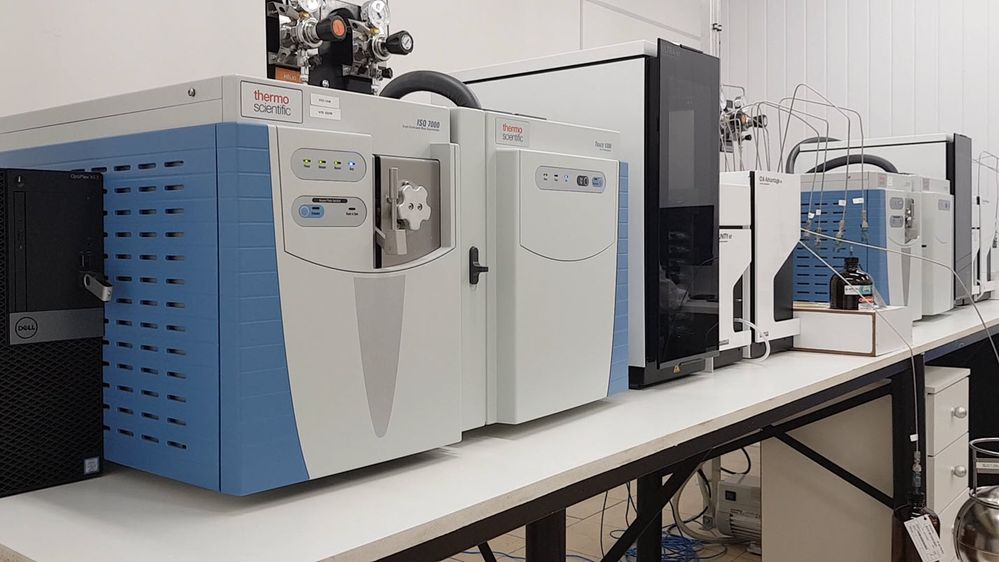
The Thermo Scientific ISQ 7000 GC-MS connected to the Markes TD and CIA Advantage is successfully used to perform air analysis, supporting environmental testing laboratories with high sensitivity, repeatability and robustness. This is what Vapor Solutions, a Brazilian contract testing lab specialized in soilvapor/air analysis, is experiencing.

Looking for high sample throughput capabilities, Vapor Solutions analyzes about 600 samples/month, with the goal of reaching throughput of +1000 samples/month in the near future. Uptime and reduced scheduled maintenance are key for Vapor Solutions to boost their productivity.

Thermo Fisher Scientific is proud to provide advanced analytical technologies to environmental testing laboratories like Vapor Solutions, supporting their commitment to serve customers with excellent quality results on time.

MOSH MOAH image

MOSH/MOAH Analysis: Technology, Regulation, and the Road Ahead

Mineral oil hydrocarbons (MOSH) and mineral oil aromatic hyd...

Read More
wine bottle image

New European Wine Scandal on PFAS in Wine

Introduction PFAS, also known as “eternity chemicals&#...

Read More
Brooklynn McNeil

GC Orbitrap Guru Series #2: Brooklynn McNeil

Hey everyone! Welcome to the second post in the GC Orbitrap ...

Read More

Tackling PAH Analysis in Environmental Samples: Overcoming the Challenges with Advanced GC-MS Technology

Polycyclic aromatic hydrocarbons (PAHs) are a group of organ...

Read More

Dr. Daniela Cavagnino

Dr. Daniela Cavagnino is Product Marketing Manager for GC and Sampling Solutions. She started her career in gas chromatography at Thermo Fisher Scientific spending several years in the R&D laboratories working on GC technology innovation. Then, she conveyed her technical background into product management and marketing management roles with more than 20 years’ experience in promoting GC/GCMS technology and applications in several different market segments.
Alkanolamine Determination by Ion Chromatography Enhanced Using Advanced Cation-Exchange Columns
Experts Discuss the Role of Chromatography in LC-MS Proteomics: Listen to the Podcasts

Privacy StatementTerms & ConditionsLocationsSitemap

© 2025 Thermo Fisher Scientific. All Rights Reserved.

Talk to us