Thermo Fisher Scientific

Your educational resource for biopharma, pharma, environmental, food and agriculture, industrial, and clinical labs

  • Categories
    • Advancing Materials
    • Advancing Mining
    • AnalyteGuru
    • Analyzing Metals
    • Ask a Scientist
    • Behind the Bench
    • Biotech at Scale
    • Clinical Conversations
    • Examining Food
    • Identifying Threats
    • Illuminating Semiconductors
    • Life in Atomic Resolution
    • Life in the Lab
    • OEMpowered
    • The Connected Lab
  • About Us
  • Contact
Accelerating ScienceAnalyteGuru / Gas Chromatography / What Good is Conserving Helium Carrier Gas Only When Your GC System is Idle?

What Good is Conserving Helium Carrier Gas Only When Your GC System is Idle?

By Dr. Daniela Cavagnino, Product Marketing Manager, GC/Autosampler, Thermo Fisher Scientific 04.13.2022

Effective helium conservation is once again becoming a real need for many laboratories worldwide. If helium is still your choice for GC and GC-MS analysis and you are not willing to convert to a different carrier gas, then you should know there is a much more effective way to conserve helium.

Two years ago I commented on Helium Shortage 3.0. It was the beginning of 2020 and the expectation was that helium availability would gradually recover in 2021, thanks to new production capability in Amur, Russia, where helium is extracted as a byproduct of natural gas. But it remained productive for only a short time.

Unfortunately, political instability in Europe, and technical issues combined with fire accidents at the Amur helium plant, will delay production until late 2022 or possibly 2023. This will generate another wave of helium shortage and price spikes, referred to by experts as Helium Shortage 4.0. This time, the non-availability of the gas seems to be much more severe than the higher price.

Listen to this C&EN Podcast: The helium shortage that wasn’t supposed to be

C&EN Podcast: The helium shortage that wasn’t supposed to be

How can labs avoid recurring shortages and the high price of helium?

Analysts using gas chromatographs have different options to relieve this pressure. Moving to a different carrier gas, like hydrogen or nitrogen, is definitely a convenient solution, and many laboratories are adopting this approach and converting their methods. Hydrogen is particularly suitable to combine lower costs with high separation efficiency at higher flow rates, offering shorter analysis time.

However, not all laboratories are willing to convert and re-validate their methods, and some may have concerns about safety issues associated with using hydrogen.

Modern technology allows laboratories that need to maintain helium as a carrier gas, to significantly reduce the helium consumption, alleviating the pain of costs and supply shortage.

However, easy solutions offered for reducing helium consumption are limited to automatically swapping with another gas — typically nitrogen — when the instrument is not running samples, like overnight or during the weekend. With the introduction of the new Thermo Scientific TRACE 1600 Series GC, the proprietary iConnect Helium Saver SSL injector offers gas chromatographers a unique way to dramatically reduce helium gas consumption during operation, as well as during standby conditions, providing real 24/7 savings.

What differentiates iConnect Helium Saver SSL from other helium-saving solutions?

The majority of carrier gas consumption is due to splitting the sample during injection and keeping the injector purged during analysis. If a gas saver solution is not capable of removing these major sources of consumption, it can offer only partial savings, especially for high-throughput laboratories that run instruments around the clock.

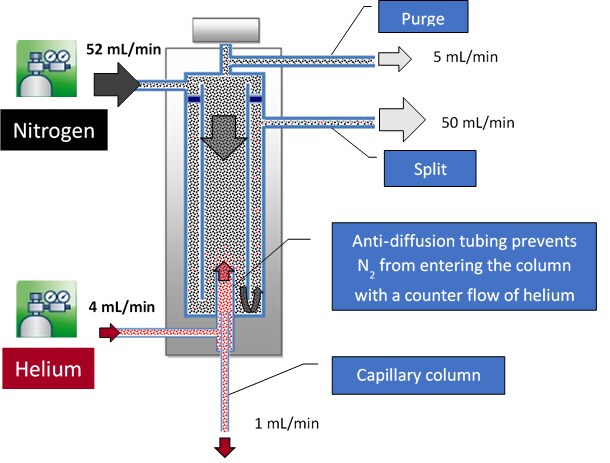
Think how much helium you can save by feeding a limited flow of helium, slightly more than what is required through the capillary column for the separation process. This is exactly what the iConnect Helium Saver SSL injector offers.

Schematic of the iConnect HeSaver SSL injector

Learn more about how the Helium Saver SSL works by watching this video.

If you wonder how much helium you can save, consider that a cylinder of helium connected to one instrument can last from 3.5 to 14 years, depending on how much the GC or GC-MS is used. Try the Helium Saver Calculator to discover how much you can save based on your method and sample throughput.

The smart design of the iConnect Helium Saver SSL injector offers additional benefits worth highlighting:

  • Turning off helium pressure and letting nitrogen feed the column when the instrument is not running samples is quick, as is restoring helium operations. There is no need to wait until the entire pneumatic circuit is swept with new gas, because helium and nitrogen are supplied directly to the SSL injector using independent lines.
  • The column is separated from the inlet (except during the sample injection period) because the carrier helium is not flushing through it. Therefore, there is much less transfer of byproducts/sample matrix from the inlet to the column, preserving column performance/lifetime.
  • Pressurizing gas (nitrogen) can be closed while the column remains under helium flow. Inlet maintenance can be done without the need to cool down the GC oven, making this operation even quicker.

Don’t let the helium crisis shut your laboratory down or drive your costs up. Saving helium has never been easier and more effective while keeping your methods intact, validation-effective, and regulation-compliant.

Related Content

  • Helium Shortage and Price Spikes: Which is More Concerning?
  • Video: A better way to manage gas consumption with the HeSaver-H2Safer technology
  • Moving to Hydrogen or Staying with Helium? A solution to support both choices
Fairy light background image

When “Fairy Lights” Turn Toxic: The Hidden Hazard of Chlorinated Paraffins

Are you looking forward to the holidays and a lot of cozy ev...

Read More
wine bottle image

New European Wine Scandal on PFAS in Wine

Introduction PFAS, also known as “eternity chemicals&#...

Read More
Chromeleon CDS: Hints and tips to help optimize your GC-MS workflows

Chromeleon CDS: Hints and Tips to Help Optimize your GC-MS Workflows

Gas Chromatography-Mass Spectrometry (GC-MS) is a workhorse ...

Read More
Pesticides

Pesticide Residue Analysis in the 21st Century: Innovations in Sample Preparation and Detection Using the Thermo Scientific TSQ 9610 GC-MS/MS

Introduction The accurate detection of pesticide residues in...

Read More

Dr. Daniela Cavagnino

Dr. Daniela Cavagnino is Product Marketing Manager for GC and Sampling Solutions. She started her career in gas chromatography at Thermo Fisher Scientific spending several years in the R&D laboratories working on GC technology innovation. Then, she conveyed her technical background into product management and marketing management roles with more than 20 years’ experience in promoting GC/GCMS technology and applications in several different market segments.
Perform Data Treatment for Chlorinated Paraffins in 10 Seconds?
Algorithms Combine With Chromatography to Help Select the Right LC Column for Your Needs

Privacy StatementTerms & ConditionsLocationsSitemap

© 2025 Thermo Fisher Scientific. All Rights Reserved.

Talk to us