You have a crime scene sample, extracted plenty of DNA, and searched the sample profile against your national DNA database – you’ve received no hits… nothing at all. For many casework labs, the lack of a match is potentially a stopping point in the investigation. Now what’s the next step? First, let’s think about AIMs. Ancestry Informative Markers are SNPs that are scattered across the genome with different frequencies among various populations1 and can be used to assess the biogeographic origins of an individual. Add to that the ability to multiplex and analyze hundreds of such SNPs in a single reaction using massively parallel sequencing (MPS). Now forensic DNA analysts have an avenue for generating investigative leads for their law enforcement partners.
| The Applied Biosystems™ Precision ID Ancestry Panel includes 165 autosomal markers that provide biogeographic ancestry information. Fifty-five of these markers were selected based on a publication by Dr. Kenneth Kidd2 , and 123 markers were selected based on a publication by Dr. Michael Seldin3. These amplicons are all <130 bases in length which makes them ideal for analyzing degraded samples. Let’s take a look at how this approach is being used to evaluate samples and populations from around the globe. | 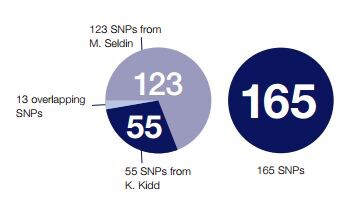 |
mtDNA + Y-STRs + piSNPs + AIMs = Biogeographical Ancestry of a Carbonized Corpse
 An unidentified adult male body was found in Paris (2014) but no further information could be determined. There were no matching dental records, an STR profile did not generate a match to any database and all personal belongings found were charred. The French authorities then approved the use of additional genetic analyses. Hollard, C., et al devised a strategy to analyze mtDNA for maternal lineage, Y-STRs for paternal lineage, AIMs for additional elucidation of biogeographic ancestry and phenotypic SNPs for physical traits. The combined results from all these tests indicated an individual from either the Mediterranean Basin or Southwest Asia. The mtDNA haplotype from EMPOP was HV0, found primarily in west Eurasian populations, the Y-STR profile was E1b1b with a match in 2 Tunisian individuals, piSNP showed a 95% chance of having brown eyes, and AIMs results from Precision ID Ancestry Panel and HID SNP Genotyper showed ancestry from southwest Asia and Mediterranean regions. The admixture analysis from the two subpanels showed slightly different results, likely due to the available underlying populations. According to the authors “…this work has already provided elements that are useful to the progress of the investigation and it also highlighted specific issues that will arise in concrete forensic cases4.
First Step for Using Ancestry Inference in Crime Labs
 The Section of Forensic Genetics at the University of Copenhagen recently published their validation of identity SNP usage in their crime laboratory. They’ve now begun to establish the parameters needed to use ancestry SNPs as well. In Pereira,V et al, the team has evaluated parameters such as locus balance, heterozygote balance and noise level in the Precision ID Ancestry Panel and set their analysis criteria accordingly. In this study, the team analyzed DNA from 142 subjects of Danish ancestry, 98 individuals from Somalia and included data from a previous study of 77 individuals from Greenland5. They include a material and methods section that describes their changes to standard protocol and describe why they have chosen to eliminate 3 SNPs from the final analysis. This study stresses the importance of using suitable reference populations to infer ancestry, particularly populations with admixture6.
Custom Panel Design Tailored to Your Regional Needs
 The EUROFORGEN consortium has designed a new global ancestry informative SNP panel using the Ion AmpliSeq™ design pipeline. Eduardoff, M. et al originally designed a panel consisting of 128 SNPs, of which 125 performed well for a first-time conversion rate of 97.6%. For the three SNP assays that underperformed, two of them were replaced with new assays. After evaluation of the primers, the group recommends pre-selection of markers that avoid homopolymer content and indels in the flanking sequence as a key to success. In this study, the group tested inter-laboratory performance across five sites that included sequencing performance on the Ion PGM™ System, sensitivity analysis via serial dilution and use of degraded DNA samples, and mixture detection. The results for the 14 study populations, across the five major continental populations, showed very good results for group differentiation and admixture detection. However south Asian populations were not well discriminated and additional markers specific to those populations are being sourced7.
More and more labs are investigating how they can implement targeted sequencing of ancestry informative SNPs using MPS to help solve more crimes. Whether it’s an off-the-shelf panel or one designed especially for your geographic region, the Precision ID NGS System for human identification offers flexibility and simplicity for your applications. Dr. Soizic Le-Gunier from IGNA in France has discussed how SNP genotyping will have an impact in the future.
To keep up-to-date on all the latest news from the human identification team, from CE to NGS, you can subscribe to our blog and quarterly newsletter, and follow us on Facebook and Twitter.
References:
- Bruce Budowle and Angela van Daal. Forensically relevant SNP classes. BioTechniques 44:603-610 (25th Anniversary Issue, April 2008)
- Kidd, K et al. Better SNPs for Better Forensics: Ancestry, Phenotype, and Family Identification. Poster presented at the National Institute of Justice (NIJ) annual meeting, Arlington VA, June 2012.
- Kosoy R, Nassir R, Tian C, et al. (2009) Ancestry informative marker sets for determining continental origin and admixture proportions in common populations in America. Hum Mutat 30(1):69–78
- Hollard, C. et al. Case report: on the use of the HID-Ion AmpliSeq™ Ancestry Panel in a real forensic case International Journal of Legal Medicine. March 2017,Volume 131, Issue 2, pp 351-358.
- Espregueira Themudo, Gonçalo et al. Frequencies of HID-ion ampliseq ancestry panel markers among Greenlanders Forensic Science International: Genetics, Volume 24 , 60 – 64
- Pereira,V., et al. Evaluation of the Precision ID Ancestry Panel for crime case work: a SNP typing assay developed for typing of 165 ancestral informative markers, Forensic Science International: Genetics
- Eduardoff, M. et al Inter-laboratory evaluation of the EUROFORGEN Global ancestry-informative SNP panel by massively parallel sequencing using the Ion PGM™ Forensic Science International: Genetics , Volume 23 , 178 – 189
For Research, Forensic or Paternity Use Only. Not for use in diagnostic procedures.

Discover the future of DNA sample prep with me, Kayli Carrillo
Hey everyone! I’m Kayli Carrillo, a PhD student in the For...
Read More
Hernando County Is First in Florida to Use Rapid DNA for Booking
The RapidHIT ID DNA Booking System helps solve and prevent c...
Read More
Rediscovering Gregor Mendel Through Genetics
There are a few names that, even to non-scientists, are repr...
Read More
Unsolved Cases: Lawfully Owed DNA May Hold the Answers
Many states have laws requiring that people arrested, convic...
Read More
Leave a Reply