At Livingston Med Lab in central Texas, the team has long prided itself on doing quality molecular medicine work including qPCR, array cards, and infectious disease panels, and always pushing to offer more to its community. But a roadblock emerged when they asked: how do we scale more efficiently without sacrificing cost or quality?
The Challenge: Maximizing Throughput
Livingston Med Lab runs moderate to high complexity testing in molecular medicine, immunology, hematology, chemistry, allergies and plans to grow into next‑generation sequencing and full toxicology. One key challenge: figuring out which technology to use when, especially given variable sample volumes.
They’d used array cards in the past, but array cards have limits: lower throughput, certain workflow constraints, and sometimes cost inefficiencies when sample numbers increase. When looking at OpenArray technology on the QuantStudio™ 12K Flex system, questions arose:
- When is OpenArray better than array cards?
- What throughput can realistically be achieved?
- What are the cost trade‑offs, and when does the extra investment in reagent and consumables pay off?
These are questions many labs face when balancing precision, speed, and cost.
Bringing in the Field Application Scientist (FAS)
Enter John Pfeifer, Thermo Fisher’s Field Application Scientist. Livingston’s molecular lab supervisor, Sean Villasana, describes the FAS’s role as crucial:
- First, John helped break down when each technology makes sense, not just the “how.”
- He walked through the methods for OpenArray-how to set it up, run it, get good data, what pitfalls to avoid.
- Importantly, the help was remote (and sometimes onsite) but always hands‑on: step by step guidance, including tips & tricks.
The remote support made a big difference-not just for speed of resolution but for cost. For example, eliminating the need for outside contractors to fix or set up certain workflows saved Livingston Med Lab an estimated $60,000–$80,000 in one year just for their HIV testing workflow.
The Turning Point: From Modest to Massive Throughput
With guidance from the FAS, Livingston recalibrated how they use OpenArray vs array cards. The results were dramatic:
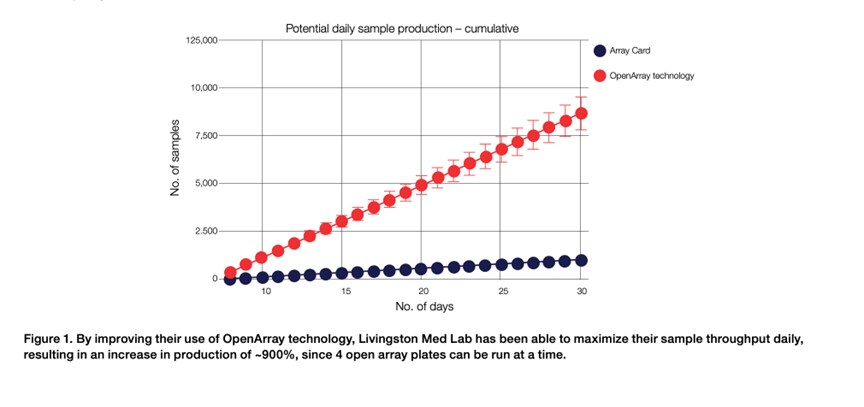
- By switching from array cards (low volume panels) to OpenArray for high‑volume infectious disease panels, they could run 4 OpenArray plates simultaneously, drastically increasing daily sample throughput.
- Where they once were handling small numbers (e.g. 7 samples on a card), they now manage ~23 in a similar timeframe using OpenArray.
Overall, this contributed to nearly 900% scale‑up in daily production.
Strategy Lessons: Matching the Right Tool to the Right Job
The key to success wasn’t simply adopting a new technology-it was leveraging it strategically. Livingston implemented a blended approach:
| Panel Type | When To Use Array Cards | When To Use OpenArray |
| Low sample volume / smaller panels | Use array cards (lower upfront consumable cost) | Not cost-effective to use OpenArray |
| High sample volume / high throughput panels | Array cards too slow, less scalable | OpenArray is faster, more samples, better throughput |
By knowing clearly which panel to route to which platform, and by leveraging the training and support from their FAS, they avoided waste and maximized production where it counts.
The Impact: What This Means for Labs Like Yours
If you run molecular diagnostics, this case has some key takeaways:
- Don’t assume “faster tech = always better.” It depends on your sample load and your panel type.
- Training and support matter. Having a partner who understands both your lab’s constraints and the biology behind the methods accelerates learning and pays off.
- Remote support can give big savings in both time and money. Especially when dealing with unfamiliar technologies or optimizing workflows.
- Scalability isn’t just buying expensive instruments. It’s about process: choosing when to switch platforms, optimizing reagent use, and running multiple plates efficiently.
Resources:
- Read the full customer case study
- Learn more about our services and support
- Have a question? Ask our team of experts

Direct-from-Lysate SNP Genotyping in Research Applications
Can You Perform SNP Genotyping Without DNA Purification? The... Emily Payne, PhD
Read More
When PCR Gets Dirty – Tackling PCR Inhibitors
In this first Absolute Gene-ius: Science Snapshot episode, h...
Read More
qPCR-based fragmentomics for monitoring cancer disease progression
As fragmentomics gains momentum in cancer liquid biopsy rese...
Read More
Tracking grape pathogens from air to vine – a conversation with Lexi Heger
On the Absolute Gene-ius podcast, Lexi Heger, PhD candidate ...
Read More
Leave a Reply