We’re attending and exhibiting at the BIO International Convention in Boston, the largest conference in biotechnology that brings over 20,000 leaders globally. Read on as Jenny Ro, Director, Biotech, Pharma and Applied Segment Marketing, recaps the key takeaways from each day.
I spent most of my morning roaming around the exhibitor floor. Though there were many exhibitors, some of my senior biotech customers expressed that this was just a shell of what it used to be pre-pandemic. They said some of the key industry organization’s booths used to be 4X bigger, and that it was a telling sign of the current challenging macroenvironment for the life science industry.
There were many booths of states and countries trying to showcase their life science ecosystem and potentially attract more into their cluster, and I was especially impressed by the sheer volume of Korean organizations represented in the exhibitor hall. I lost counting after a couple dozen!

Afternoon Session
Building Resilient Global and National Supply Chains
I attended this afternoon session to get a sense on the current state of global supply chain.
Highlights:
What key vulnerability do you see in supply chain from your respective region?
- Rory Mullen from IDA Ireland said there are lots of uncertainty in global supply. As a reaction to that, regionalization of biomanufacturing is happening
- Jurie Hwang from Korea Biotechnology Industry Organization said Korea relies on 95% of API raw and intermediate material supply from outside of their country, mostly China and India. So the fact that they don’t have a global reference is a major vulnerability. Another big pain point for them is that they have strong governmental support for technology and infrastructure, but have a huge gap in workforce in this sector.
- Hilary Stiss from Biotechnology Innovation Organization (BIO) said for the U.S., the lack of government’s understanding on what supply chain is and how to secure it can make it difficult to even pinpoint our main vulnerability. She emphasized that we as an industry need to do a better job at educating our governments on how the global supply chain works. The gap in our biomanufacturing workforce has always been an issue here. Presently, there still are 65,000 open positions in the industry.
- K.Anand Kumar from Indian Immonologicals Ltd. said India’s situation is little bit different than other countries on the stage because raw materials may be coming from everywhere like others, but packaging materials are all coming within India. They also have a significant manufacturing capacity and capabilities. For example, during the COVID pandemic, all COVID vaccines for Indians were manufactured in India unlike most other countries.
What is your strategy for supply chain resilience in your respective country?
- Jurie Hwang said in Korea, government has incentivized clustering the hub organizations critical for biomanufacturing like Samsung Biologics, Thermo Fisher Scientific, Cytiva, etc in Songdo and created a good infrastructure and ecosystem for them. In addition, tax exemption strategy worked well as well as following Ireland’s National Institute for Bioprocessing Research and Training (NIBRT) model for catalyzing collaboration between industry, government and academia.
- Dr. Kumar said for India, the supply chain resilience experienced during the pandemic was a happy accident, but government now recognizes our strength and adopted as a strategy. For India the current focus is on creative nurturing environment for new innovative ideas to grow within India instead of having to rely on others. For example, government is running a“Innovate India” campaign along with more investment in infrastructure and incubators.
What do you imagine you’ll see in 10 years in supply chain:
- Jurie Hwang said for Korea, they need to be able to rely on themselves first before considering expanding to another region or globe. Samsung Biologics came about not by wish but by need to gain national knowledge by doing it ourselves instead of rely 100% on foreign organizations. Korean innovators have been productive at creating Phase 1-2 drug assets and intellectual properties (IP) but because we didn’t have indigenous biomanufacturing know-how and capabilities to go beyond that, they always had to out-license their IPs to others to create new medicine. In 10 years, Korea’s aspiration is to be as equipped and experienced to attract and be the hub for ln-licensing therapeutic assets.
- Rory Mullen said for outsiders, they of course aspire Ireland to be the first landing spot for foreign company’s European region expansion but that they would really like to grow and nurture their own drug development companies.
- Dr. Kumar shared reverse migration is happening after long years of brain drain and he hopes that Indian academic institutions would be in a position to start innovating new ideas to marry them with their internal excellence in manufacturing capabilities.
A representative from a Korean contract API manufacturing company said he would often get a call from foreign companies saying they are trying to diversify their manufacturing sources and ask them to produce their API. However, they themselves also must source raw and intermediate materials from China, so at the end of the day, there isn’t a true diversification. Everyone on the panel agreed that nobody can manufacture API without China’s raw material any time soon and therefore we need to work with them not against them.
Afternoon Session
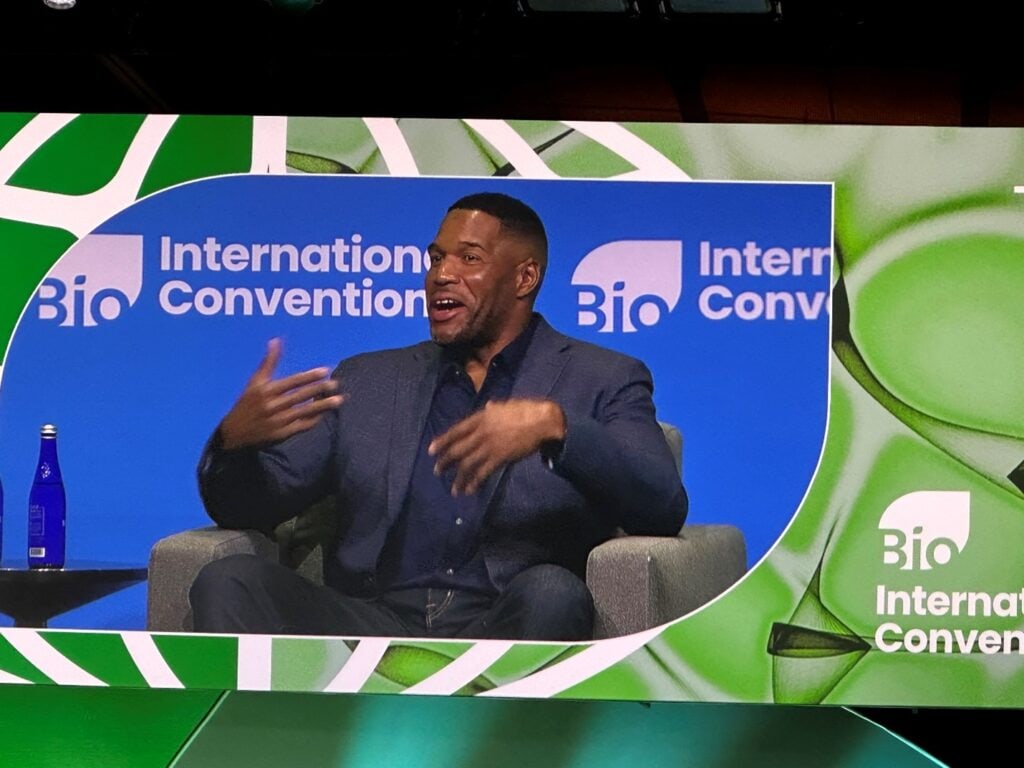
Wednesday Featured Program: Michael Strahan
I wanted to step out of all things life science/biotech/pharma for a bit and this was just the right place for a breath of fresh air.
I knew who Michael Strahan was through his appearance as a host in Good Morning America and Fox NLF Sunday but never paid much attention to his personal story. After I entered the auditorium and listened to him for two minutes, I became an instant fan of his! Everyone is gifted with something, and for Michael, he is truly gifted with being able to lift everyone’s heart by just being present.
A few highlights I took away:
- To be a good storyteller, you need to be a good listener first.
- The secret to success behind all of his entrepreneurial ventures: Surround yourself with good people and don’t take away from others.
- HLYB mindset: Hustle Like You are Broke! It came about while working with Tony Gonzales who initially was hustling like a rich man. If you are not passionate about what you want to create, or aren’t hungry enough to put work behind it, you can’t succeed.
- He shared a lot of heartfelt stories about one of his daughters, Isabella. She was diagnosed with medulloblastoma, a form of brain cancer that is known for having a better prognosis than glioblastoma. With successful surgery, now she is cancer free!
- Once you become a parent, your heart lives outside of your body and in your children. Since he has become a father, he never stops being concerned about his three kids regardless of their age. I think every parent can relate to that!
- Strahan rule: Do not pre-judge! Life is about connecting and seeing different perspectives. He never closes off or blocks anyone from sharing something with him because people fascinate him and he can learn so much.
Perhaps his prolific multifaceted career came about because of Michael following his heart and curiosity with Strahan rule!


“Lighthouse Hubs” Can Create Specialized Clusters in Europe to Elevate Particular Sub-Disciplines in the ATMP-Field
When experts from across Europe sit around one table to deba... Frauke Graalfs
Read More
Which Financial Solution Is Right for You? A Guide for Biotech Leaders
Whether you’re a startup navigating early fundin...
Read More
Smart Leasing Strategies for Growth-Phase Companies
The scientific landscape is undergoing a lot of change and c...
Read More
Balancing Progress and Cash Flow: How One Pharmaceutical Company Optimized Funding with an Extended Terms Agreement
Pharmaceutical companies often face long timelines and ...
Read More
Leave a Reply