
In the fast-evolving field of cell and gene therapy, keeping up with the latest advancements and best practices is crucial for professionals involved in the development and production of biotherapies. Recently, a pair of highly informative webinars titled “Analytical Strategies for Sterility and Mycoplasma Testing in Biotherapies: From Early Development to Production Scale-Up” and “Overcoming Challenges in Cell Therapy Production: Insights from the Latest Webinar on Rapid Sterility Testing” provided valuable insights into the critical aspects of sterility and mycoplasma testing. Hosted by a team of specialists from BioInsights and Thermo Fisher Scientific, these webinars delved into the types of analytical testing that can be implemented at early stages of therapeutic development and scaled to meet the challenges of production. This article recaps the key takeaways from the webinars, highlighting the importance of robust testing methods which help to ensure the safety and efficacy of cell therapy products.
On-demand webinars
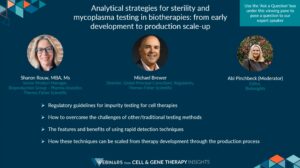
Analytical Strategies for Sterility and Mycoplasma Testing in Biotherapies: From Early Development to Production Scale-Up
| Sharon Rouw, Senior Product Manager with the Bioprocessing Group at Thermo Fisher Scientific, is responsible for the development and commercialization of testing applications for microbiology, analytical sciences, and quality control. Mike Brewer, Director, Global Principal Consultant of Regulatory for the Bioprocessing Group at Thermo Fisher Scientific, provides global support to bioprocessing customers and serves as the regulatory thought leader and specialist across all technology areas within bioprocessing. |
Hosted by Abi Pinchbeck, BioInsights Editor |
Overcoming Challenges in Cell Therapy Production: Insights from the Latest Webinar on Rapid Sterility Testing
| Seth Peterson, Senior Manager of Application Support at Thermo Fisher Scientific
|

Hosted by Roisin McGuigan, BioInsights Editor |
Complexity of cell therapy workflows
In the webinar, Mike Brewer outlines the cell therapy workflow, from isolation of cells from the patient, followed by processing, selecting appropriate cells, engineering them with the transgene or genetic modification, and then expanding the cells. After cell expansion, the cells are processed, washed, and prepared into the final dosage form for infusion. Brewer emphasizes the complexity of both the product and the process.
Seth Peterson highlights the intricate nature of cell therapy workflows, particularly for Advanced Therapy Medicinal Products (ATMPs) like CAR T-cell therapy. These therapies involve complex processes, including the harvesting and modification of a patient’s T-cells to target cancer cells. Given the rapid growth in the field and the increasing number of approved treatments, efficient and reliable sterility testing is paramount.
Peterson further explains that cell therapy products are incredibly complex and involve multiple workflows, whether they are CAR-T, CAR-NKs, allogenic, autologous, or even xenogenic. With such complexity, analytical testing becomes crucial as the product nears patient administration. During his presentation, Peterson covers the various areas of the workflow that benefit from analytical testing and the regulatory compliance required.
Analytical testing in cell therapy
Peterson highlights the importance of various layers of characterization and testing in biotherapeutics, particularly in two main categories: identity (potency, viability, titer) and purity (sterility testing for bacteria, fungi, mycoplasma, and process residuals). For cell therapies, these categories help ensure the product’s integrity and safety.
Adding to the discussion, Brewer stresses the importance of choosing analytical assays that comply with or exceed regulatory guidelines. He highlights the benefits of integrated sample-to-answer solutions, which can speed up the implementation process, facilitate optimization of routine use, and help ensure scalability. Brewer encourages planning for success early in development to accommodate future needs, such as testing an increasing number of samples as the product moves from development to commercial launch.
From a regulatory standpoint, guidelines from the US FDA and European Pharmacopoeias support the use of rapid and advanced detection capabilities for sterility testing. For instance, FDA 21 CFR 610.12 states that manufacturers may benefit from using sterility test methods with rapid and advanced detection capabilities. This is especially crucial for cell therapies with limited shelf lives.
Characterization and testing
Characterization of biological products includes determining physiochemical properties, biological activity, immunochemical properties, purity, and impurities. Brewer’s focus was on purity—particularly mycoplasma and sterility testing. He provides a regulatory perspective, referencing FDA guidance on CAR-T cell products and the need for rapid sterility tests, rapid mycoplasma tests, and rapid endotoxin tests.
Regulatory landscape and guidelines
Recent updates from the FDA, including the January 2024 guidelines, emphasize the need for rapid sterility testing methods. These guidelines recommend a risk-based approach, considering factors such as time-to-result, specificity, limit of detection (LOD), and sample size. Rapid methods, particularly nucleic acid amplification techniques, are encouraged to ensure timely and accurate sterility testing.
Peterson notes that while guidelines like USP <1071> are recommendations and not enforceable methods, they serve as a crucial reference for selecting appropriate rapid sterility tests. The guidelines suggest that the selection of a rapid sterility test should be driven by a risk-based approach, with stakeholders choosing their preferred technology based on specific product attributes.
Brewer explains that traditional culture-based assays for mycoplasma and sterility testing are often impractical for cell therapies with limited dating periods. The FDA recommends using PCR-based mycoplasma assays or other rapid detection assays with adequate sensitivity and specificity. Mycoplasma testing is typically done after cell expansion and before final dosage form processing, while sterility testing is performed on the final dosage form before patient infusion.
Rapid molecular testing methods
Sharon Rouw discusses the challenges of traditional 28-day culture-based tests for mycoplasma, which can delay lot disposition and increase costs. She introduces PCR-based tests as an alternative, offering high sensitivity and specificity, low cost per sample, and the potential for same-day lot release. These tests use genomic DNA and do not require live control organisms during validation.
Thermo Fisher Scientific solutions
Mrs. Rouw presented Thermo Fisher Scientific’s MycoSEQ and MycoSEQ Plus Mycoplasma Detection Kits, both designed to meet regulatory guidelines for lot release. These kits offer a complete analytical solution that can be completed in five hours and include relevant controls to ensure reliable results. The MycoSEQ kit is a legacy product with a strong track record of regulatory acceptance, while the MycoSEQ Plus kit is a newer offering with a TaqMan probe-based approach.
Workflow and automation
Both MycoSEQ and MycoSEQ Plus kits work with PrepSEQ nucleic acid extraction kits for flexible and scalable testing. The automated express instrument allows for walk-away extraction, reducing preparation time and variability. The AccuSEQ Real-Time PCR detection software supports GMP labs, enabling 21 CFR Part 11 compliance with security, audit, and e-signature capabilities.
Comparability study
Brewer shares data from a MycoSEQ kit comparability study, which evaluated seven mycoplasma species spiked into a CHO Bioreactor Bulk Rituximab Clarified Harvest sample. The study compared the performance of the MycoSEQ kit, the MycoSEQ Plus kit, and the USP <63> mycoplasma test. The results show both MycoSEQ kits provide robust detection of mycoplasma with 100% positivity in the 24 test replicates for each species.
Introducing the SteriSEQ Rapid Sterility Testing Kit
A highlight of the webinars was the introduction of the SteriSEQ Rapid Sterility Testing Kit, a TaqMan-based qPCR assay designed to detect bacteria and fungi within the same day. This kit offers a comprehensive, user-friendly solution with multiplexing capabilities, enabling simultaneous detection of multiple contaminants with high specificity and sensitivity with specificity achieved through probes and primers designed for the 16S region of bacteria and the 18S region of fungi. The workflow includes DNA sample preparation, reaction setup, running the assay on recommended qPCR systems, and analyzing results with AccuSEQ software.
Key benefits of SteriSEQ
- Rapid results—Enables reliable results in less than a day, fitting the rapid testing requirements for cell therapy products
- Multiplex assay—Tests for both fungi and bacteria in a single assay, reducing hands-on work and handling time
- Integrated controls—Includes internal positive and discriminatory positive controls to minimize false positives and false negatives
- Small sample volume—Requires a minimal sample volume, aligning with reduced sampling guidelines outlined in USP <1071> and the European Pharmacopoeia.
Data and validation
Peterson shares data demonstrating the robustness, sensitivity, and specificity of the SteriSEQ assay across various organisms, including bacteria and fungi. The assay consistently delivers reproducible outcomes on both the 7500 Fast and QuantStudio 5 real-time PCR platforms, even with high background cell counts.
The SteriSEQ assay utilizes the full multiplexing capabilities of qPCR by having five targets in a single assay, reducing the need for multiple tubes and hands-on work. Additionally, two integrated controls (internal positive control and discriminatory positive control) help enhance accuracy, minimizing both false positives and false negatives.
Regulatory guidance and workflow integration
Peterson emphasizes that regulatory guidelines suggest multiple test points in the cell therapy workflow. By testing raw materials and additional in-process points, manufacturers can detect potential contamination events much sooner. This approach increases confidence in the final product and aligns with FDA and USP recommendations.
The SteriSEQ system can be leveraged for multiple test points, including raw materials, in-process monitoring, viral vector manufacturing, and lot release testing of the cell therapy product. This comprehensive approach facilitates early detection and timely response to potential contamination events.
Conclusion
The webinars provide valuable insights into analytical strategies for sterility and mycoplasma testing in biotherapies, emphasizing the importance of rapid, reliable testing methods that comply with regulatory guidelines. Thermo Fisher Scientific’s MycoSEQ and SteriSEQ kits offer robust solutions for ensuring the safety and efficacy of cell therapy products, from early development to production scale-up.
For those who missed the live session, the webinars are available on-demand. Stay tuned for more insights and innovations in cell and gene therapy production.
Learn more about the SteriSEQ Rapid Sterility Testing System >
Learn more about the MycoSEQ and MycoSEQ Plus Mycoplasma Detection systems >

Start Small to Move Fast: The Benefits of the 5 L DynaDrive Benchtop Bioreactor
In the fast-paced world of bioprocessing, innovation and eff...
Read More
Maximize Uptime and Elevate Performance with Thermo Fisher Scientific FlexCare Services
In the world of bioprocessing, reliable equipment is the bac...
Read More
Scalable Fed-Batch Bioreactor Process for Lentiviral Vector Production
In cell and gene therapy, the production of lentiviral vecto...
Read More
Enhanced Oxygen Transfer in Single-Use Fermentors Revolutionizes High-Density Cultures
In bioprocessing, the ability to cultivate fast-growing, hig...
Read More
Leave a Reply