The adoption of New Approach Methodologies (NAMs) in drug discovery and regulatory toxicology is rapidly accelerating, driven by the critical need for human-relevant predictive models. This need is being reflected in changes in the regulatory and funding environment, with multiple government agencies encouraging the transition away from animal models. In this rapidly evolving field, microphysiological systems (MPS) and organ-on-a-chip (OOC) devices have emerged as key NAMs that could transform how we test drugs and understand human biology.
Microphysiological Systems
Microphysiological Systems (MPS) are advanced, in vitro platforms that replicate the structure and function of human tissues and organs using living cells within engineered microenvironments. These systems are designed to model physiological responses and disease processes in a controlled setting, providing more accurate predictions of human outcomes compared to traditional cell culture or animal testing methods.
Through a strategic alliance, Thermo Fisher Scientific and AIM Biotech are collaborating to develop standardized, reliable microphysiological systems. Thus far, the partnership has focused specifically on creating vascularized tumoroid models, an application of MPS technology that could revolutionize cancer research and immunotherapy development. In this project, AIM Biotech contributes their proprietary organiX (MPS for organoids and biopsies), VasQ Kit (all-in-one vascularization solution), and technical expertise, while Thermo Fisher Scientific provides well-characterized patient-derived tumoroid models, fit-for-purpose OncoPro Tumoroid Culture Medium, and an extensive array of supporting reagents.
Microfluidic Platforms
AIM Biotech’s microfluidic platforms are highly standardized, easy-to-use, and scalable solutions optimized for complex, high-fidelity three-dimensional (3D) tissue culture and microenvironment control. The platform’s core competitive advantages are derived from specialized engineering innovations that overcome common limitations in traditional organ-on-a-chip (OoC) systems. These innovations include a patented post design crucial for matrix stabilization and the integration of a gas-permeable laminate, which enable efficient gas exchange while doing away with the need for rockers or pumps. Thermo Fisher Scientific provides a wide variety of cGMP reagents for cell growth and analysis, offering the building blocks needed to develop, characterize, and perform assays using MPS. AIM Biotech has also chosen to deploy OncoPro Tumoroid Cell Lines, which are patient-derived cancer organoid models, due to their recapitulation of key mutations and gene expression profiles present in the tumors from which they were derived.
Generation of Vascularized Tumoroid Models
In initial work, Thermo Fisher Scientific’s OncoPro Tumoroid Culture Medium and OncoPro Tumoroid Cell Lines have been used to incorporate physiologically-relevant, patient-derived tumoroid models within AIM Biotech’s microfluidic platforms. AIM’s VasQ Kit provides users with many of the necessary building blocks to set up microvascular networks reproducibly. AIM’s organiX plates are designed to accommodate organoids or biopsies. Co-culture of tumoroid models, endothelial cells, and fibroblasts in hydrogel matrices generates perfusable microvascular networks that surround and interface with tumoroid models. These human relevant models can be reproducibly established on AIM Biotech’s organiX platform and could be used to study vascular delivery of biologics or immune cells to solid tumors or the impact of the tumor microenvironment on vasculogenesis. By incorporating OncoPro Tumoroid Cell Lines derived from various cancer indications and using Thermo Fisher Scientific imaging reagents to visualize different cell types and states (e.g., apoptotic cells), the interaction of these cellular compartments can be quantified and compared.
Microphysiological Systems for Drug Development
By providing more physiologically relevant environments than traditional two-dimensional culture systems, MPS can support the evaluation of biological responses in the early stages of research. These systems may provide insights that inform progression from discovery through Investigational New Drug (IND)–that can help enable studies by improving preclinical model accuracy and data relevance.
The combination of Thermo Fisher Scientific reagents and patient-derived models with AIM Biotech’s microfluidic technologies, including the organiX and VasQ platforms, supports reproducible and standardized assay conditions. The use of consistent reagents and microengineered environments can help minimize experimental variability and help support the generation of reliable datasets suitable for cross-study comparison.
Although many current applications focus on oncology research, MPS platforms can also be used in a variety of contexts, including drug screening, efficacy testing, and personalized medicine research. Within oncology, vascularized tumoroid models can be used to study interactions among tumor cells, stromal components, and the vasculature in a three-dimensional context. Similar approaches can be adapted for other therapeutic areas to evaluate compound activity, mechanism of action, and tissue-level responses in human-relevant models.
Collaborative efforts between technology developers and reagent providers can help continue to advance the standardization of these systems, supporting broader adoption of MPS within preclinical and translational research settings.
New Approach Methodologies
Microphysiological systems are only one part of a larger shift toward animal-free, human-relevant testing. See how New Approach Methodologies are transforming drug discovery, and dive deeper in our related New Approach Methodologies blog post.
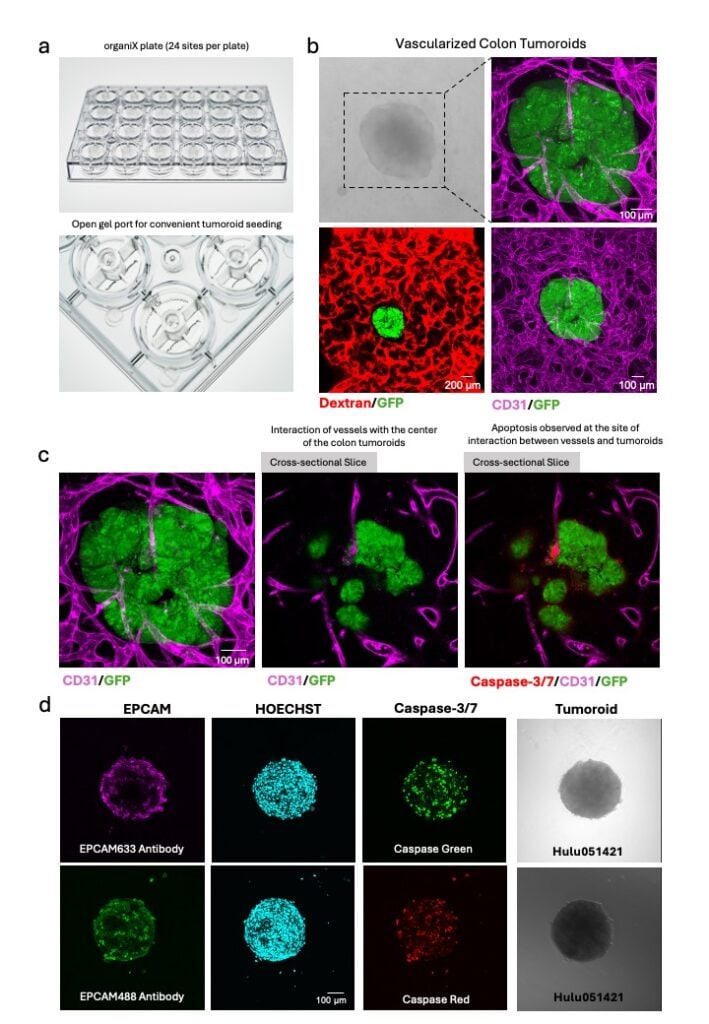
Figure 1. Generation of vascularized tumoroid models. (a) AIM Biotech organiX plates with 24 individual inserts that accommodate organoids or biopsies up to 2 mm in diameter. (b) Images of vascularized tumoroid (colorectal cancer, HuCo1044-GFP) model where the tumor cells have been engineered to stably express green fluorescent protein (GFP). Microvascular networks can be perfused with media containing Texas Red-labelled dextran to visualize intact vessels. In the right panels, the endothelial cells in the microvascular network are stained with an anti-CD31 antibody and imaged to visualize vasculature-tumoroid interactions. (c) Detailed images of vasculature and HuCo1044-GFP colorectal tumoroids, highlighting interaction of vessels with tumor cells and detection of apoptotic cells (by CellEvent™ Caspase-3/7 staining) in a cross-sectional slice of the tumoroid visualized using confocal microscopy. (d) Staining of lung tumoroids (HuLu051421) cultured in organiX device and stained with anti-EpCAM antibodies, Hoechst 33342, or CellEvent caspase indicators to delineate tumoroid boundaries, cell nuclei, and apoptotic cells, respectively.
This work has significant implications for cancer research and immunotherapy development, potentially providing standardized platforms for screening cellular therapies and assessing immune cell infiltration. The partnership between Thermo Fisher Scientific and AIM Biotech exemplifies how industry collaboration can drive standardization in the use of advanced in vitro models such as microphysiological systems. By combining their expertise and resources, these companies are not only advancing their own technologies but also contributing to broader efforts that will ultimately benefit drug discovery and development.
Learn more about how New Approach Methodologies are transforming drug discovery.
Related Content
New Approach Methodologies (NAMs) in Drug Development
Five steps to establishing tumoroid models for cancer research
Intended Use Statements may vary.

5 Solutions for Overcoming Research Challenges in Vaccine Development
What are the main challenges in vaccine development? The mai...
Read More
Spatial Omics Meets Neuroscience: Dual ISH-IHC Brain Mapping Case Study
Spatial omics biology is reshaping how researchers study com... Dana D'Amico
Read More
APD vs PMT and Beyond: Flow Cytometry Light Detectors
Flow cytometry relies on sensitive photodetectors to convert... Aram Schiffman Eric Finan
Read More
Financing Your Lab Expansion: How to Make the Most of Flexible Options
Scaling a biotech lab is a thrilling milestone—new experim...
Read More
Leave a Reply