 Portable XRF analyzers are used by regulatory agencies, manufacturers, and distributors because they are helpful in screening consumer products for lead and other toxic metals. We’ve previously talked about XRF analysis of toys, beaded necklaces, electronics parts, and plastic scrap materials.
By enabling rapid screening of metals, plastics and paints at the receiving dock, in the warehouse, during product assembly, and in finished goods, XRF analyzers greatly reduce the chance that hazardous materials will enter the manufacturing process or accidentally end up in children’s hands. However, are the XRF analyzers safe themselves?
If you use portable x-ray fluorescence (XRF) analyzers for identifying toxic metals in paints and plastics, do you wonder if they emit radiation and if they are safe? Should you take precautions?
X-ray fluorescence (XRF) is a non-destructive analytical technique used to determine the chemical composition of materials. XRF occurs when a fluorescent (or secondary) x-ray is emitted from a sample that is being excited by a primary x-ray source. See image below:
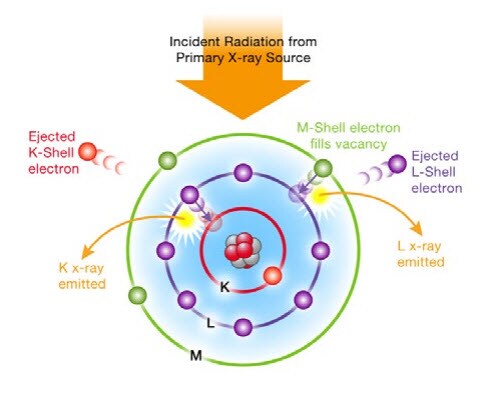
Because this fluorescence is unique to the elemental composition of the sample, XRF is an excellent technology for qualitative and quantitative analysis of the material composition.
During the analysis, the analyzer emits a directed radiation beam when the tube is energized (tube based instrument) or when the shutter is open (isotope based instrument). Reasonable effort should be made to maintain exposures to radiation as far below dose limits as is practical. This is known as the ALARA (As Low as Reasonably Achievable) principle. For any given source of radiation, three factors will help minimize your radiation exposure: time, distance, and shielding.
While the radiation emitted from a portable XRF analyzer is similar to the exposure received in a normal medical or dental x-ray, care must be taken to always point a handheld XRF analyzer directly at the sample and never at a person or a body part.
Radioactive material is considered a hazardous material (HAZMAT) for the purposes of transport. This means that the transportation of a portable XRF device containing radioactive sources is regulated.
Want to know more about XRF and how it works… but you don’t want to delve into the details because you are not a scientist? Then download this free eBook – XRF in the Field: XRF Technology for the Non-Scientist .
XRF in the Field: XRF Technology for the Non-Scientist, written by an expert in X-ray fluorescence (XRF) techniques, explains the technology in an easy-to-understand manner.

Register now to download your free eBook!

K 2025: Showcasing the Future of Sustainable, Smart, and Responsible Plastics Production
This week, more than 3,000 exhibitors and 177,000 visitors f... Keith Cornell Nimesh Khadka, PhD
Read More
Monitoring the UV Cure Process of a Polymer Based Ink by FT-IR
Can the degree of cure of a polymer-based ink applied to a M...
Read More
Advances in Analytical Technologies for Battery Manufacturing
Introduction Recent advancements in analytical technologies ... Kyle D'Silva
Read More
Battery Professionals Organization Hosts Webinar on Advanced Analytical Technologies. Here’s a Recap.
Editor’s Note: A recent webinar hosted by the Volta Fo... Kyle D'Silva
Read More
Leave a Reply