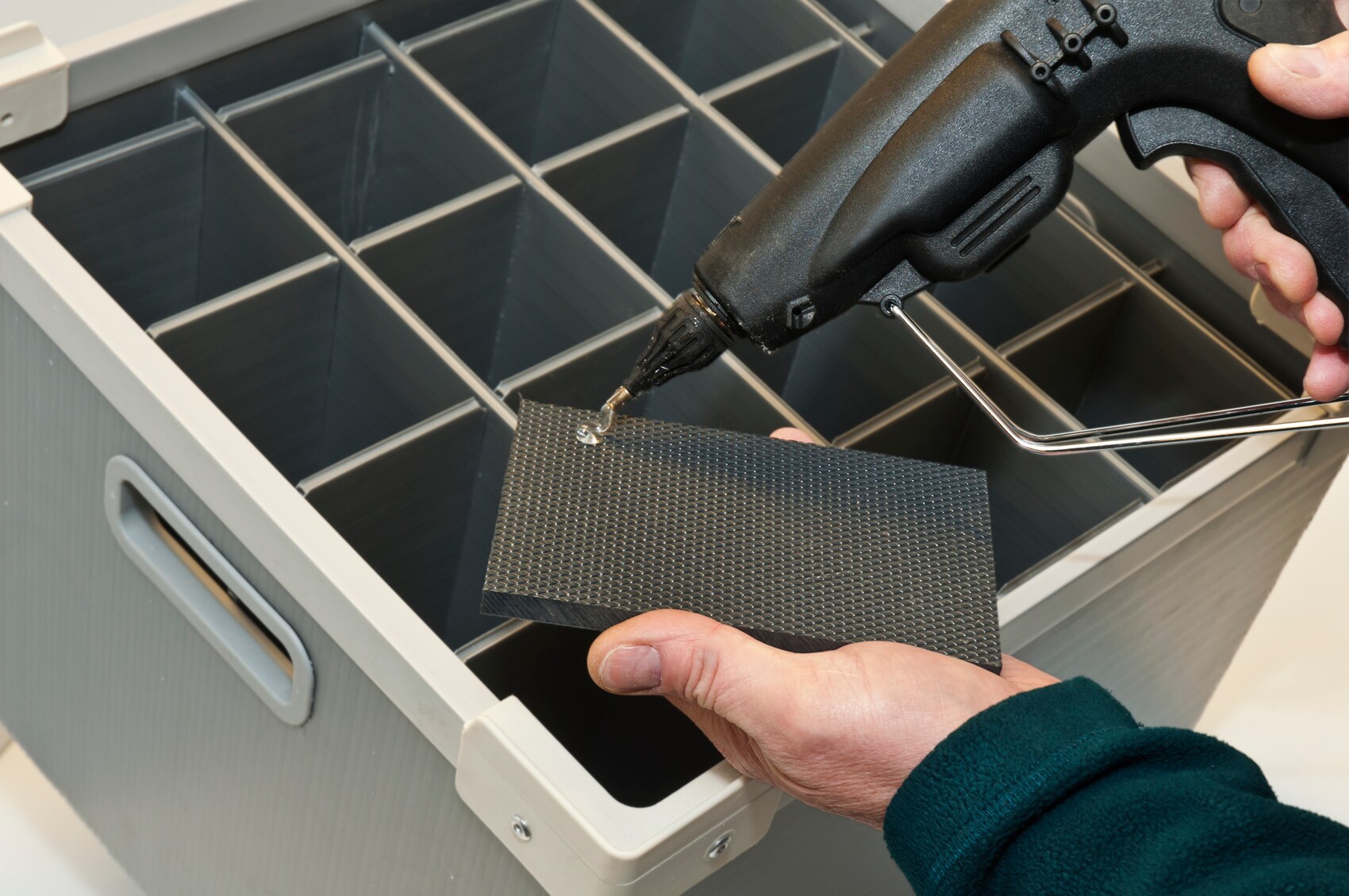
 Is there an adhesive on the market that seems to have the same characteristics and is of the same quality as the one you produce? Or maybe better quality? Reverse engineering is a way to determine how competitive products have been formulated or if there has been a patent infringement. An FT-IR spectrometer can be used to reverse engineer and identify the adhesive in question to determine its primary ingredients.
We conducted a study to determine the primary ingredients of an uncured acrylate adhesive. A small drop of the material was deposited on the surface of the diamond crystal on a built-in diamond ATR accessory of an FT-IR spectrometer.
Fourier Transform Infrared (FT-IR) spectrometers are the standard for organic compound identification work in academic, analytical, QC/QA and forensics laboratories. FTIR spectroscopy is used to quickly and definitively identify compounds such as compounded plastics, blends, fillers, paints, rubbers, coatings, resins, and adhesives. It can be applied across all phases of the product lifecycle including design, manufacture, and failure analysis, as well as reverse engineering.
The spectrum of the uncured acrylate adhesive was collected under these conditions:
- A small drop of an acrylate adhesive (Dymax 6-621-GEL) was placed on the diamond crystal of a FT-IR spectrometer built-in diamond ATR accessory.
- The IR Spectrum was collected at 4 cm-1 resolution, coadding 32 scas (<1 minute)
- The spectrum was processed with an innovative identification and interpretation software tool that uses a multi-component search algorithm to perform a mixture search and identify the primary components of the mixture.
In a typical library search algorithm, a single spectrum that represents the best match to the unknown spectrum is displayed as the top hit from the search. For a mixture, this may be one of the components of the mixture, or it may display a spectrum of a molecule that has the same functional groups as the mixture. Neither case is correct. With the software tool, the number of components can be pre-determined to fit to the unknown spectrum (up to 4), and the program can search through the combination of spectra in the library that best matches the spectrum of the unknown mixture, displaying not only the individual components but also their relative concentrations.
The results of the analysis of the acrylate adhesive are displayed here.
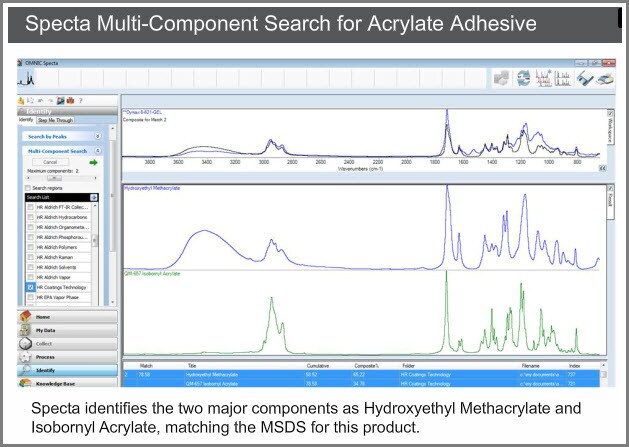
The components were identified as hydroxyethyl methacrylate and isobornyl acrylate, matching the Material Safety Data Sheet for the major components of this product. The mixture spectrum is displayed in the top panel in blue, and the composite spectrum constructed from roughly a 2:1 ratio of the individual components is displayed in the top panel in black. We can see that most of the major peaks are accounted for in the composite spectrum, leaving only a few peaks from other minor components of the mixture.
We recently conducted a webinar on the Analysis of Automotive Adhesives Using FTIR Spectroscopy, and discussed the above example during the webinar. You can download the recorded 30-minute webinar here, which is available on demand until March, 2017.
Access the webinar now: Analysis of Automotive Adhesives Using FTIR Spectroscopy

Enhancing aircraft engine performance
SEM analysis of René N5, a nickel-based superalloy for hig... Alice Scarpellini
Read More
Why Ultra-High-Purity Gas Analysis Outperforms Conventional Methods in Semiconductor Manufacturing
As semiconductor production reaches unprecedented levels of ... Daniel Merriman
Read More
Modular Multiplex Raman vs. Traditional Multiplexing: A Smarter Approach to Process Monitoring
In process analytical technology (PAT), few innovations have... Janam Pandya
Read More
How Parts-Per-Trillion Gas Analysis Protects Semiconductor Wafer Production
Ultra-high-purity gases are essential to semiconductor manuf... Daniel Merriman
Read More
May you please tell me the contact information of a lab or two that uses your technology? I would like to reverse engineer a clothing fabric adhesive