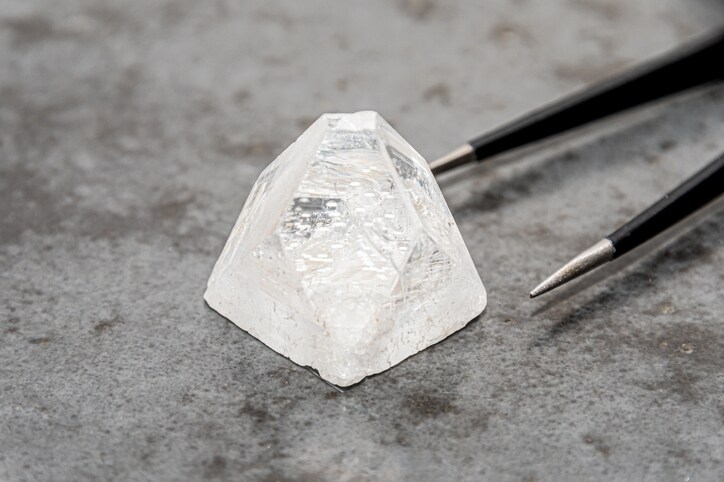
 If you’re thinking about buying diamond jewelry and you’re concerned about procuring diamonds that are conflict-free, Tiffany & Co. has news for you. According to an article on Mining.com, beginning in October, the company will provide customers with expanded origin details for newly sourced, individually registered diamonds that trace the stone’s path from the ground to the jewelry case. The project, which the company says is an industry first, took nearly two decades to complete due to the challenges of tracking down sourcing information.
Tiffany said it doesn’t acquire diamonds from “areas of concern,” such as Zimbabwe and Angola, where international observers say mining is associated with human rights violations. A look at the company’s vast global supply chain, which stretches from Namibia to Cambodia and beyond, shows the challenges of tracking a product that often measures just a few millimeters across.
The new disclosures — which include details on where a stone was mined, sorted, graded, cut and set — expand on Tiffany’s effort last year to begin providing the country of origin for its diamonds. (Read Kimberlite: A Girl’s Best Friend? to learn about the origin of diamonds.)
Of the 30% of mined diamonds that are gem quality and suitable for jewelry, Canada is one of the top three diamond producing countries in the world on the basis of carats produced and has been a major diamond producer for two decades.
According to an article on geology.com, Canadian diamonds are highly regarded because Canadian diamond mines have some of the world’s highest environmental standards. They are also conflict-free, having undergone a certification process that allows the stones to be tracked from mine through manufacturing, wholesaling and to the retail consumer. Many diamonds that have been mined and cut in Canada are documented and have their certificate number laser-inscribed on their girdle along with a trade logo that assures consumers of their diamond’s origin.
Natural diamonds, both gem and industrial quality, are the product of either open pit or underground mining, in which diamonds are contained in kimberlite pipes, or they are extracted from alluvial deposits in riverbeds, coastal, and undersea locations. Each scenario requires an efficient and streamlined mining process to recover the most diamonds in the most economical way. Miners determine if a kimberlite pipe is worth pursuing by conducting regional sampling schemes and airborne geophysical surveys in a precise search area. Once a list of the best targets is assembled, grade analysis is done to find out if the kimberlite is sufficiently diamondiferous.
Recommended reading to learn more about industrial and gem-quality diamonds:
- Synthetic Industrial Diamonds Rule. Will the Jewelry Business Catch Up?
- Diamonds: Not Always Hard to Find?
- Industrial Diamonds – As Good as Gemstones, or Better?
Explore more aspects of mining, exploration, processing, and mineral analysis in the Cement, Coal, and Minerals Learning Center.

What Is In Situ Geochemical Analysis — And Why It Is Critical for Modern Field Operations
In situ geochemical analysis has become a cornerstone of mod... Mathieu Bauer
Read More
Nickel Ore Analysis: Boosting Mining Quality with WDXRF
Accurate analysis of nickel ores is essential for efficient ... Jill Staggert
Read More
The Role of EDXRF Spectrometers in the Extraction of Copper from Ore
Copper extraction is a complex process requiring precise con... Jill Staggert
Read More
A Halloween Treat – Free Periodic Table
No tricks here. Download this handy periodic table and X-ray... Marlene Gasdia-Cochrane, Editor
Read More


Leave a Reply