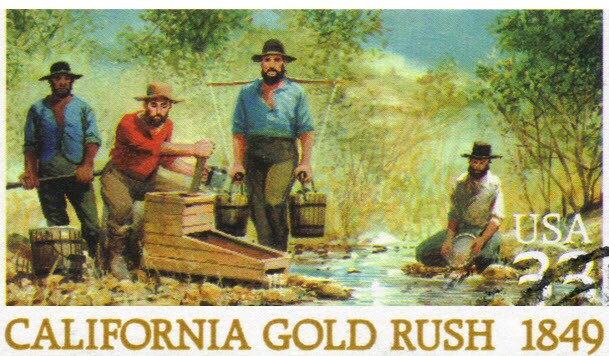
 In 1848, the discovery of a gold nugget in northern California sparked the California Gold Rush, the largest mass migration in U.S. history. Tens of thousands of “49ers” flooded the area to pan for gold. This period gave rise to the popular expression, “Mother Lode,” which is sometimes thought to mean a large amount of treasure, but the term actually refers to the region of California known as the California Gold Belt.
Today, the Mother Lode region is experiencing a rebirth of sorts. As reported in the LA Times, record snow melt is washing gold into streams, and modern-day prospectors are taking up residence to search for gold the old-fashioned way, using buckets and classifiers, hog pans and cradles. The prospectors are looking for signs: ancient rivers, rounded boulders tumbled together, orange soil tainted by rusted iron and veins of quartz hiding gold, or any irregularity such as a riffle, a ledge, or a waterfall, that could create a backward eddy for the gold to escape the water’s momentum and drop to the floor.
A similar situation is happening in Italy. According to CNN, members of the Association of Gold Seekers of Biella are searching this Northern province for gold that has washed down from the melting glaciers of the Alps and been deposited along the banks of the Elvo river. The article explains that the hills just above the Elvo were once part of a vast Roman gold-mining operation and are composed of rocks and stones that local inhabitants separated from the gold-bearing sand. Gold panners are allowed to take no more than five grams, or 0.176 of an ounce, per day, but rarely find even that much.
Modern gold mining is quite different, taking advantage of technological advancements including Portable X-ray fluorescence (XRF) analyzers. While technologies such as XRF have significantly improved the speed, productivity, and safety of mining operations, gold remains difficult to find because it is relatively scarce in the earth and occurs in a variety of rocks and geological environments. Typical prospecting involves examining samples throughout the mine site to determine if the region is worth exploring. To enhance their chances of finding gold, geologists may use geophysical methods to measure variations in the physical properties of rocks that may indicate the presence of gold, such as density, magnetism, electrical conductivity, or natural radioactivity. Although these geophysical methods can be crucial for gold exploration, geochemical methods, including using portable XRF analyzers, are the only methods that can measure concentrations of gold and other associated elements.
XRF sampling techniques are aimed at mapping the distribution of gold and in particular, the various elements associated with gold known as the pathfinder elements (silver, copper, zinc, nickel, mercury, arsenic and barium). Pathfinder elements are very important in finding gold because they help focus the search area. It’s much easier to find the pathfinder elements, due to their higher concentration, than it is to find gold, and once found they can help determine if gold is nearby. Portable XRF analyzers are used in other stages of gold exploration and mining including core logging, identification of lithologies, and even grade control.
To learn about a potential new gold “pathfinder” read Trees, Termites, and …Gold?

A Halloween Treat – Free Periodic Table
No tricks here. Download this handy periodic table and X-ray... Marlene Gasdia-Cochrane, Editor
Read More
Efficient Mining of Tantalum, Niobium, and Tin Using Handheld XRF Analyzers
Most mining operators are familiar with the importance of ta... Pete Anzalone
Read More
Why Mining Organizations are Increasing Investment in Tailings Management
Mining as an industrial activity is set to continue expandin... John Margeson
Read More
What are the Largest Diamonds and How Are they Found?
In previous articles, we wrote about the January 1905 discov... Marlene Gasdia-Cochrane, Editor
Read More


Leave a Reply