This quarter, I am excited to share the news about a newly released system from Thermo Fisher Scientific that will help accelerate yield ramp and address bottlenecks in fab process control.
Process engineers are under intense pressure to tune fab equipment to maximize yield, but things do not always go according to plan. Innovations in device architecture are adding complexity while demanding tighter control. For example, the 3D NAND roadmap is approaching 1,000 layers, and understanding CD trends throughout the device height is becoming imperative. With continued semiconductor 3D scaling, structures that are tens or hundreds of microns beneath the wafer surface often require SEM-based characterization to qualify a process for yield ramp. Typical fab-based techniques have reached their limits.
This is why we are introducing the Thermo Scientific Helios MX1 PFIB-SEM.
Semiconductor development moves fast, and the Helios MX1 PFIB-SEM is designed with this in mind, offering the ability to place the system in the fab for immediate in-line data. Outsourcing metrology or defect analysis to the lab can add several days to the turnaround time. Now, fab engineers can quickly generate, access, and act on data directly.
The ability to perform 3D analysis of structures buried beneath the wafer surface is at the core of Helios MX1 PFIB-SEM technology. To maximize throughput, we have incorporated a multi-ion species plasma FIB column that rapidly removes material to reveal buried features. By using the argon plasma FIB, we have improved throughput by 20x compared to traditional gallium-based milling.

(Left) Argon plasma FIB mill revealing through-volume NAND devices. (Center) SEM image with nanometer-scale measurements of NAND channel CDs. (Right) Plot showing individual channel diameters vs. height through the stack.
We developed the Helios MX1 PFIB-SEM to offer a high-precision workflow for sequential imaging through large-volume samples. These image stacks are automatically reconstructed into detailed 3D models. For metrology, virtual cross-sections can be extracted in any orientation from the 3D dataset to measure profiles such as diameter and shape in individual NAND channels across layers. This approach delivers statistically meaningful data on multi-channel variability and process consistency throughout the device volume.
Our solutions go below the surface to uncover hidden insights within increasingly complex architectures. With a worldwide network of experienced support teams, Thermo Fisher Scientific is a trusted partner in semiconductor development and manufacturing. We are here to help streamline your fab process control.
Check out the Helios MX1 PFIB-SEM launch page

DRAM Device Manufacturing – Illuminating Semiconductors
Dynamic random-access memory (DRAM) plays a crucial role in ...
Read More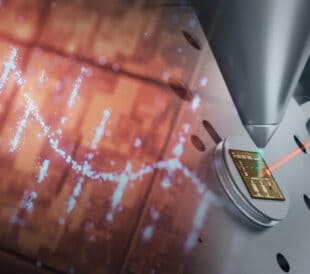
High-Quality TEM Lamella Preparation: Critical Factors and Best Practices
Introduction: The quality of transmission electron microscop... Trevan Landin
Read More
Removing Large Volumes of Material Fast with FIB-SEMs
Focused ion beam scanning electron microscopes (FIB-SEMs) ar...
Read More
Transmission Electron Microscopy in Semiconductors: Generating Ground Truth Insights
What is the current state of TEM in semiconductor analysis? ...
Read More
The need for more granular insight into the wafer at different depths is becoming more critical with advancements like 3D NAND. It’s great to see tools evolving to meet these growing demands, especially when it comes to reducing bottlenecks in the process.