Search
Invitrogen
Monkey IgE ELISA Kit
{{$productOrderCtrl.translations['antibody.pdp.commerceCard.promotion.promotions']}}
{{$productOrderCtrl.translations['antibody.pdp.commerceCard.promotion.promocode']}}: {{promo.promoCode}} {{promo.promoTitle}} {{promo.promoDescription}}. {{$productOrderCtrl.translations['antibody.pdp.commerceCard.promotion.learnmore']}}
{{$ctrl.translations['antibody.pdp.skuNotes.additionalInformation']}}:


Product Specifications
Analytical sensitivity
37.5 pg/mL
Assay range
62.5-4,000
Sample type/volume
Serum
100 µL
Plasma
100 µL
Hands-on time
1 hr 20 min
Time-to-result
2 hr 30 min
Homogenous (no wash)
No
Interassay CV
<10%
Intraassay CV
<10%
Instrument
Absorbance Microplate Reader
Product size
96 Tests
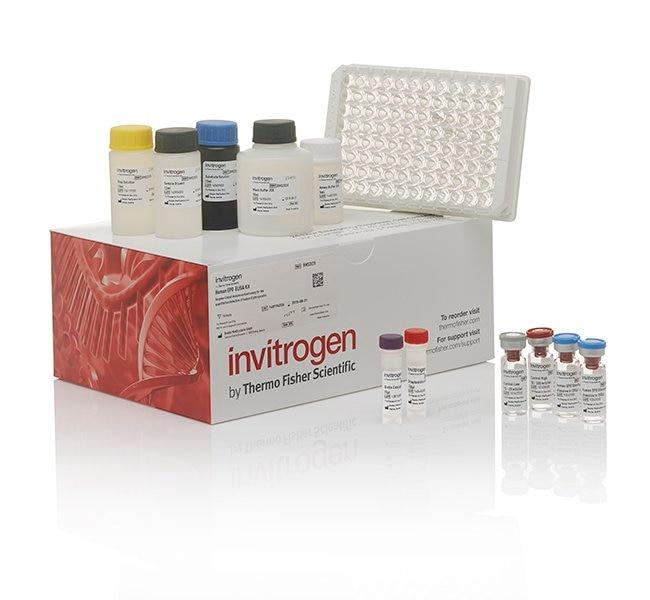
Contents
Pre-coated microwell plate
Standard
Biotinylated Detection Antibody
Streptavidin-HRP
Standard and Sample Diluent
Biotinylated Detection Antibody Diluent
HRP Conjugate Diluent
Wash Buffer Concentrate
Stop Solution
Substrate Solutio
Adhesive Plate Covers
Standard
Biotinylated Detection Antibody
Streptavidin-HRP
Standard and Sample Diluent
Biotinylated Detection Antibody Diluent
HRP Conjugate Diluent
Wash Buffer Concentrate
Stop Solution
Substrate Solutio
Adhesive Plate Covers
Shipping conditions
Wet ice
Storage
At 2-8°C for one year. Protect from light. Do not freeze.
Protein name
Monkey IgE
Species (tested)
Non-human primate
Detector antibody conjugate
Biotin
Label or dye
HRP
About This Kit
The Monkey IgE (Immunoglobulin E) ELISA quantitates IgE in serum, plasma, and other biological fluids.
Target information
The IgE gene in monkeys, particularly in cynomolgus monkeys, has garnered significant interest due to its similarities with human IgE. IgE antibodies play a critical role in allergic reactions and are involved in several allergic conditions including asthma and atopic dermatitis. Studies have shown that IgE in cynomolgus monkeys binds to receptors with an affinity similar to human IgE, suggesting these primates as a valuable model for preclinical studies of anti-IgE therapies. This binding capability is crucial for examining therapeutic antibodies that aim to obstruct IgE interactions with receptors on immune cells, thus offering insights into treatment strategies for IgE-mediated allergic responses. The use of monkey models helps in understanding the mechanisms of IgE synthesis and function, providing a bridge in research from mouse models to human clinical applications. Such studies are essential in advancing the development of therapies targeting IgE production and action in allergic diseases.
For Research Use Only. Not for use in diagnostic procedures. Not for resale without express authorization.
References (0)
Have you cited this product in a publication?
Let us know so we can reference it here.

Performance Guarantee
If an Invitrogen™ immunoassay doesn't perform as described on our website or datasheet,we'll replace the product at no cost to you, or provide you with a credit for a future purchase.*
Learn more
We're here to help
Get expert recommendations for common problems or connect directly with an on staff expert for technical assistance related to applications, equipment and general product use.
Contact tech support