Search


Citations & References (10)
Invitrogen™
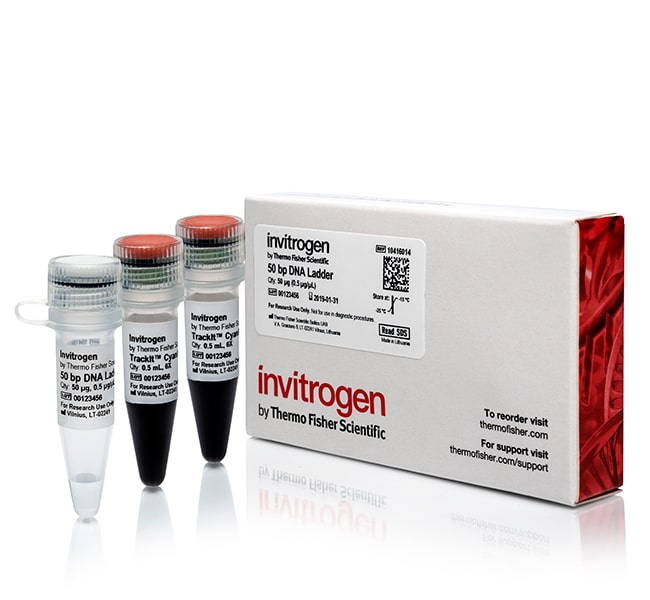
50 bp DNA Ladder
Invitrogen 50 bp DNA Ladder is designed for sizing and approximate quantification of double-stranded DNA in the range of 50Read more
| Catalog Number | Quantity |
|---|---|
| 10416014 | 50 μg |
Catalog number 10416014
Price (USD)
121.65
Online exclusive
131.00Save 9.35
Each
Quantity:
50 μg
Price (USD)
121.65
Online exclusive
131.00Save 9.35
Each
Invitrogen 50 bp DNA Ladder is designed for sizing and approximate quantification of double-stranded DNA in the range of 50 bp to 2,500 bp. 50 bp DNA Ladder consists of 17 individual chromatography-purified DNA fragments and has reference bands at 2500, 800, and 350 bp for easy orientation.
50 bp DNA Ladder is ideal for separation on 2% agarose gels.
Highlights of 50 bp DNA Ladder:
• Sharp, clear bands—chromatography purified fragments for consistent and reliable results
• Convenient—provided with 6X TrackIt Cyan/Orange Loading Buffer for tracking of DNA migration
• Precise—an exact amount of DNA in each band
Product use
The double-stranded DNA ladder can be visualized on 2% agarose gels after ethidium bromide or SYBR Safe staining. The ladder is designed with a uniform intensity of DNA bands for a clear view of each band. An exact amount of DNA in each band allows approximate quantification of DNA samples.
This ladder can be radiolabeled with T4 polynucleotide kinase or T4 DNA polymerase.
50 bp DNA Ladder is ideal for separation on 2% agarose gels.
Highlights of 50 bp DNA Ladder:
• Sharp, clear bands—chromatography purified fragments for consistent and reliable results
• Convenient—provided with 6X TrackIt Cyan/Orange Loading Buffer for tracking of DNA migration
• Precise—an exact amount of DNA in each band
Product use
The double-stranded DNA ladder can be visualized on 2% agarose gels after ethidium bromide or SYBR Safe staining. The ladder is designed with a uniform intensity of DNA bands for a clear view of each band. An exact amount of DNA in each band allows approximate quantification of DNA samples.
This ladder can be radiolabeled with T4 polynucleotide kinase or T4 DNA polymerase.
For Research Use Only. Not for use in diagnostic procedures.
Specifications
Concentration0.5 μg/μL
Gel CompatibilityAgarose gel
No. of Reactions100 Applications
Quantity50 μg
Ready to LoadNo
Sample Loading Volume1 mL
Shipping ConditionApproved for shipment at Room Temperature or on Dry Ice
TechnologyIndividual chromatography-purified DNA fragments
Volume (Metric)100 μL
Gel TypeAgarose
Product TypeDNA Ladder
Size Range50 to 2500 bp
Unit SizeEach
Contents & Storage
• 100 µL 50 bp DNA Ladder
• 1 mL 6X TrackIt Cyan/Orange Loading Buffer
Store at -20°C.
• 1 mL 6X TrackIt Cyan/Orange Loading Buffer
Store at -20°C.
Frequently asked questions (FAQs)
Can I know the sequences of Invitrogen DNA ladders?
Are Invitrogen DNA ladders composed of linear or circular/supercoiled DNA?
Are Invitrogen DNA ladders composed of single-stranded or double-stranded DNA fragments?
I'm seeing anomalous migration of my DNA ladder. What happened?
What is the difference between the TrackIt DNA Ladders and other DNA ladders?
Citations & References (10)
Citations & References
Abstract
ChIP-Seq using high-throughput DNA sequencing for genome-wide identification of transcription factor binding sites.
Journal:Methods Enzymol
PubMed ID:20946807
'Much of eukaryotic gene regulation is mediated by binding of transcription factors near or within their target genes. Transcription factor binding sites (TFBS) are often identified globally using chromatin immunoprecipitation (ChIP) in which specific protein-DNA interactions are isolated using an antibody against the factor of interest. Coupling ChIP with high-throughput
Post intrastromal corneal ring segments insertion complicated by Candida parapsilosis keratitis.
Journal:Clin Ophthalmol
PubMed ID:23467516
'This case report describes the clinical and histopathologic features, including molecular confirmation, of fungal keratitis after intrastromal corneal ring segments placement for keratoconus. A 52-year-old woman underwent insertion of Intacs(®) corneal implants for treatment of keratoconus. Extrusion of the implants was noted 5 months post insertion and replaced. Three months
Development of PCR-RFLP assay for the discrimination of Plasmodium species and variants of P. vivax (VK210, VK247 and P. vivax-like) in Anopheles mosquitoes.
Journal:Acta Trop
PubMed ID:21420375
'The identification of Plasmodium species in Anopheles mosquitoes is an integral component of malaria control programs. We developed a new assay to identify Plasmodium falciparum, Plasmodium malariae, and Plasmodium vivax variants. Specific primers were designed to hybridize to CS gene-specific regions. Polymerase chain reaction (PCR) and restriction fragment length polymorphism
Report of an international collaborative study to evaluate the suitability of multiplex PCR as an identity assay for different sub-strains of BCG vaccine.
Journal:Vaccine
PubMed ID:20732463
'Current methods for the identification of BCG vaccine in quality control settings involve acid-fast staining with microscopic examination. However, this method is unable to distinguish the many different sub-strains of BCG, or to differentiate BCG strains from virulent members of the Mycobacterium tuberculosis complex. A multiplex PCR (mPCR) which uses
Identification of novel mutation in cathepsin C gene causing Papillon-Lefèvre Syndrome in Mexican patients.
Journal:BMC Med Genet
PubMed ID:23311634
Papillon-Lefèvre Syndrome (PLS) is a type IV genodermatosis caused by mutations in cathepsin C (CTSC), with a worldwide prevalence of 1-4 cases per million in the general population. In México, the prevalence of this syndrome is unknown, and there are few case reports. The diagnosis of twenty patients in the