Search

Thermo Scientific™
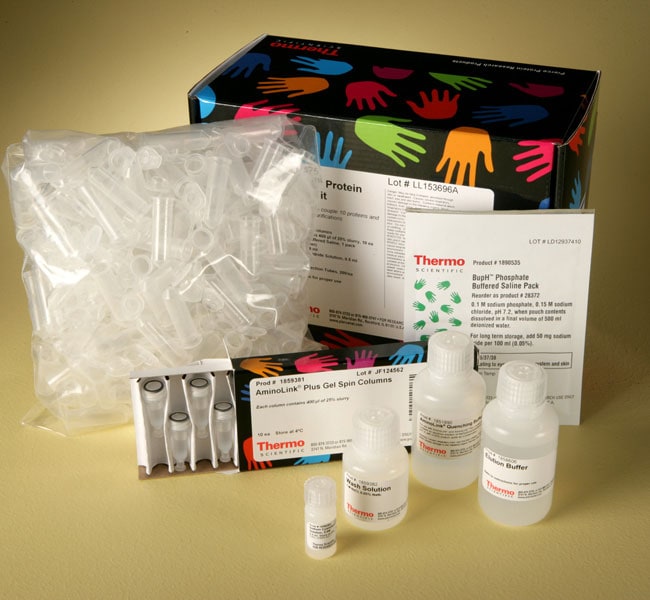
AminoLink™ Plus Micro Immobilization Kit, 0.1 mL
The Thermo Scientific AminoLink Plus Micro Immobilization Kit enables covalent attachment of amine-containing ligands for use in antibody purification and深入閱讀
| 產品號碼 | Quantity |
|---|---|
| 20475 | 10 Column Kit |
產品號碼 20475
價格 (HKD)
4,902.00
Each
Quantity:
10 Column Kit
價格 (HKD)
4,902.00
Each
The Thermo Scientific AminoLink Plus Micro Immobilization Kit enables covalent attachment of amine-containing ligands for use in antibody purification and other affinity protocols.
Features of the AminoLink Plus Micro Immobilization Kit:
• Optimized for small scale—ideal for coupling small amounts (25 to 250 μg) of purified antibodies, proteins and other amine-containing ligands for purification of specific antibodies from crude serum
• High-performance affinity resin—covalent attachment of the protein to AminoLink Plus Coupling Resin results in a leach-resistant affinity support
• Efficient coupling chemistry—immobilization efficiency greater than 80% (as measured with 4 hour coupling reaction using mammalian antibodies)
• Fast and easy to use—perform wash and elution steps using a microcentrifuge
• Reusable—use prepared peptide resin several times with no significant loss of capacity
The AminoLink Plus Micro Immobilization Kit is for immobilizing small amounts (25 to 100 μg) of purified antibody and other proteins onto Thermo Scientific AminoLink Plus Coupling Resin (crosslinked 4% beaded agarose) to create a small, reusable, microcentrifuge affinity column. The coupling and affinity purification procedures are optimized for small sample volumes (200 to 300 μL). Wash and elution steps are achieved rapidly and efficiently with the convenient microcentrifuge spin columns. Each kit contains sufficient reagents for 10 coupling reactions and 20 affinity purifications.
Related Products
AminoLink™ Plus Coupling Resin
AminoLink™ Plus Immobilization Kit, 2 mL
Features of the AminoLink Plus Micro Immobilization Kit:
• Optimized for small scale—ideal for coupling small amounts (25 to 250 μg) of purified antibodies, proteins and other amine-containing ligands for purification of specific antibodies from crude serum
• High-performance affinity resin—covalent attachment of the protein to AminoLink Plus Coupling Resin results in a leach-resistant affinity support
• Efficient coupling chemistry—immobilization efficiency greater than 80% (as measured with 4 hour coupling reaction using mammalian antibodies)
• Fast and easy to use—perform wash and elution steps using a microcentrifuge
• Reusable—use prepared peptide resin several times with no significant loss of capacity
The AminoLink Plus Micro Immobilization Kit is for immobilizing small amounts (25 to 100 μg) of purified antibody and other proteins onto Thermo Scientific AminoLink Plus Coupling Resin (crosslinked 4% beaded agarose) to create a small, reusable, microcentrifuge affinity column. The coupling and affinity purification procedures are optimized for small sample volumes (200 to 300 μL). Wash and elution steps are achieved rapidly and efficiently with the convenient microcentrifuge spin columns. Each kit contains sufficient reagents for 10 coupling reactions and 20 affinity purifications.
Related Products
AminoLink™ Plus Coupling Resin
AminoLink™ Plus Immobilization Kit, 2 mL
For Research Use Only. Not for use in diagnostic procedures.
規格
Column TypeAffinity, Agarose Resin
FormatKit, Microcentrifuge, Spin Column
FormulationMulti-component kit with 10 x 0.1mL resin columns
Quantity10 Column Kit
Stationary PhaseAldehyde
Sufficient For25 to 100 μg of Protein per Column
TargetAntibody, Proteins through Primary Amine
Capacity (Metric)25 to 100 μg Protein Immobilization per Column
Product LineAminoLink
TypeImmobilization Kit
Unit SizeEach
內容物與存放
Sufficient For: Immobilizing 25 to 100 μg of protein per column; Includes buffers for 20 affinity purifications
• AminoLink Plus Spin Columns, 0.1 mL, 10 columns
• PBS Pack (makes 500 mL), 1 pack
• Sodium Cyanoborohydride Solution, 5M, 0.5 mL
• Quenching Buffer, 60 mL
• Wash Solution, 25 mL
• Elution Buffer, 50 mL
• Collection Tubes, 200 tubes
Store at 4°C.
• AminoLink Plus Spin Columns, 0.1 mL, 10 columns
• PBS Pack (makes 500 mL), 1 pack
• Sodium Cyanoborohydride Solution, 5M, 0.5 mL
• Quenching Buffer, 60 mL
• Wash Solution, 25 mL
• Elution Buffer, 50 mL
• Collection Tubes, 200 tubes
Store at 4°C.