Search


Citas y referencias (3)
Thermo Scientific™
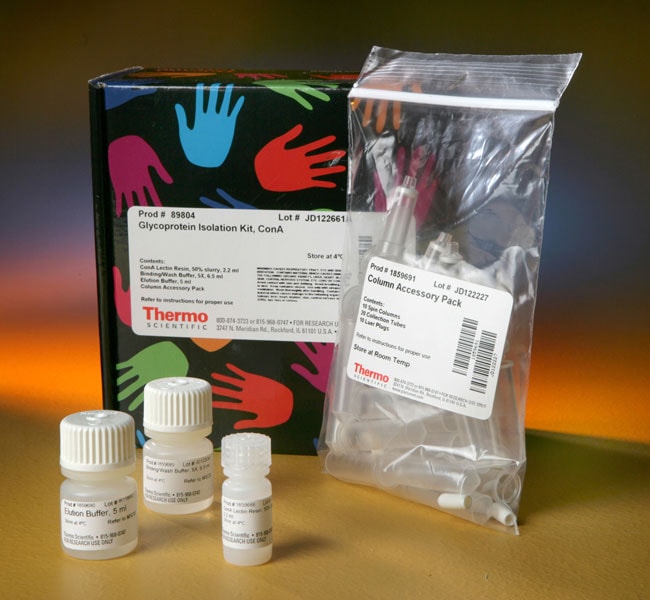
Pierce™ Glycoprotein Isolation Kit, ConA
El kit de aislamiento de glicoproteínas Thermo Scientific Pierce (concanavalina A) permite el aislamiento de glicoproteínas de mezclas complejas, comoMás información
| Número de catálogo | Cantidad |
|---|---|
| 89804 | 1 kit |
Número de catálogo 89804
Precio (MXN)
-
Cantidad:
1 kit
El kit de aislamiento de glicoproteínas Thermo Scientific Pierce (concanavalina A) permite el aislamiento de glicoproteínas de mezclas complejas, como suero, tejido y lisados de células cultivadas. El procedimiento utiliza la concanavalina A (ConA) como ligando para unir una clase específica de glicoproteína a partir de muestras de proteínas complejas, que contienen manosa con revestimiento alfa o residuos de terminales de glucosa. Este kit se ha utilizado para aislar glicoproteínas del suero, así como lisados de células HeLa y CHO en aproximadamente 50 minutos.
Características de este kit de aislamiento de glicoproteínas:
• Alta recuperación: recuperación equivalente o mayor de glicoproteínas que la de kits de la competencia y resinas de lectina
• Rápido: purificación de glicoproteínas en menos de una hora
• Versátil: aísle glicoproteínas de varios tipos de muestras, por ejemplo, suero humano y lisado celular.
• Robusto: la lectina no se filtra de la resina al procesar la muestra
• Práctico: el kit completo ofrece resinas de lectina y columnas de centrifugación con todos los reactivos necesarios
• Compatible con ensayos de proteínas basados en Bradford: no se requiere diálisis o precipitación de proteínas de las glicoproteínas recuperadas antes del ensayo de proteínas
Productos relacionados
Kit de aislamiento de glicoproteínas Pierce™, WGA
Características de este kit de aislamiento de glicoproteínas:
• Alta recuperación: recuperación equivalente o mayor de glicoproteínas que la de kits de la competencia y resinas de lectina
• Rápido: purificación de glicoproteínas en menos de una hora
• Versátil: aísle glicoproteínas de varios tipos de muestras, por ejemplo, suero humano y lisado celular.
• Robusto: la lectina no se filtra de la resina al procesar la muestra
• Práctico: el kit completo ofrece resinas de lectina y columnas de centrifugación con todos los reactivos necesarios
• Compatible con ensayos de proteínas basados en Bradford: no se requiere diálisis o precipitación de proteínas de las glicoproteínas recuperadas antes del ensayo de proteínas
Productos relacionados
Kit de aislamiento de glicoproteínas Pierce™, WGA
Para uso exclusivo en investigación. No apto para uso en procedimientos diagnósticos.
Especificaciones
Tipo de columnaAfinidad, resina de agarosa
DescripciónKit de aislamiento de glicoproteínas Pierce, ConA
FormatoKit, microcentrífuga, columna de centrifugación
Cantidad1 kit
Fase estacionariaLectina
Suficiente para10 reacciones
ObjetivoGlucoproteína
Línea de productosPierce
TipoKit de aislamiento de glicoproteínas
Unit SizeEach
Contenido y almacenamiento
Suficiente para: Aislamiento de glicoproteínas con fuerte afinidad por ConA a partir de 10 muestras de hasta 640 µl (1 a 1,5 mg de proteína total) cada una
• Resina de lectina ConA, 1,1 ml
• Tampón de unión/lavado (5x), 6,5 ml
• Tampón de elución, 5 ml
• 10 columnas de centrifugación
• 20 tubos de recogida
Almacenar a 4 °C.
• Resina de lectina ConA, 1,1 ml
• Tampón de unión/lavado (5x), 6,5 ml
• Tampón de elución, 5 ml
• 10 columnas de centrifugación
• 20 tubos de recogida
Almacenar a 4 °C.
Preguntas frecuentes
What is the difference between your Pierce Glycoprotein Isolation Kit, ConA and WGA?
Can I isolate my proteins based on their post-translational modification (PTM) or active binding site?
Citations & References (3)
Citations & References
Abstract
Lectin affinity as an approach to the proteomic analysis of membrane glycoproteins.
Journal:J Proteome Res
PubMed ID:15359739
The aim was to determine the proportion of membrane glycoproteins captured using concanavalin A or wheat germ agglutinin lectin affinity chromatography. Digests of the isolated proteins were separated by reversed-phase liquid chromatography and analyzed by matrix-assisted laser desorption tandem mass spectrometry. The two lectins identified different groups of proteins with
GlycoSuiteDB: a new curated relational database of glycoprotein glycan structures and their biological sources.
Journal:Nucleic Acids Res
PubMed ID:11125129
GlycoSuiteDB is a relational database that curates information from the scientific literature on glyco-protein derived glycan structures, their biological sources, the references in which the glycan was described and the methods used to determine the glycan structure. To date, the database includes most published O:-linked oligosaccharides from the last 50
Development of serum glycoproteomic profiling technique; simultaneous identification of glycosylation sites and site-specific quantification of glycan structure changes.
Journal:Mol Cell Proteomics
PubMed ID:20811073
Characterization and interpretation of disease-associated alterations of protein glycosylation are the central aims of the emerging glycoproteomics projects, which are expected to lead to more sensitive and specific diagnosis and improve therapeutic outcomes for various diseases. Here we report a new approach to identify carbohydrate-targeting serum biomarkers, termed isotopic glycosidase